
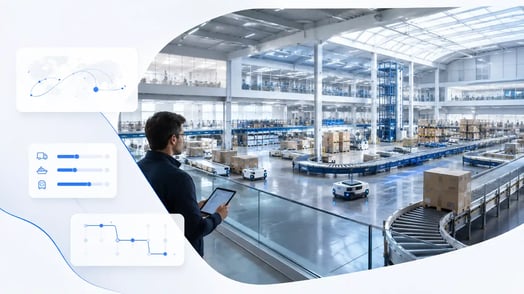
According to industry forecasts, ecommerce continues to gain market share across virtually every retail category. As online sales grow, logistics has become one of the most important competitive differentiators for retailers.
Customers now expect fast delivery, accurate order fulfillment, real-time tracking, flexible return options, and complete visibility throughout the buying journey.
Meeting these expectations requires more than simply moving products from a warehouse to a customer. It requires a well-structured ecommerce logistics strategy.
In this guide, we explore the fundamentals of ecommerce logistics, the challenges facing online retailers, and the best practices that help companies improve operational efficiency and customer satisfaction.
What is ecommerce logistics?
Ecommerce logistics refers to all logistics operations required to fulfill online orders.
This includes:
- Procurement
- Inventory management
- Warehousing
- Order processing
- Picking and packing
- Transportation
- Last-mile delivery
- Returns management
The objective is to ensure that products reach customers quickly, accurately, and cost-effectively.
Unlike traditional supply chains, ecommerce logistics typically handles a large volume of smaller orders destined for individual consumers.
As a result, speed, flexibility, and operational precision become critical success factors.
Ecommerce logistics vs traditional logistics
Although both models involve moving goods through a supply chain, there are significant differences.
Traditional logistics generally focuses on B2B operations, manufacturing supply chains, distribution centers, and large-volume shipments such as pallets or full truckloads.
Ecommerce logistics focuses primarily on B2C fulfillment, requiring:
- Smaller order sizes
- Higher order volumes
- Faster delivery expectations
- More frequent returns
- Greater shipment visibility
This shift creates new operational challenges that require specialized processes and technologies.
Why ecommerce logistics is essential
For online retailers, logistics directly impacts customer satisfaction.
A poor delivery experience can quickly damage brand reputation, while an efficient logistics operation can become a competitive advantage.
Strong ecommerce logistics helps companies:
- Improve customer satisfaction
- Reduce fulfillment costs
- Increase order accuracy
- Improve inventory visibility
- Accelerate delivery times
- Simplify returns management
As competition increases, logistics performance becomes a key driver of business growth.
The biggest challenges in e-commerce logistics
Managing customer expectations
Consumers increasingly expect:
- Fast delivery
- Accurate deliveries
- Flexible shipping options
- Real-time tracking
Meeting these expectations consistently requires highly efficient logistics processes.
Inventory management
Inventory management remains one of the most complex aspects of ecommerce operations.
Insufficient inventory can result in stockouts and lost sales.
Excess inventory increases storage costs and ties up working capital.
Maintaining optimal inventory levels requires accurate forecasting and real-time visibility.
Companies often monitor metrics such as stock coverage, minimum stock level and maximum stock to balance availability and inventory costs.
Order accuracy
Picking and packing errors create additional transportation costs, returns, customer complaints, and operational inefficiencies.
Modern fulfillment operations increasingly rely on automation and warehouse management software to reduce errors.
Many ecommerce warehouses also implement optimized pick and pack warehouse processes to improve fulfillment speed and accuracy.
Returns management
Returns have become an integral part of ecommerce.
Customers expect simple and convenient return processes.
Companies must therefore establish efficient reverse logistics operations that minimize costs while maintaining customer satisfaction.
Delivery flexibility
Today's consumers expect multiple delivery options, including:
- Home delivery
- Express delivery
- Click-and-collect
- Parcel lockers
- Pickup points
Providing this flexibility requires close collaboration with transportation providers and carrier networks.
Many retailers leverage multi carrier shipping software to offer a wider range of delivery services while maintaining operational efficiency.
Ecommerce logistics models
There is no single logistics model suitable for every ecommerce business.
The best solution depends on product characteristics, order volumes, growth objectives, and available resources.
Dropshipping
Under a dropshipping model, products are shipped directly from suppliers to customers.
Advantages include:
- Low startup costs
- No inventory investment
- Wide product assortment
Challenges include:
- Lower margins
- Limited operational control
- Dependence on suppliers
Fulfillment services
Third-party fulfillment providers manage:
- Inventory storage
- Order processing
- Picking and packing
- Shipping operations
This approach allows ecommerce companies to scale more rapidly while reducing operational complexity.
Many businesses rely on specialized 3PL WMS solutions to coordinate fulfillment activities efficiently.
In-house logistics
Some retailers manage their entire logistics operation internally.
Benefits include:
- Greater control
- Customized processes
- Direct visibility
However, this model requires significant investment in facilities, systems, and personnel.
Full logistics outsourcing
Companies may also outsource their entire logistics operation to specialized providers.
This enables businesses to focus on sales, marketing, and product development while leveraging logistics expertise externally.
The seven key stages of ecommerce logistics
Warehouse organization
Efficient warehouse organization is essential for fast order fulfillment.
Modern ecommerce warehouses often use:
- Dynamic storage systems
- Conveyor systems
- Automated picking technologies
- WMS software
These tools improve productivity and reduce fulfillment errors.
For larger operations, integrating warehouse processes with an ERP and WMS ecosystem helps synchronize inventory, purchasing, and fulfillment activities.
Receiving goods
Inbound logistics must ensure inventory availability while avoiding overstocking.
Many companies use demand forecasting and seasonal planning to prepare for peak periods such as:
- Black Friday
- Holiday seasons
- Promotional campaigns
Efficient inbound logistics processes are essential to ensure products arrive on time and inventory remains available during demand peaks.
Inventory management
Real-time inventory visibility is essential for maintaining product availability and reducing stock-related issues.
Warehouse inventory management software helps optimize inventory accuracy and warehouse performance.
To improve inventory control, ecommerce businesses often rely on concepts such as safety stock and buffer stock to protect against demand fluctuations and supply disruptions.
Picking and packing
Order preparation directly impacts customer satisfaction.
Accurate picking and secure packaging help reduce returns and transportation claims while improving delivery performance.
Efficient warehouse operations are critical for maintaining fast fulfillment speeds and minimizing operational costs.
Carrier management
Strong relationships with transportation providers are essential.
Retailers should evaluate carriers based on:
- Service quality
- Delivery performance
- Geographic coverage
- Cost efficiency
Many ecommerce organizations use dedicated TMS shipping software to centralize carrier management and automate transportation execution.
Returns management
Efficient reverse logistics improves customer experience and helps recover product value.
Successful return strategies often include:
- Prepaid return labels
- Parcel drop-off networks
- Simplified return procedures
Returns processes should be continuously monitored to minimize unnecessary transportation and handling costs.
Shipment visibility
Customers increasingly expect shipment tracking throughout the delivery journey.
Providing real-time updates helps improve transparency and reduce customer service inquiries.
Visibility across transportation flows is becoming a key differentiator for ecommerce brands.
Why transportation management matters in ecommerce
Transportation plays a critical role in ecommerce profitability.
As shipping volumes increase, companies need better control over transportation costs, carrier performance, and delivery visibility.
This is where a Transportation Management System becomes valuable.
A TMS helps organizations:
- Manage carrier relationships
- Automate transport procurement
- Consolidate shipments
- Track deliveries
- Reduce transportation costs
- Improve operational visibility
Businesses seeking to optimize shipping performance often use a freight management system to gain better control over transportation execution and analytics.
How Shiptify supports ecommerce logistics
Shiptify helps ecommerce businesses optimize transportation operations through a collaborative shipper TMS.
The platform enables companies to:
- Centralize transportation management
- Track shipments in real time
- Improve carrier collaboration
- Automate transport processes
- Consolidate transportation data
- Monitor logistics performance
For retailers managing both parcel shipments and larger freight movements, Shiptify provides a unified transportation environment.
The platform also helps companies improve transportation efficiency through advanced carrier management and visibility capabilities.
Why transportation management matters in ecommerce
Transportation plays a critical role in ecommerce profitability.
As shipping volumes increase, companies need better control over transportation costs, carrier performance, and delivery visibility.
This is where a Transportation Management System becomes valuable.
A TMS helps organizations:
- Manage carrier relationships
- Automate transport procurement
- Consolidate shipments
- Track deliveries
- Reduce transportation costs
- Improve operational visibility
Businesses that manage a growing number of shipments often rely on a freight management system to centralize transportation operations and improve efficiency across their logistics network.
How Shiptify supports ecommerce logistics
Shiptify helps ecommerce businesses optimize transportation operations through a collaborative shipper TMS.
The platform enables companies to:
- Centralize transportation management
- Track shipments in real time
- Improve carrier collaboration
- Automate transport processes
- Consolidate transportation data
- Monitor logistics performance
For retailers managing both parcel shipments and larger freight movements, Shiptify provides a unified transportation environment.
Companies using multiple parcel carriers can also benefit from multi carrier shipping software integrations that simplify carrier selection and shipment execution.
Why dock scheduling matters in ecommerce logistics
As ecommerce volumes continue to grow, warehouse efficiency becomes increasingly important.
One often-overlooked area is dock scheduling.
Poorly coordinated inbound and outbound flows can create:
- Warehouse congestion
- Delivery delays
- Labor inefficiencies
- Inventory inaccuracies
A structured dock appointment scheduling process helps smooth warehouse operations and improve inventory flow.
For high-volume fulfillment centers, efficient coordination between transportation providers and warehouse teams is becoming a key component of modern logistics scheduling strategies.
How ShiptiDock improves warehouse operations
ShiptiDock helps companies optimize warehouse appointment scheduling and dock management.
The solution enables organizations to:
- Schedule carrier appointments
- Coordinate inbound deliveries
- Manage outbound shipments
- Reduce congestion
- Improve warehouse productivity
- Increase visibility across dock operations
For ecommerce businesses operating fulfillment centers, cross docking facilities, or distribution hubs, efficient dock scheduling contributes directly to faster inventory turnover and improved customer service.
Organizations looking to digitize these processes often deploy dedicated dock scheduling software to improve visibility and resource allocation.
Conclusion
Ecommerce logistics has become a strategic differentiator for online retailers.
As customer expectations continue to rise, businesses must optimize every stage of the fulfillment process, from inventory management and order preparation to transportation and returns.
Companies that invest in efficient logistics processes, modern transportation management systems, and warehouse optimization technologies are better positioned to reduce costs, improve customer satisfaction, and support long-term growth.
Solutions such as Shiptify and ShiptiDock help ecommerce organizations build more agile, visible, and efficient logistics operations capable of meeting the demands of modern online commerce.
By combining transportation visibility, warehouse efficiency, and continuous performance monitoring through relevant supply chain KPIs, organizations can transform logistics into a true competitive advantage.