
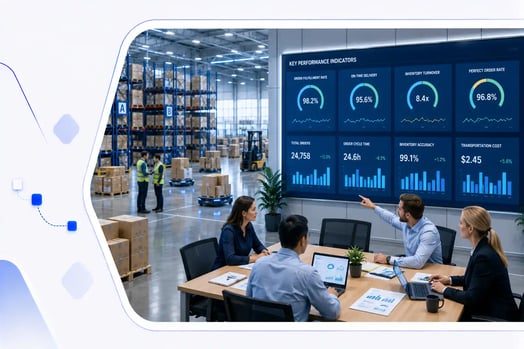
Logistics performance, customer satisfaction, inventory optimization, transportation costs, and profitability all depend on one thing: the ability to measure performance accurately.
As supply chains become more complex and customer expectations continue to rise, key performance indicators (KPIs) have become essential management tools for logistics teams.
But which KPIs truly matter? How can companies avoid drowning in data while focusing on the metrics that drive real business outcomes?
This guide explores the 11 most important supply chain KPIs to monitor in 2026 and explains how to use them to improve operational performance.
Why supply chain KPIs matter in 2026
What is a supply chain KPI?
A Key Performance Indicator (KPI) is a measurable metric used to evaluate the effectiveness of a specific process or activity.
Within the supply chain, KPIs help organizations measure:
- Service performance
- Inventory efficiency
- Transportation effectiveness
- Cost control
- Supplier reliability
- Customer satisfaction
Effective KPIs should follow the SMART framework:
- Specific
- Measurable
- Achievable
- Relevant
- Time-bound
Without clearly defined KPIs, logistics teams often struggle to identify inefficiencies, prioritize improvements, and make informed decisions.
Data-driven supply chains require measurable performance
Modern supply chains generate vast amounts of operational data.
Transportation management systems, warehouse management software, ERPs, and connected devices provide real-time visibility across logistics operations.
The challenge is no longer collecting data. It is transforming that data into actionable insights.
The right KPIs help companies:
- Reduce lead times
- Improve inventory performance
- Increase service levels
- Lower logistics costs
- Strengthen customer satisfaction
Using the SCOR model to structure KPIs
Many organizations use the SCOR (Supply Chain Operations Reference) framework to organize performance measurement.
The model divides supply chain activities into five core processes:
- Plan
- Source
- Make
- Deliver
- Return
This approach helps companies align operational KPIs with broader strategic objectives and supports broader supply chain optimization initiatives.
How to choose the right supply chain KPIs
Align KPIs with business objectives
Not every company should track the same metrics.
A fast-growing e-commerce business, a manufacturer, and a 3PL provider all have different priorities.
Before selecting KPIs, define the objectives you want to improve:
- Customer experience
- Profitability
- Inventory optimization
- Sustainability
- Cash flow
- Operational efficiency
Build a KPI hierarchy
Supply chain KPIs generally fall into three categories.
Strategic KPIs
These support long-term business objectives.
Examples:
- Cash-to-Cash Cycle
- Carbon emissions
- Working capital performance
Tactical KPIs
These support medium-term operational improvements.
Examples:
- Inventory turnover
- Supplier performance
- Lead time
Operational KPIs
These measure day-to-day execution.
Examples:
- OTIF
- Fill rate
- Returns rate
- Dock utilization
Companies often monitor these indicators through a centralized supply chain dashboard.
Avoid vanity metrics
A KPI should drive action.
Metrics that look impressive but provide little operational value often create confusion rather than clarity.
Always ask:
"What decision can we make based on this KPI?"
If the answer is unclear, the metric may not be useful.
The 11 most important supply chain KPIs in 2026
1. OTIF (On-Time In-Full)
OTIF measures whether customers receive complete orders on time.
It is one of the most widely used supply chain performance indicators.
Formula
OTIF (%) = (Orders delivered on time and complete ÷ Total orders) × 100
Why it matters
OTIF directly reflects customer service performance and supply chain reliability.
2. Perfect order rate
The Perfect Order Rate measures orders delivered without any errors.
This includes:
- Correct products
- Correct quantities
- Accurate documentation
- On-time delivery
- No damage
Formula
Perfect Order Rate (%) = (Perfect orders ÷ Total orders) × 100
Why it matters
It provides a comprehensive view of logistics quality.
3. Fill rate
Fill rate measures the percentage of customer demand fulfilled directly from available inventory.
Formula
Fill Rate (%) = (Units delivered ÷ Units ordered) × 100
Why it matters
A low fill rate often indicates forecasting or inventory management issues that can be addressed through better WMS software.
4. Lead time
Lead time measures the time required to complete a process from start to finish.
In logistics, it often refers to the period between order placement and delivery.
Formula
Lead Time = Delivery date − Order date
Why it matters
Shorter lead times improve responsiveness and customer satisfaction.
5. Order cycle time
Order cycle time measures the complete order fulfillment process.
Formula
Order Cycle Time = Order delivery date − Order receipt date
Why it matters
It provides a broader view of operational efficiency than lead time alone.
6. Cash-to-cash cycle time
This KPI measures how long company cash remains tied up within supply chain operations.
Formula
Cash-to-Cash = DIO + DSO − DPO
Where:
- DIO = Days Inventory Outstanding
- DSO = Days Sales Outstanding
- DPO = Days Payable Outstanding
Why it matters
A shorter cycle improves liquidity and working capital performance.
7. Inventory turnover
Inventory turnover measures how efficiently stock is consumed and replenished.
Formula
Inventory Turnover = Cost of Goods Sold ÷ Average Inventory Value
Why it matters
Higher turnover generally indicates healthier inventory management and more efficient use of working capital.
8. Days of inventory on hand
This metric estimates how many days current inventory can support demand.
Formula
Days of Inventory = Average Inventory ÷ Average Daily Consumption
Why it matters
It helps balance inventory availability and carrying costs.
Organizations seeking to optimize this KPI often combine inventory analysis with advanced warehouse management software and forecasting tools.
9. Inventory carrying cost
Inventory carrying cost measures the total cost of holding inventory.
This includes:
- Storage
- Labor
- Insurance
- Obsolescence
- Capital costs
Why it matters
It highlights hidden costs that can impact profitability and helps organizations identify opportunities to reduce supply chain costs.
10. Supplier on-time delivery rate
Supplier reliability directly affects overall supply chain performance.
Formula
On-Time Supplier Deliveries (%) = (On-time deliveries ÷ Total deliveries) × 100
Why it matters
Poor supplier performance often creates downstream disruptions, especially for companies relying heavily on inbound logistics.
11. Sustainability KPIs
Environmental performance has become a strategic supply chain priority.
Common sustainability metrics include:
- CO₂ emissions per shipment
- Share of low-carbon transportation
- Packaging waste reduction
- Energy consumption
Why it matters
Sustainability performance increasingly influences both customer expectations and regulatory compliance.
How to monitor and analyze supply chain KPIs
Build a clear dashboard
KPIs only create value when they are visible and actionable.
A modern dashboard should provide:
- Real-time updates
- Trend analysis
- Alerts
- Performance comparisons
Popular tools include:
- Power BI
- Tableau
- Excel
- TMS software
- Supply Chain Control Towers
Companies increasingly rely on a dedicated supply chain dashboard to centralize KPI monitoring and improve decision-making.
Define the right reporting frequency
Not every KPI requires the same monitoring frequency.
Daily or weekly
- OTIF
- Lead time
- Delays
- Fill rate
Monthly
- Inventory turnover
- Carrying costs
- Supplier performance
Quarterly
- Cash-to-Cash Cycle
- Sustainability metrics
- Strategic performance indicators
Turn KPIs into action plans
The purpose of a KPI is not reporting.
The purpose is improvement.
Best practices include:
- Defining performance thresholds
- Setting automated alerts
- Creating corrective action plans
- Following continuous improvement methodologies such as PDCA (Plan, Do, Check, Act)
Why transportation KPIs matter
Transportation often represents one of the largest logistics cost centers.
Monitoring transportation-specific KPIs helps organizations improve:
- Carrier performance
- Delivery reliability
- Transportation costs
- Carbon emissions
- Customer satisfaction
Many companies track these indicators through advanced shipment tracking capabilities and transportation analytics.
Organizations managing large carrier networks may also monitor metrics related to freight management systems and transportation spend management.
How Shiptify helps companies monitor supply chain KPIs
Shiptify helps logistics teams centralize transportation and dock management data within a single platform.
Using Shiptify, companies can:
- Monitor OTIF performance
- Track transportation lead times
- Measure carrier performance
- Analyze dock utilization
- Monitor CO₂ emissions
- Access real-time logistics dashboards
Companies can also leverage dedicated solutions for dock appointment scheduling and improve visibility across outbound dock management operations.
For organizations managing complex logistics sites, integrating KPI monitoring with a Yard Management System (YMS) provides additional visibility into yard activity, trailer movements, and dock utilization.
Automated reporting eliminates manual calculations and provides faster access to actionable insights.
As a result, supply chain teams can spend less time collecting data and more time improving performance.
Conclusion
The most successful supply chains are not necessarily the largest or the most complex.
They are the ones that measure performance effectively.
The 11 KPIs presented in this guide provide a balanced framework for evaluating service quality, inventory efficiency, supplier reliability, financial performance, and sustainability.
By selecting the right metrics and monitoring them consistently, organizations can transform operational data into better decisions, stronger performance, and a more resilient supply chain.
In 2026, supply chain leaders will not be defined by how much data they collect, but by how effectively they use it.
For organizations looking to continuously improve logistics execution, combining KPI monitoring with technologies such as Yard Management Systems, WMS software, and modern transportation management systems creates the foundation for sustainable operational excellence.