
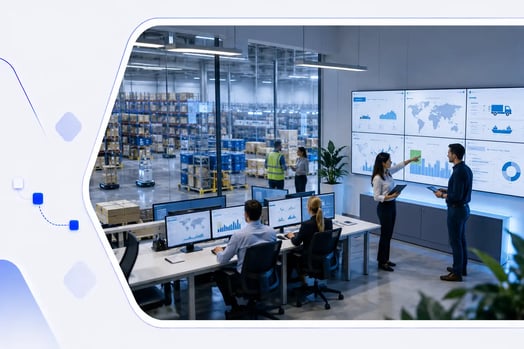
Data has become one of the most valuable assets in modern logistics operations.
However, transportation and supply chain data is often scattered across multiple systems, including ERP platforms, email inboxes, carrier portals, spreadsheets, and archived documents. While this information has tremendous value, many companies struggle to transform raw data into actionable insights.
This is where a logistics dashboard becomes essential.
By centralizing operational data and displaying meaningful performance indicators, logistics dashboards help companies make faster decisions, improve efficiency, reduce costs, and gain full visibility across their supply chain.
In this guide, we'll explain what a logistics dashboard is, its benefits, the most important KPIs to track, and how a Transportation Management System (TMS) can simplify logistics performance management.
What is a logistics dashboard?
A logistics dashboard is a centralized reporting tool that consolidates transportation and supply chain data into a single interface.
Its purpose is to transform complex operational data into clear, actionable insights that support decision-making.
A well-designed dashboard enables companies to:
- monitor logistics performance in real time;
- identify operational bottlenecks;
- track transportation costs;
- measure service quality;
- improve supply chain visibility.
By monitoring key performance indicators (KPIs), organizations can continuously optimize logistics operations and align performance with business objectives.
Why is a logistics dashboard important?
Without reliable performance data, it becomes difficult to identify inefficiencies and implement improvement initiatives.
A logistics dashboard provides a real-time overview of operations and helps companies make informed decisions based on accurate data.
Real-time visibility
A dashboard provides a live overview of shipments, transportation costs, inventory movements, and delivery performance.
Better decision-making
Centralized data enables logistics teams to react faster and make more informed operational and strategic decisions.
Process optimization
By highlighting inefficiencies and bottlenecks, dashboards help improve transportation and logistics processes while supporting broader supply chain optimization initiatives.
Performance monitoring
Companies can compare actual performance against predefined objectives and continuously monitor progress.
Cost reduction
Improved visibility helps identify cost-saving opportunities across transportation, inventory management, and operations, particularly in areas such as transportation spend management.
Improved customer service
Accurate shipment tracking and delivery monitoring contribute to better customer communication and higher satisfaction levels.
Better forecasting and planning
Historical data and trend analysis help organizations anticipate demand and plan resources more effectively.
Risk management
Early detection of operational issues allows companies to take corrective actions before disruptions impact performance.
Which KPIs should be included in a logistics dashboard?
The most effective logistics dashboards combine operational, financial, service, and sustainability metrics.
Transportation performance KPIs
These indicators help monitor transportation efficiency and carrier performance.
Key metrics include:
- average transportation cost;
- transportation mode split;
- vehicle load factor;
- empty miles rate;
- carrier quotation response time;
- carrier response rate;
- number of shipments completed;
- savings achieved through spot purchasing;
- driver waiting time;
- shipment tracking update rate;
- on-time departure rate.
These metrics are often monitored through dedicated freight management systems and transportation analytics tools.
Customer service KPIs
Customer satisfaction remains one of the most important measures of logistics success.
Key indicators include:
- customer satisfaction rate;
- on-time delivery rate;
- service level;
- compliance with delivery schedules;
- claims and dispute rate.
Monitoring these KPIs helps organizations improve customer experience and maintain service quality.
Supply chain KPIs
Beyond transportation metrics, companies should also track broader supply chain KPIs to evaluate overall logistics performance and identify strategic improvement opportunities.
How to build a logistics dashboard
The first step is identifying the KPIs that best reflect your business objectives.
Not every company requires the same indicators. KPI selection should be based on:
- operational priorities;
- transportation volumes;
- customer expectations;
- supply chain complexity.
Once KPIs have been defined, organizations can build dashboards that provide meaningful visibility into logistics performance.
The goal is not simply to collect data but to create a decision-making tool that drives continuous improvement.
Excel vs dedicated logistics dashboard software
Many companies initially use spreadsheets to build logistics dashboards.
While Excel can be useful for basic reporting, maintaining dashboards manually becomes increasingly time-consuming as transportation volumes grow.
Common challenges include:
- manual data entry;
- reporting delays;
- limited automation;
- increased risk of human error;
- difficulties consolidating data from multiple systems.
As operations become more complex, dedicated logistics platforms provide greater efficiency and scalability.
Why use a TMS for logistics reporting?
Modern Transportation Management Systems automatically collect, centralize, and analyze transportation data.
A TMS enables companies to:
- automate KPI tracking;
- improve data accuracy;
- gain real-time visibility;
- monitor carrier performance;
- optimize transportation costs;
- generate reports instantly.
Advanced TMS software also provides automated reporting capabilities that eliminate the need for manual spreadsheet management.
This eliminates the need for manual reporting while providing more reliable insights.
Organizations can also benefit from advanced transportation management system features such as predictive analytics, automated alerts, and performance benchmarking.
Why use Shiptify for your logistics dashboard?
Shiptify combines transportation management and logistics reporting within a single platform.
The solution provides real-time visibility into transportation performance through a comprehensive set of dashboards and KPIs.
Transportation management dashboard
Users can monitor:
- shipment volumes;
- transportation expenses;
- quotation response times;
- transportation savings;
- average cost per shipment.
Quotation performance dashboard
Track:
- number of quotations requested;
- carrier response rates;
- quotation acceptance rates;
- savings achieved.
Transportation execution dashboard
Monitor:
- on-time pickup performance;
- on-time delivery performance;
- shipment tracking quality;
- transportation execution efficiency.
Financial dashboard
Analyze:
- transportation spending;
- invoice compliance;
- average transportation costs;
- budget performance.
Sustainability dashboard
Measure:
- CO₂ emissions;
- shipment distances;
- transportation mode performance.
These insights help companies better manage freight transport operations while continuously improving logistics performance.
By centralizing transportation data and automating KPI monitoring, Shiptify helps companies improve visibility, optimize performance, and make better decisions.
Conclusion
A logistics dashboard is no longer a simple reporting tool. It has become an essential component of modern supply chain management.
By centralizing operational data and monitoring the right KPIs, companies can improve efficiency, reduce costs, enhance customer satisfaction, and strengthen decision-making.
When combined with a Transportation Management System such as Shiptify, logistics dashboards become powerful tools for driving continuous improvement and operational excellence.