
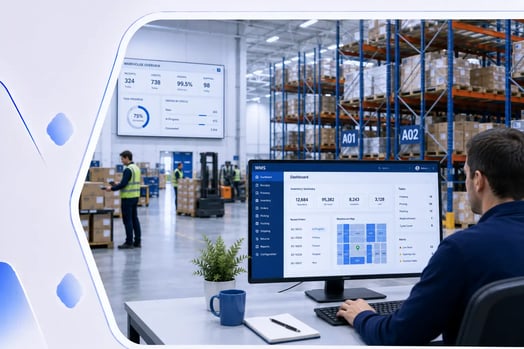
In a warehouse or logistics hub, problems can quickly accumulate: discrepancies between actual and theoretical stock levels, time wasted in picking, or shipping delays. Sooner or later, these malfunctions end up undermining the company's productivity and, consequently, customer satisfaction.
The solution? Implement a WMS (Warehouse Management System). This is software designed to boost the operation of a logistics warehouse. This tool is equally suited to logistics service providers and carriers, e-tailers, distributors and manufacturers, SMEs (small and medium-sized enterprises) and major groups.
How does a WMS work? What functionalities does it offer? How do you choose the most appropriate solution for your business, and get the most out of it? In this practical guide, Shiptify answers all your questions about WMS software.
What is a WMS?
A WMS is warehouse management software used to optimize logistics operations - receiving, storage, order preparation, inventory management and parcel dispatch. The aim? Improve productivity, reduce delivery times and minimize operating costs, by automating tasks linked to inventory management, goods flow and location tracking.
Key features of WMS software
In order to increase efficiency, these software packages all focus on centralization and automation. They integrate various modules and functionalities to cover the entire logistics process:
- Inventory management: real-time monitoring of goods in, out and where they are, with alerts on critical thresholds.
- Picking and order-picking management : planning picks to minimize the risk of errors and accelerate dispatch times.
- Location optimization: arrange goods in a logical way to optimize operator movements and reduce errors.
- Product or item traceability: ensure complete tracking of each batch of goods, often via barcodes.
- Receiving and dispatch automation : speed up incoming and outgoing goods control, without compromising quality.
- ERP or third-party system integration: synchronize data with the organization's ERP (Enterprise Resource Planning), accounting, CRM (Customer Relationship Management) or other software for reliable, continuous tracking.
- Analysis and reporting: a dashboard adapted to the company's objectives enables performance to be assessed and monitored, so that areas for improvement can be identified.
WMS use cases
Although they are the first to use it, transport and logistics companies are not the only ones to need a WMS. This type of program is useful for any organization that needs to ensure product traceability, or manage complex, voluminous or frequent inventory movements. In fact, its applications cover a wide range of sectors:
- Distribution and retail, for managing large volumes of SKUs, frequent pickings and daily goods traffic.
- Manufacturing industry for tracking raw materials, finished and semi-finished products, to ensure reliable inventory control and accelerate production.
- E-commerce, for fast online order processing, reliable control of stock levels and accurate, real-time tracking of shipments.
- The healthcare and pharmaceutical industries to ensure rigorous traceability and irreproachable regulatory compliance in the management of sensitive products.
- The agri-food industry, which must comply with strict hygiene and cold chain standards.
- High-tech companies needing to coordinate complex flows and ensure precise management of electronic components.
- Car manufacturers, who need to control an extended supply chain and manage spare parts inventories.
What WMS software will be available in 2026?
There will be numerous solutions on the market in 2025. Each is distinguished by its degree of automation, its deployment architecture, the depth of its integration with other software and the responsiveness of its support.
Comparative table of notable WMS solutions in 2025
Here are just a few of the warehouse management software packages in use in France and internationally in 2025.
|
Software |
Type of deployment* |
Strengths |
ERP/TMS integration |
Automation / AI |
Support |
|
Sitaci WMS EGO |
On-premise and SaaS |
Coordination and optimization of logistics flows |
Yes |
Advanced |
French / European |
|
Manhattan Associates WMS |
SaaS and On-premise |
High-powered, complex center management |
Yes (major ERP/TMS) |
Very advanced |
International** |
|
Blue Yonder (ex-JDA) |
SaaS |
Advanced planning, predictive logistics |
Yes |
AI and predictive analytics |
International |
|
Infor CloudSuite WMS |
SaaS |
Multi-industry, flexibility, modern interface |
Yes |
Standard and IA |
International |
|
SAP Extended WMS (EWM) |
SaaS and On-premise |
Strong ERP integration (SAP), rich in functionality |
Yes (SAP and third parties) |
Automation |
Global*** |
|
SAP Warehouse Management (WM - classic) |
On-premise (SAP ERP) |
Old version integrated into SAP ERP, robust |
Yes (SAP ERP) |
Basic |
Global |
|
Oracle WMS Cloud |
SaaS |
Scalability, mobility, native Oracle integration |
Yes |
AI and automation |
Global |
|
HighJump (Korber WMS) |
SaaS and On-premise |
Modularity, multi-warehouse |
Yes |
Standard |
Global |
|
Microsoft Dynamics 365 Supply Chain Management |
SaaS |
WMS functionality integrated with Microsoft ERP |
Yes (Microsoft ERP and TMS) |
AI and automation possible |
Global |
|
Mecalux Easy WSM |
SaaS and On-premise |
Modular software for SMEs and large groups alike |
Yes |
Progressive automation |
European (especially in France and Spain) |
*Type of deployment: SaaS (cloud) = hosted by the publisher, On-premise or on-premise = deployed at the customer's site, hybrid = mixed.
** International: support available abroad, but not 100% global coverage.
*** Global: worldwide support for large groups operating in several countries.
Disclaimer: this software may evolve over time: editors, versions and functionalities may change. Before investing, make sure your information is up to date (publisher's official website, demo, etc.) and that the solution really meets your needs.
Choose your WMS according to 6 criteria
As you can see, there's no such thing as the "best WMS": each organization or company needs to choose the tool best suited to its specific needs and growth ambitions. 6 criteria must be taken into account:
- Business requirements: warehouse size (surface area, height, number of storage bays), flow volume, merchandise characteristics and constraints (batches, expiry date, regulations, etc.).
- Level of automation: will you need to integrate robots, AS/RS or IoT (connected objects)?
- ERP integration: the tool must also be able to exchange data easily with your accounting, transport (TMS) or e-commerce management systems. Otherwise, you'll have to deal with transmission errors, information silos and redundancies.
- TCO (total cost of ownership): in addition to the price of the license, it's important to take into account the costs of implementation, training, maintenance or customization of parameters and functionalities.
- Support and user interface: ask publishers for demonstrations and POCs(Proofs Of Concept ). It's also important to check support responsiveness, customer reviews and the quality of documentation (instructions and help).
💡 Good to know: a POC is a small-scale test. It is used to check, before general deployment, whether a solution corresponds to the structure's expectations. For example, a WMS can be deployed in a small area of the warehouse, or for a single type of product, in order to check its ergonomics or validate its ability to integrate into the organization's information system.
- Growth strategy: think long-term. Will the software be able to keep pace with an increase in workload, a market expansion or a tightening of regulations? The tool's flexibility, scalability and ability to keep pace with changes in the business are essential criteria.
How does a WMS work?
A WMS program operates in 5 main stages, reflecting the progress of an internal supply chain:
- Receiving: using barcodes or radio frequency identification (RFID), the system identifies the product, automatically registers it and updates the stock status.
- Stocking : the software suggests the optimum location according to the criteria set (product rotation, bin size, forecasts, etc.).
- Order preparation: items are picked using optimized picking methods (by zone or by batch), then grouped and packaged according to customer requirements.
- Dispatch : the software manages labeling, generates shipping documents and ensures tracking to the carrier.
- Returns (if any): once received, returned parcels are inspected, repackaged if necessary, then reintegrated into availability catalogs or put aside, depending on their condition. The WMS records and tracks these returns.
💡 Good to know: RFID(Radio Frequency Identification) is a technology that consists in identifying and tracking an object equipped with a small electronic chip, called an RFID tag, which emits data via radio waves. In a warehouse equipped with a WMS, items are tagged with RFID. An RFID reader captures the information (reference, batch, quantity, etc.), without manual scanning, and transmits it instantly to the WMS.
👉 In short: the WMS orchestrates and optimizes all stages of the supply chain. It identifies incoming goods, determines the right location, facilitates picking, ensures traceability and manages returns. The result? Fewer errors, greater efficiency and improved inventory visibility.
What are the advantages of a WMS?
There's no denying it: using a WMS transforms logistics management. The benefits are tangible, measurable and directly linked to business performance.
💡 Good to know: the use of a WMS reduces picking distances by around 70% and pick times for fast-moving goods by 66% (source: the Efficiency Enhancement of Warehouse Management using ABC and Forecasting Technique - case study).
The main advantages of a WMS
Implementation of the program provides :
- Significant time savings thanks to automation of repetitive tasks, optimization of picking routes, and better organization of logistics and information flows.
- Greater visibility of the supply chain, with near-instantaneous monitoring of stock movements and receipts, limiting both out-of-stocks and overstocks.
- Lower warehousing costs, fewer customer disputes and, consequently, greater profitability.
- Improved service levels, with fewer shipping and ordering errors, oversights and duplicates.
- Improved customer satisfaction and loyalty, thanks to faster turnaround and more reliable orders.
Points to watch: the limits of a WMS
The WMS is a powerful performance lever, but its effectiveness depends on the quality of its implementation, which depends on several conditions:
- Data quality: if the information entered is imprecise or inaccurate, the results will be too, resulting in poor tracking.
- Team buy-in: training, employee involvement in setting up processes and support for change are fundamental to the successful use of the software.
- Initial investment: the deployment of such a system represents a significant cost (license, hardware, configuration, training, installation time and maintenance) which needs to be weighed up against the ROI (Return on Investment).
- System maintenance: the long-term viability of the software and its profitability depend on regular technical and functional monitoring, hence the importance of choosing a WMS with efficient, responsive support.
How to implement a WMS : 7 key steps
The implementation of a WMS is somewhat complex, requiring rigorous planning and a clear roadmap from the outset. To ensure a successful implementation, follow the guide below.
Step 1 : draw up precise specifications
Assess the company's needs and objectives in terms of order volumes, business constraints and expectations (speed, error reduction, traceability, etc.).
Step 2 : carry out a software benchmark
Compare the solutions available on the market that meet your specifications, taking into account :
- your budget ;
- compatibility with your other software;
- essential functionalities (RFID, reporting, level of automation, etc.).
Select 2 or 3 software packages, then request demonstrations and quotes from software vendors before making a final decision.
Step 3 : Prepare data and processes
Clean up and organize your product, customer and supplier databases, then map your logistics processes to ensure seamless integration.
Step 4 : Set up and test
With the editor's help, configure the software according to your internal rules and processes: storage areas, inventory, picking. Run pilot tests to detect any bottlenecks.
Step 5 : Train your teams
Organize training sessions for operators, managers and administrators, to ensure rapid mastery of the tool by its direct users.
Step 6 : Roll out the software in phases
Set up a gradual roll-out (one warehouse, one flow at a time), to limit operational risks and quickly correct any bugs or configuration problems.
Step 7 : Monitor post-Go Live KPIs
Measure key performance indicators (KPIs): error rates, turnaround times, productivity. Adjust parameters according to results.
WMS and TMS: what are the differences and how can they be integrated?
WMS and TMS work together, but at different levels of the supply chain.
The differences between WMS and TMS
As we saw earlier in this article, the WMS manages everything that happens inside a warehouse: goods receipt, registration, inventory management and picking.
As soon as goods leave the warehouse, the TMS (Transport Management System) takes over. takes over. The system plans and optimizes shipments, selects carriers, calculates transport costs, defines the ideal route, instantly tracks vehicles and generates transport documents (label, waybill, consignment note, etc.).
👉 In short: the WMS ensures stock availability and inventory reliability, while the TMS guarantees smooth, cost-effective deliveries.
Complementarity between WMS and TMS
Companies operating both systems derive real benefit when WMS and TMS communicate with each other. How can they do so? The first system provides the second with reliable information on stock levels, item availability and when an order is ready for dispatch. From there, the TMS :
- selects the most suitable carrier: express, courier, etc. ;
- optimizes truck filling to take up the maximum amount of space, without risking damage to the goods;
- calculates transport times and costs;
- tracks each parcel to provide visibility for the end customer.
👉 To sum up: combining WMS and TMS reduces logistical errors, saves time and increases efficiency, while improving customer satisfaction.
Case studies
Let's take theexample of an e-commerce site, which also applies to a B2B distributor:
- a customer places an order online;
- after checking that the items ordered are available in stock, the WMS automatically triggers picking and supervises it;
- the TMS retrieves the order data and, once the order is ready, assigns it to a carrier, generates the transport documents and schedules delivery;
- the customer automatically receives a real-time tracking link.
This synergy is necessary in various sectors, such as healthcare, agri-food or automotive. It guarantees proper management of sensitive stocks, compliance with standards and regulations, and just-in-time deliveries.