
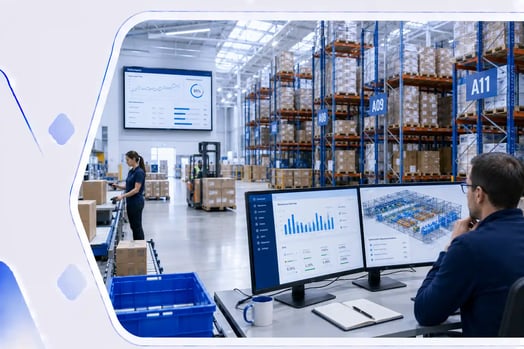
Warehouses are among the most important elements in logistics. They are the foundation on which the various flows of goods are built. Their organization represents a strategic challenge for the supply chain. From inventory tracking to incoming and outgoing flows, to the coordination of human and material resources, warehouse management is becoming a decisive factor in a company's competitiveness.
While many companies continue to use manual methods or unsuitable solutions, the problem has evolved, and these time-consuming methods, sources of potential errors, end up weakening the profitability of these same companies. Warehouse management software, such as WMS or YMS, is now emerging to secure, automate and optimize logistics operations. If you don't yet know what these systems are capable of, we'll tell you all about it in this article.
Why use warehouse management software?
The challenges of manual management
Managing a warehouse without appropriate software, such as a WMS or WCS, means running the risk of making a mistake, with serious problems. Human error is a frequent occurrence. We're talking here about miscounting stock, forgetting to update or misaddressing locations. These shortcomings prevent good visibility of the real state of inventory. The company ends up penalized because it cannot anticipate out-of-stocks or overstocks.
The complexity of logistics operations also makes it difficult to optimize incoming and outgoing flows. And the absence of KPIs limits the acuity of dashboards, preventing managers from making informed decisions about the efficiency of their warehouse.
Software: automation and optimization
Warehouse management software, such as WMS, radically transforms the way we work. Thanks to system automation, there are fewer errors, stocks are updated in real time, and information processing is more secure and archived.
Companies that continue to use old-fashioned warehouse management methods are faced with :
- A high risk of errors,
- Lack of visibility on activity,
- Loss of process efficiency,
- Lack of agility in responding to customers,
- Complex logistics operations,
- Reduced profitability.
Whereas the use of warehouse management software would enable them to :
- Increase efficiency,
- Improve productivity,
- Manage flows more fluidly,
- Increase goods traceability,
- Plan orders,
- Apply more appropriate processes,
- Allocate resources to the right place at the right time,
- Gain better visibility of activity and stock levels,
- Anticipate needs,
- Make decisions with complete information,
- Control document management,
- Automate repetitive tasks.
The main types of warehouse management software
WMS (Warehouse Management System)
The WMS is specifically designed for warehouse operations. It is a powerful piece of software, capable of managing racking locations, correctly addressing incoming goods, defining order preparation, tracing all flows and managing all the documentation that accompanies freight. WMS systems are packed with features that make them the backbone of the best-organized, most profitable warehouses.
YMS (Yard Management System)
YMS software deals with the flow of vehicles on site. From truck arrival to truck departure, YMS handle security protocols, appointment scheduling, dock allocation, transit zones and circulation areas.
WCS (Warehouse Control System)
WCSs are software packages that supervise and control automated warehouse installations such as conveyors, picking robots or sorting systems. They often work in correlation with WMS.
ERP (Enterprise Resource Planning)
ERP is an integrated management system that centralizes all information circulating within a company, including logistics data. ERPs equipped with a WMS module help with planning and unify warehouse management with other company departments, such as accounting, sales or purchasing.
ShiptiDock: making appointments in the warehouse
ShiptiDock is our dedicated tool for managing loading and unloading docks and slots. It improves the fluidity of shipping and receiving operations, optimizing resource allocation and reducing carrier waiting times. The result? Docks run more smoothly every day, teams are more efficient and everything is calibrated to perfection.
|
Software type |
Main function |
Benefits |
Limitations |
|
WMS |
Warehouse management (stocks and flows) |
Inventory optimization, traceability, efficiency |
High cost of ownership |
|
YMS |
On-site dock and flow management |
Optimization of vehicle rotations |
Requires coordination with carriers |
|
WCS |
Control of automated warehouse equipment |
Improve productivity and accuracy of operations |
Dependence on automated equipment |
|
ERP |
Integration of logistics functions with other company departments |
Unified vision of operations, better process synchronization |
Less specialized than a WMS, complex parameterization |
|
Shiptidock |
Management of order loading and unloading slots |
Optimization of dock flows, smoothing of activity, reduction of waiting times |
Suitable for warehouses with more than 3 trucks per day. |
How to choose the right warehouse management software?
Define your needs and priorities
If you decide to manage your warehouse with specific management software, such as a WMS, ERP or WCS, you need to ask yourself the right questions, starting by defining your needs and priorities. The size of the warehouse is a good starting point, as is the rate of goods flow. Depending on order volumes and stock rotation, you may opt for a simple WMS for moderate flows.
But if you're equipping a large-scale warehouse, or even a logistics hub, or if you're planning to expand, then an advanced ERP solution incorporating at least one WMS might be right for you. For example, if you receive a lot of trucks, you could add a YMS. If you use automated equipment, add a WCS system. The question of costs will also arise, but think of the productivity and profitability gains brought about by such software.
Check integration with other systems
One of the main constraints is to guarantee interoperability between each system you want to connect. Your new warehouse management software will need to integrate easily with other solutions already in place in the company, such as ERP or TMS (Transport Management System). For example, ShiptiDock can connect to all types of existing software, such as WMS, WCS, etc.
Analyze ergonomics and support
When choosing software, you can also consider its ergonomics, i.e. how easy it is to use. Is the WMS intuitive? Will it be easy for your teams to get to grips with the system? Is there a hotline or support? The support provided by the software publisher is just as important as the functionalities.
These points should be taken into account, as the technical aspects can, for example, reduce training times, reduce the risk of errors, fine-tune calibration, and so on. The most important thing is to ensure a smooth transition to the new solution.
Consider scalability and cost
It's important that the WMS, ERP or YMS you choose is scalable, i.e. capable of adapting to your company's growth. Software in SaaS mode will be hosted in the cloud and offer a subscription fee, in exchange for regular updates and greater scalability.
On-premise solutions, installed on the company's own servers, offer a little less flexibility, but guarantee permanent access. You'll need to assess your total cost of ownership (TCO), integrating not only acquisition or subscription costs, but also installation, training and maintenance costs.
Mistakes to avoid
To avoid making mistakes when choosing your warehouse management software, you need to be aware of the following pitfalls:
- Software that is too complex for your company's real needs, resulting in under-utilization of functionalities and unjustified extra costs.
- Failure to check compatibility with other systems already in place, leading to data integration and synchronization problems.
- Underestimating hidden costs (training, maintenance) and miscalculating TCO.
ShiptiDock: a solution for dock management
While the WMS manages the inside of the warehouse, ShiptiDock takes care of its docks. In fact, our solution is dedicated exclusively to optimizing dock operations. It digitizes the management of order loading and unloading slots to improve the fluidity of logistics flows and reduce driver waiting times.
Our software organizes arrival and dispatch appointments, paces vehicle rotations on your site, and secures product freight. Carriers can access the online schedule directly, and book slots as they see fit. Waiting times will be reduced, and carriers will no longer be able to claim compensation for vehicle immobilization.
Thanks to its intuitive interface and simplified connection with other software such as WMS, ERP or WCS, ShiptiDock contributes directly to improving overall warehouse performance.
As you can see, adopting a warehouse management software solution is a considerable asset for improving logistics efficiency and meeting the ever-increasing demands of the marketplace. There are many different types of digital solution, ranging from WMS and YMS to ERP and specialized tools such as Shiptidock. Making the right choice depends on an in-depth analysis of the company's needs, specific constraints and costs, to ensure optimum return on investment.