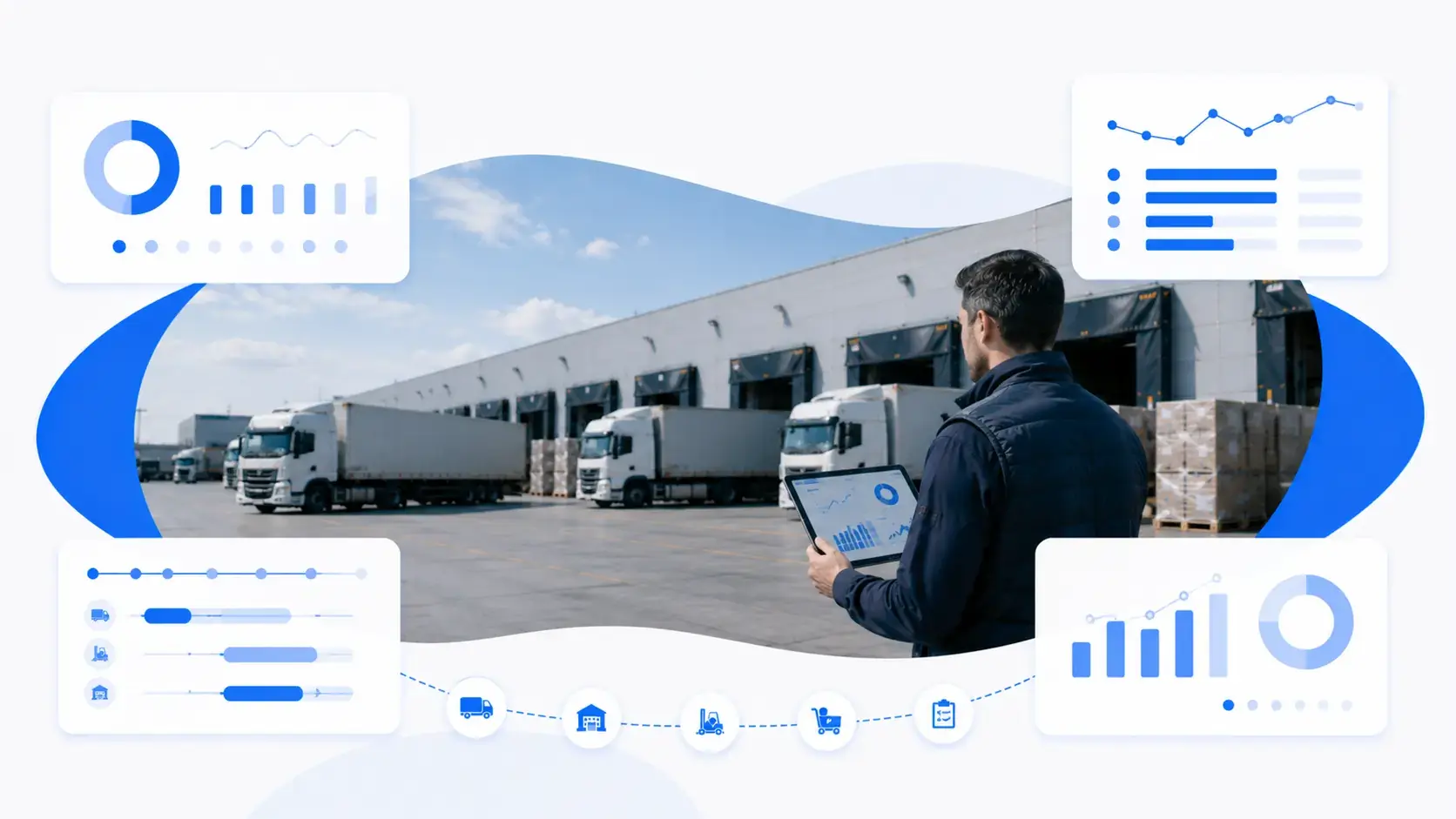



Supply chain KPIs: essential metrics for logistics managers
Transportation performance is no longer measured solely by delivery volumes or freight costs. In today's increasingly complex supply chains, logistics managers need precise data to optimize operations, control expenses, improve customer satisfaction, and meet sustainability goals.
This is where transportation KPIs (Key Performance Indicators) play a critical role.
Transportation KPIs provide measurable insights into the efficiency, reliability, and profitability of logistics operations. By tracking the right metrics, companies can identify inefficiencies, improve decision-making, and continuously optimize their transportation performance.
In this article, we'll explore the most important transportation KPIs, how to calculate and interpret them, and how a Transportation Management System (TMS) can help organizations turn data into operational excellence.
What are transportation KPIs?
Transportation KPIs are measurable metrics used to monitor and evaluate transportation performance.
They help logistics and supply chain teams assess the efficiency of transportation operations, identify opportunities for improvement, and ensure business objectives are being met.
These indicators provide visibility into key areas such as:
- transportation costs;
- delivery performance;
- vehicle utilization;
- carrier efficiency;
- customer satisfaction;
- environmental impact.
By monitoring transportation KPIs regularly, companies can make data-driven decisions that improve both operational and financial performance.
Why are transportation KPIs important?
Transportation operations involve numerous stakeholders, processes, and variables. Without clear performance indicators, it becomes difficult to identify inefficiencies or measure improvement initiatives.
Effective KPI monitoring enables companies to:
- improve operational visibility;
- reduce transportation costs;
- optimize resource utilization;
- increase service quality;
- anticipate operational issues;
- support strategic decision-making.
For logistics leaders, transportation KPIs are essential tools for maintaining competitiveness and driving continuous improvement.
Transportation KPIs vs logistics KPIs: what's the difference?
Although transportation and logistics KPIs are often linked, they measure different aspects of supply chain performance.
Transportation KPIs focus specifically on the movement of goods and transportation execution. They evaluate areas such as carrier performance, vehicle utilization, freight costs, and delivery reliability.
Logistics KPIs take a broader view of supply chain performance and may include:
- inventory management;
- warehouse operations;
- order fulfillment;
- procurement performance;
- customer service metrics.
Together, these indicators provide a comprehensive view of supply chain efficiency.
The most important transportation KPIs
Different KPIs provide visibility into different aspects of transportation performance. The most effective KPI strategy combines operational, financial, and sustainability metrics.
Route profitability KPIs
Route profitability indicators help companies evaluate how efficiently transportation resources are being utilized.
Vehicle fill rate
The vehicle fill rate measures the percentage of available vehicle capacity being used.
Formula:
Vehicle fill rate (%) = (Loaded volume or weight ÷ Total vehicle capacity) × 100
A higher fill rate generally improves profitability by maximizing asset utilization and reducing transportation costs per shipment.
Empty miles rate
This KPI measures the percentage of distance traveled without cargo.
Reducing empty miles is one of the fastest ways to improve transportation efficiency and lower fuel costs.
Average transportation cost per shipment
This metric measures the average cost incurred for each shipment.
Monitoring this KPI helps organizations identify cost-saving opportunities and improve transportation budgeting.
Claims and dispute rate
The claims rate measures the number of damaged, delayed, or disputed shipments compared to the total number of shipments completed.
A high dispute rate may indicate operational inefficiencies or service quality issues that require corrective action.
Driver performance KPIs
Drivers play a crucial role in transportation performance. Monitoring driver-related KPIs helps organizations improve service quality, safety, and operational efficiency.
On-time delivery performance per driver
This KPI measures a driver's ability to meet scheduled delivery deadlines.
Consistent on-time performance contributes directly to customer satisfaction and operational reliability.
Average fuel consumption per driver
Fuel efficiency varies significantly between drivers.
Tracking fuel consumption helps identify best practices and opportunities to reduce operating costs.
Average operation time
This KPI measures the average time required to complete a transportation operation, including:
- loading activities;
- transportation time;
- unloading operations;
- waiting time at docks.
Reducing operation times improves asset utilization and overall productivity.
Fleet management KPIs
Fleet-related KPIs help ensure transportation assets operate efficiently and cost-effectively.
Average distance traveled per vehicle
This metric provides visibility into vehicle utilization levels and transportation workload distribution.
Fuel consumption per 100 km
Fuel consumption remains one of the most important transportation cost indicators.
Monitoring this KPI helps companies improve fuel efficiency and reduce operating expenses.
Vehicle compliance rate
This KPI tracks whether vehicles meet all regulatory and documentation requirements.
Ensuring compliance reduces operational risks and helps avoid penalties.
Real-time fleet visibility
Real-time tracking provides continuous visibility into vehicle locations and transportation progress.
Improved visibility enables faster decision-making and more proactive issue resolution.
Sustainability KPIs
Sustainability has become a strategic priority for transportation and logistics organizations.
Environmental KPIs help companies monitor and reduce their carbon footprint.
CO₂ emissions per shipment
This KPI measures greenhouse gas emissions generated by each shipment.
It provides a clear view of transportation sustainability performance.
CO₂ emissions by transportation mode
Different transportation modes generate different levels of emissions.
Tracking emissions by road, sea, rail, or air enables organizations to make more sustainable transportation decisions.
Total distance traveled
Although not a sustainability metric on its own, monitoring total distance traveled helps identify opportunities to optimize routes and reduce emissions.
How to calculate and analyze transportation KPIs
Collecting KPI data is only the first step. The real value comes from analyzing the results and translating insights into action.
Accurate KPI analysis depends on reliable and well-structured data.
For this reason, many companies rely on transportation dashboards that centralize operational data and provide real-time visibility into performance metrics.
Modern TMS platforms automatically calculate KPIs and display them through intuitive dashboards, allowing teams to identify trends, detect anomalies, and monitor progress over time.
When analyzing KPIs, companies should consider:
- business objectives;
- historical performance;
- industry benchmarks;
- operational trends.
KPIs should always be evaluated within their broader operational context.
Why monitor transportation claims rates?
Transportation claims directly impact profitability, customer satisfaction, and operational efficiency.
A rising claims rate may indicate:
- inadequate handling procedures;
- insufficient carrier performance;
- packaging issues;
- communication gaps across the supply chain.
Monitoring this KPI helps organizations identify root causes and implement corrective actions before service quality deteriorates.
How do you calculate load factor?
Load factor measures how effectively vehicle capacity is being utilized.
Formula:
Load factor (%) = (Cargo volume or weight ÷ Available vehicle capacity) × 100
A higher load factor generally results in:
- lower transportation costs;
- improved profitability;
- reduced environmental impact;
- better resource utilization.
Optimizing load factor remains one of the most effective ways to improve transportation performance.
How to improve transportation performance using KPIs
KPIs are only valuable when they support continuous improvement initiatives.
Organizations that consistently improve transportation performance typically focus on three key areas.
Establish regular performance monitoring
Transportation is a dynamic environment that requires continuous oversight.
Regular KPI reviews help organizations:
- identify emerging trends;
- detect anomalies early;
- anticipate operational risks;
- implement corrective actions quickly.
Consistent monitoring enables companies to remain agile and responsive to changing conditions.
Support employee performance and well-being
Drivers and logistics teams have a direct impact on transportation performance.
Organizations that invest in employee well-being, safety, and professional development often achieve:
- fewer incidents;
- improved service quality;
- higher productivity;
- stronger employee retention.
Operational excellence begins with engaged and well-supported teams.
Leverage technology and automation
Modern transportation operations rely heavily on technology.
Solutions such as Transportation Management Systems (TMS), advanced analytics platforms, and AI-powered optimization tools help organizations:
- monitor KPIs in real time;
- automate reporting;
- predict operational trends;
- optimize transportation planning.
Technology enables faster decision-making and more effective performance management.
Why use Shiptify to monitor transportation KPIs?
Managing transportation KPIs manually can be time-consuming and prone to errors.
Shiptify helps companies centralize transportation data, automate KPI monitoring, and gain real-time visibility into logistics performance.
Real-time transportation performance monitoring
Shiptify provides instant access to critical transportation metrics, including:
- shipment volumes;
- transportation costs;
- savings achieved;
- average cost per shipment;
- carrier performance;
- delivery reliability.
This visibility enables organizations to make faster, more informed decisions.
Carrier and driver performance analysis
The platform helps companies evaluate carrier and transportation performance through indicators such as:
- on-time pickup rate;
- on-time delivery rate;
- quotation response time;
- service quality performance.
These insights support carrier selection, contract negotiations, and continuous improvement initiatives.
Sustainability monitoring
Shiptify also helps organizations track environmental performance through:
- CO₂ emissions by transportation mode;
- monthly emissions monitoring;
- distance traveled analysis.
This data supports sustainability objectives while improving transportation efficiency.
A powerful TMS for transportation analytics
Shiptify's fully digital Transportation Management System is designed to improve supply chain performance while delivering rapid return on investment.
The platform helps companies:
- optimize transportation spending;
- improve transportation planning;
- enhance shipment traceability;
- automate operational workflows;
- anticipate and manage transportation issues;
- centralize operations through a Control Tower approach.
By combining operational visibility, analytics, and automation, Shiptify enables organizations to continuously improve transportation performance.
Conclusion
Transportation KPIs are essential tools for measuring, analyzing, and improving logistics performance.
By monitoring the right indicators, organizations can reduce costs, improve service quality, optimize resource utilization, and support sustainability objectives.
However, KPI management is only effective when supported by reliable data and powerful technology.
With Shiptify, companies gain the visibility, automation, and analytics capabilities needed to transform transportation data into measurable business results.
Take control of your transportation KPIs with Shiptify
Discover how Shiptify helps logistics teams improve visibility, optimize transportation performance, and make better decisions across the supply chain.