In today's supply chains, visibility is no longer optional.
Customers expect accurate delivery updates, logistics teams need real-time information to make decisions, and businesses must react quickly to disruptions that impact transportation operations.
This is why shipment tracking has become a critical component of modern logistics management.
By monitoring the movement of goods from origin to destination, companies gain greater control over transportation operations, improve customer satisfaction, and optimize supply chain performance.
In this guide, we'll explain what shipment tracking is, how it works, the technologies behind it, and how a Transportation Management System (TMS) can help companies improve transportation visibility.
What is shipment tracking?
Shipment tracking is the process of monitoring goods throughout their journey across the supply chain.
It provides real-time visibility into:
- shipment location;
- transportation status;
- estimated delivery times;
- delivery milestones;
- potential transportation disruptions.
Shipment tracking enables companies to monitor cargo movements from pickup through final delivery, helping logistics teams make faster and more informed decisions.
Why is shipment tracking important?
Without visibility, transportation teams often operate reactively.
Shipment tracking provides the information needed to anticipate problems and manage transportation proactively.
Real-time visibility
Companies gain continuous insight into shipment locations and transportation status.
Faster issue resolution
Transportation disruptions can be detected earlier, allowing teams to take corrective action before service levels are impacted.
Better customer experience
Providing accurate delivery updates improves communication and strengthens customer satisfaction.
Transportation cost optimization
Greater visibility helps identify inefficiencies, reduce delays, and improve route planning while supporting better transportation spend management.
Improved operational performance
Shipment tracking enables logistics teams to monitor carrier performance and continuously improve transportation processes.
What types of logistics operations require tracking?
Shipment visibility is important across all logistics activities.
Production logistics
Tracking helps manufacturers monitor material flows and reduce production lead times.
This visibility is particularly valuable for companies managing complex inbound logistics operations.
Distribution logistics
Companies can ensure products are delivered efficiently while maintaining service quality.
Sustainable logistics
Visibility helps optimize transportation routes and reduce environmental impact through more efficient operations.
Technologies used for shipment tracking
Modern shipment tracking relies on a combination of technologies that collect and share transportation data in real time.
GPS tracking
GPS technology remains one of the most widely used shipment tracking solutions.
Vehicles equipped with GPS devices can be monitored continuously throughout the transportation process.
Benefits
- real-time vehicle visibility;
- accurate location tracking;
- estimated arrival predictions.
RFID technology
Radio Frequency Identification (RFID) tags allow shipments, pallets, and containers to be automatically identified and tracked.
RFID technology improves traceability while reducing manual scanning requirements.
Barcodes
Barcode systems remain widely used across transportation and warehousing operations.
Each scan provides an update on the shipment's status and location.
IoT sensors
Internet of Things (IoT) sensors provide additional visibility into shipment conditions.
These devices can monitor:
- temperature;
- humidity;
- shocks and vibrations;
- door openings;
- cargo conditions.
This is particularly valuable for sensitive or high-value goods.
Transportation management systems (TMS)
A Transportation Management System (TMS) centralizes shipment tracking data and provides complete transportation visibility.
A TMS helps companies:
- track shipments in real time;
- manage transportation operations;
- monitor carrier performance;
- optimize routes;
- automate transportation workflows.
Instead of consulting multiple carrier portals, logistics teams can access all shipment information through a single platform using modern TMS software.
Supply chain management systems
Supply Chain Management (SCM) platforms aggregate logistics information from multiple sources and provide a broader view of supply chain performance.
These solutions often integrate with transportation systems to improve end-to-end visibility.
ERP and WMS integration
Shipment tracking becomes even more powerful when connected to:
ERP systems
Enterprise Resource Planning (ERP) systems centralize business data and improve information sharing across departments.
Understanding the relationship between ERP and WMS systems is essential for building a fully connected logistics ecosystem.
Warehouse Management Systems (WMS)
Warehouse Management Systems improve inventory control, warehouse operations, and order fulfillment processes.
When integrated with transportation systems, WMS software helps provide complete supply chain visibility.
Organizations managing larger facilities often complement these tools with dedicated warehouse management software solutions.
Why use a shipment tracking dashboard?
A shipment tracking dashboard transforms transportation data into actionable insights.
Rather than reviewing information manually, logistics managers gain instant visibility into transportation performance.
A dashboard may include:
- shipment status;
- transportation KPIs;
- carrier performance;
- on-time delivery rates;
- transportation costs;
- alerts and exceptions;
- trend analysis.
This enables teams to identify issues quickly and make faster operational decisions using measurable supply chain KPIs.
How Shiptify improves shipment tracking
Managing transportation visibility across multiple carriers can be challenging.
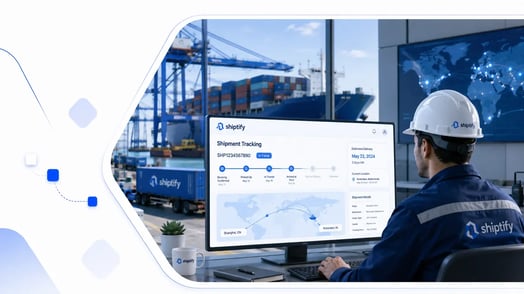
Shiptify simplifies shipment tracking by centralizing transportation data within a single platform.
Real-time transportation visibility
Shiptify provides real-time tracking for all shipments regardless of carrier.
Logistics teams gain immediate access to transportation status and delivery progress.
Automated tracking updates
Carrier tracking information is automatically integrated into the platform, eliminating the need for manual follow-up.
Proactive alerts
Users receive notifications whenever incidents, delays, or transportation anomalies occur.
This enables teams to react faster and maintain service quality.
Collaborative visibility
Tracking information can be shared with:
- logistics teams;
- customer service departments;
- suppliers;
- customers.
This improves communication and reduces the time spent answering shipment status requests.
No complex IT projects
Shiptify connects with carriers and existing transportation processes without requiring extensive development work.
Companies can rapidly improve shipment visibility while minimizing implementation efforts thanks to advanced transportation management system features.
Conclusion
Shipment tracking has become a fundamental requirement for modern logistics operations.
By combining real-time visibility, automated alerts, transportation analytics, and integrated systems, companies can improve customer satisfaction, optimize transportation costs, and strengthen supply chain performance.
With a Transportation Management System such as Shiptify, organizations gain a centralized view of all shipments, enabling them to make faster decisions and deliver a more reliable transportation experience.
Businesses looking to further enhance visibility and carrier collaboration often rely on dedicated freight management systems to centralize transportation execution and monitoring.