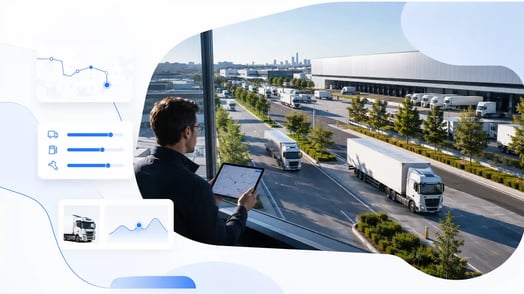
A vehicle that breaks down mid-route, a fuel bill that keeps increasing, or a compliance document that cannot be found during an inspection can all generate significant operational costs. Fleet management solutions help businesses detect and address these issues before they become expensive problems. This guide explains what these platforms do, how much they cost, and how to choose the right solution for your fleet, whether you manage ten vehicles or several hundred.
What are fleet management solutions?
Fleet management solutions are software platforms, often combined with GPS or telematics hardware, that help companies monitor vehicle locations, schedule preventive maintenance, track fuel consumption, and manage driver safety and regulatory compliance from a single interface.
Instead of relying on spreadsheets, paper maintenance records, and separate fuel reports, fleet managers gain a centralized view of fleet operations, enabling them to make faster and more informed decisions.
The market includes solutions ranging from lightweight applications designed for small fleets to enterprise platforms capable of managing thousands of vehicles across multiple sites. Regardless of their size, they all pursue the same objective: transforming fragmented operational data into actionable insights that reduce costs and improve fleet performance.
Before comparing vendors, companies should clearly identify their operational needs. The requirements of a local delivery fleet with 15 vehicles differ significantly from those of a national transport company operating hundreds of trucks across multiple depots.
Core features of fleet management solutions
Although available features vary between vendors, most fleet management platforms are built around four core capabilities.
GPS and real-time vehicle tracking
Real-time vehicle tracking is the foundation of most fleet management solutions.
Beyond simply displaying vehicle locations, GPS data enables companies to:
- optimize routes;
- provide accurate estimated times of arrival (ETAs);
- create geofencing alerts when vehicles enter or leave predefined areas.
These capabilities improve operational visibility while helping companies monitor deliveries and detect unauthorized vehicle use.
Maintenance and inspection management
Fleet management software supports preventive maintenance by scheduling servicing according to mileage, engine hours, or predefined time intervals.
Typical features include:
- automated maintenance scheduling;
- digital vehicle inspection reports;
- maintenance history;
- service reminders.
Preventive maintenance reduces vehicle downtime, minimizes repair costs, and helps prevent unexpected breakdowns.
Fuel and cost management
Fuel represents one of the largest operating expenses for most fleets.
Fleet management solutions help companies monitor:
- fuel purchases;
- actual fuel consumption;
- excessive idling;
- unusual consumption patterns that may indicate fraud or mechanical issues.
Improved fuel visibility contributes directly to lower transportation costs.
Driver safety and compliance
Modern fleet management platforms also improve driver safety by monitoring behaviors such as:
- harsh braking;
- speeding;
- rapid acceleration;
- excessive idling.
These indicators support driver coaching programs and help reduce accident risks.
From a compliance perspective, fleet management solutions also manage:
- Hours of Service (HOS) records where applicable;
- driver licenses and certifications;
- inspection reports;
- regulatory documentation.
Automating compliance activities reduces administrative work while lowering the risk of violations during audits.
Types of fleet management solutions
Not every business requires the same type of fleet management platform. Broadly speaking, the market can be divided into three categories, each designed for different operational needs.
Hardware-based telematics systems
These solutions rely on dedicated GPS and telematics devices installed in each vehicle.
Their main advantages include:
- continuous vehicle tracking;
- access to engine diagnostics;
- highly accurate operational data.
However, they require upfront hardware investments and professional installation, making them best suited to companies operating stable, company-owned fleets.
Software-only or app-based platforms
These solutions use a mobile application installed on the driver's smartphone instead of dedicated telematics hardware.
Their benefits include:
- lower deployment costs;
- faster implementation;
- greater flexibility for leased or frequently changing vehicles.
They are particularly suitable for small and medium-sized fleets that prioritize rapid deployment over advanced vehicle diagnostics.
TMS-integrated fleet tools
Some fleet management capabilities are integrated directly into a Transport Management System (TMS).
These solutions combine vehicle management with broader transportation operations, including:
- transport order management;
- carrier coordination;
- shipment visibility;
- dock scheduling.
They are particularly relevant for shippers managing both owned vehicles and outsourced carriers within the same transportation network.
There is no universally superior solution. The best option depends on whether the company operates a dedicated fleet, leased vehicles, outsourced transportation providers, or a combination of these models.
Benefits of implementing a fleet management solution
Organizations typically invest in fleet management software to achieve measurable operational improvements.
The main benefits include:
- Reduced vehicle breakdowns and maintenance costs through preventive servicing.
- Lower fuel consumption by optimizing routes and reducing unnecessary idling.
- Improved driver safety through behavior monitoring and coaching programs.
- Simplified regulatory compliance by automating inspections, certifications, and documentation.
- Greater visibility into operating costs, allowing managers to identify the vehicles, routes, or drivers generating the highest expenses.
These improvements generally accumulate over time rather than appearing immediately. Many organizations achieve the strongest return on investment after 12 to 18 months, once preventive maintenance programs and driver performance monitoring have become fully operational.
How much do fleet management solutions cost? (2026 data)
Pricing varies according to the type of platform selected, the number of vehicles managed, and whether dedicated telematics hardware is required.
| Solution type | Typical monthly cost (2026) | Hardware cost | Best suited for |
|---|---|---|---|
| Hardware-based telematics | $25–$45 per vehicle | $150–$400 per unit | Stable, company-owned fleets |
| App-based software | $10–$20 per vehicle | None | Smaller fleets and leased vehicles |
| TMS-integrated fleet tools | Varies depending on the TMS | Depends on the tracking technology used | Companies managing owned vehicles and outsourced carriers |
Beyond subscription costs, organizations should also account for:
- implementation;
- driver training;
- hardware installation where applicable;
- migration from existing systems.
In practice, the total first-year investment is often 20–40% higher than the advertised subscription price once onboarding and implementation costs are included.
How to choose the right fleet management solution for your business
Before comparing software vendors, companies should first assess their operational priorities.
Key evaluation criteria include:
- Fleet size and composition, including owned, leased, or outsourced vehicles.
- Primary business challenge, whether maintenance, fuel management, compliance, or operational visibility.
- Hardware versus software deployment, depending on operational requirements.
- Integration capabilities with existing ERP, dispatch, or TMS platforms.
- Reporting quality, including GPS refresh frequency and analytics capabilities.
- Total cost of ownership, including software, hardware, implementation, and training.
- Scalability, ensuring the platform can support future fleet growth.
A structured evaluation process helps organizations identify solutions that address their operational challenges rather than selecting software based solely on feature lists or marketing claims.
Fleet management and transport operations: Why they shouldn't live in separate tools
Fleet management software answers one important question: How are my vehicles performing? However, it was not designed to provide complete visibility over every transport order, carrier, and shipment moving through a supply chain.
This distinction is particularly important for companies that combine owned fleets with outsourced carriers.
Fleet management platforms focus on:
- vehicle location;
- maintenance;
- fuel consumption;
- driver safety;
- regulatory compliance.
They generally do not manage:
- outsourced transportation providers;
- transport orders;
- multimodal shipments;
- loading dock scheduling.
As a result, organizations relying exclusively on fleet management software often lack visibility over a significant portion of their transportation operations.
Shiptify TMS fills this gap by centralizing every transport order, whether the shipment is handled by an owned vehicle or an external carrier.
Key capabilities include:
- multimodal shipment tracking;
- centralized transport order management;
- KPI dashboards comparing owned and outsourced transport performance;
- automated transport quotation requests;
- API connectivity with existing fleet management software.
Rather than replacing fleet management platforms, Shiptify complements them by extending visibility across the entire transportation network.
ShiptiDock provides the same level of coordination for warehouse operations.
Through a single platform, warehouse teams can:
- schedule dock appointments online;
- coordinate inbound and outbound flows;
- monitor supplier performance;
- manage arrivals from both company-owned vehicles and external carriers.
These solutions provide a unified view of transport operations while allowing fleet management software to continue handling vehicle maintenance and compliance.
Rather than competing, fleet management platforms and Transport Management Systems address complementary aspects of logistics operations.
Managing both owned vehicles and outsourced carriers? Discover how Shiptify centralizes every transport order and dock appointment from a single platform.