According to Supply Chain Info, road haulage companies are set to grow by 8% between now and 2030. Constantly seeking innovations to optimize their operational efficiency, they are adopting advanced technologies. Among the tools becoming essential in this field, the Yard Management System (YMS) stands out as a strategic lever for site, operations and warehouse managers. This tool streamlines operations in warehouses and distribution centers. It responds to the logistics challenges increased tenfold by the growing volume of goods on the road: 620,600 heavy goods vehicles in France at the start of 2023 (French Ministry of Ecological Transition*). This technological integration is proving its worth in maintaining competitiveness: here's how.
What is a YMS?
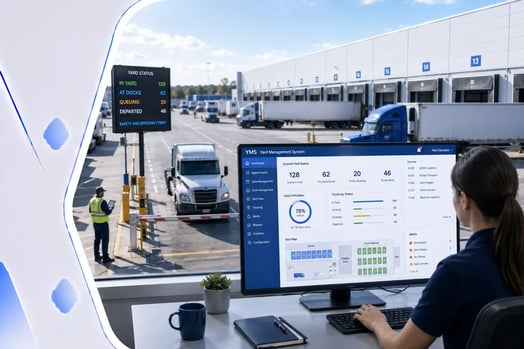
A YMS, or Yard Management System, is supply chain software designed to supervise the movement and maintenance of transport vehicles in the yard of a warehouse or distribution center. The system manages :
- Parking spaces ;
- Loading bays;
- and vehicles waiting to be loaded or unloaded.
This technology ensures optimum fluidity in logistics operations.
What are the functionalities of YMS?
YMS plays a central role in the supply chain. It provides complete visibility of resources in real time, and facilitates rapid, informed decision-making.
Vehicle tracking with the Yard Management System
This software closely monitors all activities associated with inbound and outbound transport, including loading and unloading operations. Its ability to provide real-time data on vehicle movements from the docks is proving highly valuable. It enhances operational efficiency for executives and logistics managers.
Space optimization and zone monitoring
In addition to its monitoring role, YMS also helps to manage parking zones. To do this, it analyzes available space to optimize vehicle entries and exits. This functionality ensures :
- Better organization of parking spaces;
- And operational monitoring of critical areas.
YMS makes an undeniable contribution to optimizing warehouse docks.
Why use YMS?
Integrating a YMS drastically improves warehouse management by optimizing loading and unloading operations. It reduces truck waiting times and optimizes the use of available resources.
Dock and yard management
A YMS enables active management of loading docks and yards:
- It controls the loading and unloading of trucks within optimized timeframes and in a logical sequence;
- It reduces stagnation time and increases productivity.
Real-time vehicle planning and tracking
Thanks to YMS, it is possible to track each vehicle in the yard in real time, plan operations precisely and react quickly to any changes or unforeseen events, guaranteeing greater responsiveness.
Synchronization with logistics information systems
As YMS synchronizes seamlessly with other logistics information systems, such as WMS ( Warehouse Management Systems) and TMS (Transport Management Systems), it creates a seamless, high-performance IT ecosystem .
YMS benefits for warehouse managers
YMS offers more pragmatic dock management , with :
- Reduced bottlenecks ;
- Increased throughput of loading and unloading operations;
- Reduced waiting times;
- And optimized use of resources.
By minimizing truck waiting times and rationalizing the use of docks and equipment, YMS contributes to a significant reduction in operating costs.
YMS implementation and integration
Adopting a YMS requires :
- Careful planning ;
- An assessment of the company's specific needs;
- And adequate team training.
For successful YMS integration, select a customizable system, plan for ongoing support from the supplier, and involve all stakeholders in the process.
Connecting your YMS with ShiptiDock : what are the benefits?
While a YMS simplifies truck movements in warehouses, ShiptiDock comes into play upstream, when appointments are made. In just a few clicks, you give your carriers/suppliers the option of booking their arrival at a specific dock at a specific warehouse. An undeniable time-saver! Thanks to an API, it is now possible to connect your YMS to Shiptidock. This saves even more time! So, yes, but in concrete terms, what are the advantages of such synergy?
- Improved operational efficiency: connecting YMS and ShiptiDock together enables you to manage warehouse operations more fluidly. By optimizing the use of docks and handling resources, reducing scheduling conflicts, ensuring that vehicles are loaded and unloaded quickly, and reducing waiting times, you combine efficiency with time savings.
- Better visibility and control: vehicles entering and leaving the warehouse no longer hold any secrets for you. Staff and equipment requirements are better anticipated, and operations can be adjusted in real time to avoid unforeseen events. As a result, you can better prevent bottlenecks, while maintaining a safe working environment.
- Cost reduction: the alliance between YMS and ShiptiDock appointment scheduling helps minimize downtime for resources and workers. The result is a significant reduction in operating costs. One example is the reduction in overtime needed to manage unplanned arrivals or delays.
- Improved customer satisfaction: a well-coordinated system ensures that goods are received and dispatched on time. As a result, you improve the reliability of delivery services, and therefore customer satisfaction. As we all know, a customer who enjoys on-time delivery and transparent communication is a happy customer.
How does ShiptiDock work?
The Yard Management System(YMS) is a key enabler for accelerating and optimizing logistics operations. By integrating a YMS with innovative solutions like ShiptiDock, companies achieve perfect synchronization in warehouse and appointment management. Find out how Shiptidock can boost your logistics management with cutting-edge technologies: