Optimizing loading and unloading docks helps to coordinate the supply chain. Efficient management of incoming and outgoing flows increases warehouse efficiency. Process control can be facilitated by dematerialized tools, including appointment scheduling. Orderly scheduling of arrivals and dispatches will enable you to achieve convincing results in your flow management. With productivity gains and improved working conditions, you'll be able to optimize and lighten the load on your teams. Once you've defined the types of dock best suited to your activity, you'll have a better understanding of the usefulness of an appointment scheduling tool.
Logistics docks
Warehouse docks are an integral part of the supply chain, enabling products to be transferred between the warehouse and the transport vehicle, usually a truck. Continuous rotations punctuate the flow of goods in and out of the warehouse. Efficient organization is essential to ensure continuous fluidity, combined with optimization of resources.
What is a dock?
A dock is a platform attached to an industrial building, such as a warehouse. It is used to transfer packaged products from the storage area to the truck doors, which are always docked in reverse, at the stop limit. Products are packaged mainly on wooden or plastic pallets, depending on their destination. Some bulky products are packaged in such a way as to be handled by overhead cranes or high-lift work equipment. This type of equipment is particularly common on industrial sites, rather than with carriers or logistics operators.
What are the different types of dock?
There are different types of dock, adapted to each company's operating needs. Depending on the use of the warehouse, there are docks specially designed for the company's own activity. Here are just a few examples:
- the built-in dock: part of the warehouse, located at the edge of the building, it accepts straight truck or semi-trailer type vehicles. It is fitted with a small platform, which is placed on the floor of the truck to make the junction between the warehouse and the vehicle, in order to allow handling equipment such as forklift trucks or pallet trucks to pass through;
- the enclosed dock: integrated into the building, it is mainly used for the transfer of high-value or temperature-controlled goods;
- the herringbone dock: similar to a recessed dock, with the difference that it is not in the usual axis, but rather at an angle, and very often parallel to a neighboring building. It is suitable for limited spaces with special circulation requirements, as the site entrance for docking is generally on the opposite side from the exit;
- ramps: for vehicles too low to dock, or for side-loading, particularly in the case of long vehicles. It is often used to serve private customers picking up orders with their cars, or express delivery companies with vans. It is generally made of concrete, and is used by handling equipment to secure the freight.
All docks are designed to adapt more or less to the height of the truck, and are often equipped with a small hydraulic lift to reach the required height. Trucks, for their part, can also adjust the height of their floor thanks to a compressor in the trailer structure, which raises or lowers it to the required level.
What about safety at logistics docks?
Whatever the type of dock, it is very often equipped with a wheel-lock system to prevent the truck from rolling away, and to avoid the risk of accidents by preventing the handling equipment from tipping over into the void. It is also the driver's responsibility to position the wheel chocks and rest the trailer on its support stand when uncoupling the tractor to leave the trailer at the dock or overhanging it.
Distinction between loading and unloading docks
On logistics hubs, the docks used for unloading are often not the same as those used for loading. Their distinct functionalities separate the flows so that they can be handled optimally.
What is an unloading dock?
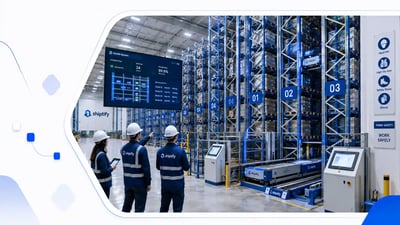
The unloading dock is designed to receive goods, but only incoming flows. Operators remove pallets from the truck and place them in a dedicated area to await processing. The key is to free the vehicle as quickly as possible.
Each unloading dock has a sorting area, or access to a general area where all arrivals converge before being identified, put into stock, sorted and then put away or reshipped.
What is a loading dock?
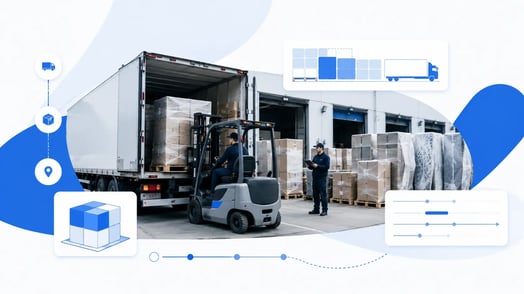
A loading bay can only dispatch goods, and only handles outgoing flows. Forklift drivers bring products on pallets from a picking or order-picking area, and place them in trucks that have already docked. This operation has to be carried out as quickly as possible. It is therefore necessary to position the shipping zones as close as possible to the docks. Products awaiting departure clutter up shipping areas and limit the working space of forklift operators, so it's vital to evacuate these goods as quickly as possible. Establishing a departure schedule is essential to ensurethe smooth flow of logistics movements, in line with available resources (men, machines and time).
Today, many companies use dock scheduling software to automate the management of loading and unloading slots. These tools help anticipate carrier arrivals, balance dock loads and reduce waiting times. Find out how to choose the best solution in our complete guide to dock scheduling software.
Characteristics of a loading dock
A loading dock is distinguished by the way it organizes the shipment of goods. This must be efficient, because loading times immobilize trucks and are lost to carriers' operations. Deficiencies in the shipping process can result in substantial delay costs.
What does a loading dock look like?
The loading dock differs from other docks in that it draws pallets from the storage area to the shipping area. Pallets are usually grouped by destination zip code. The loading dock shows zones marked on the floor near the doors. Each floor marking represents the maximum quantity of a pallet batch on the floor of a standard trailer, i.e. 33 pallets in standard 80 x 120 cm format. Other pallets can be stacked if their height permits.
Order-picking and picking areas must be located in the immediate vicinity, to limit the movement of handling equipment and the risk of accidents. This also means that checks (freight integrity, identification, quantity) have been carried out prior to shipment.
What are the technical features of a loading dock?
Important information about loading docks includes access and height. Both are crucial for smooth movements.
Access must allow several trucks capable of passing each other to maneuver. Docking is always done in reverse, so as to present the trailer doors to the forklift operator in the warehouse.
The dock height represents the loading threshold. It is usually between 1.10 m and 1.30 m. Trailer thresholds generally correspond to these figures. Some docks may be lower, depending on the vehicles required by the company's activity. Unsuitable thresholds can seriously compromise loading and unloading operations. The loss of time caused by untimely docking or ramping operations ultimately leads to additional costs, both for carriers and for the resources mobilized.
The loading process
The loading phase comprises several stages:
- grouping of orders in the dispatch area ;
- consolidation of batches by destination ;
- pick-up by forklift operators;
- loading into the trailer in the order of future unloading if several deliveries are planned;
- delivery of transport documents to the driver (consignment note, delivery note, etc.).
It's important to stress the importance of synergy between the various players involved in a load. There are always one or more forklift operators, a dock supervisor and the truck driver, who can give instructions according to his delivery points or the distribution of the load on the axles of his trailer. Good coordination is imperative for safe movement. Many machines, such as forklifts and pallet trucks, circulate in a warehouse, and their movements must remain fluid to avoid any risk of accident and make the most of resources.
Appointment scheduling to optimize loading bay utilization
Appointment scheduling is an effective tool for organizing the movement of goods in and out of a warehouse. The scheduling of vehicle arrivals enables resources to be deployed at the right time, without saturating them. The schedule adapts to the capacity of teams to prepare and then load batch shipments.
How important is appointment scheduling in organizing your logistics flows?
Appointment scheduling helps rationalize vehicle flows and available resources. It helps avoid traffic jams, but also ensures quality. Well-organized departures reduce the risk of shipping errors. It's a way of maximizing teams' operational efficiency while preserving time and budget capital.
How does appointment scheduling work?
Appointments can be booked in the traditional way, by telephone or e-mail, and recorded on a paper schedule or spreadsheet program. However, modern digital tools offer superior functionality thanks to more precise management of time slots, assignment of platforms according to needs, and real-time communication with drivers. These IT systems reduce human error and improve overall supply chain efficiency.
Why use ShiptiDock to manage your appointments?
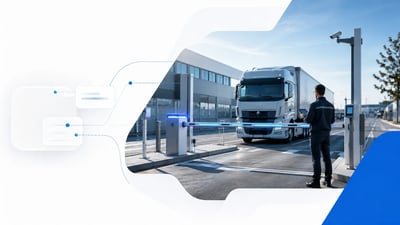
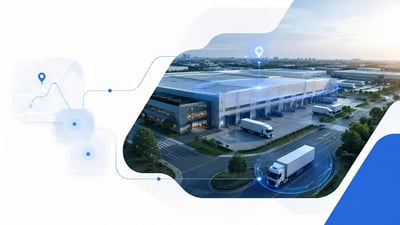
ShiptiDock is an efficient solution for managing your goods movements. You can use it to manage your logistics activity, thanks to a schedule on which your suppliers and their carriers log on to reserve a loading slot at their convenience. The system can share information with your teams and smooth out activity to make the most of all resources. You control the entry of trucks to your site, provide security protocols, direct vehicles to the right door straight away. Shiptidock also helps you establish performance indicators and manage any disputes or non-conformities. Shiptidock's comprehensive offering includes all the functionalities required for efficient logistics warehouse management.
While loading docks remain a crucial element in the supply chain, optimizing them requires an in-depth understanding of their technical characteristics, the processes that regulate them, and the tools that contribute to their operation. By investing in these aspects, site managers can considerably improve their logistics operations, thereby gaining in efficiency and profitability.