Freight transport is very important for international trade, as it enables goods to be traded all over the world. In this article, we explore the different modes of freight transport, take a look at their costs, and understand the rules that govern them. We'll also give you some useful information about the documents you need, how to use the technology, and share some practical tips.
What is freight forwarding?
Freight transport refers to the movement of commercial goods from one area to another, using various modes of transport and infrastructures.
This highly dynamic sector is part of a complex network of infrastructures. Freight transport can only take place if there are communication routes (roads, railroads, etc.), facilities for transferring goods from one mode of transport to another, space to park vehicles and accommodate drivers (ports, airports, parking lots, etc.) and, last but not least, the structures needed to overcome natural obstacles (bridges, tunnels, etc.).
There are two types of freight transport:
- Own-account transport, when you move your own goods or those for which you are responsible, using your own company's resources.
- Transport for hire or reward, also known as public transport, is when you move goods belonging to other people, either using your own resources, or calling on the services of other carriers...
Freight transport: how much will it cost me?
To manage your logistics and stay competitive, it's important to keep an eye on freight transport costs. These costs can vary according to the mode of transport and the type of goods. Let's explore the subject together!
Average freight rates
Freight transport rates are not fixed and can vary according to several criteria:
- The mode of transport: sea freight is often less expensive, but slower, while air freight is fast, but much more expensive. Road haulage, on the other hand, is highly flexible, but can be a little more expensive over long distances.
- Distance and route: costs can rise with distance, and also depend on the route chosen,tolls and possible transit charges.
- Volume and weight of goods: ratescan be calculated according to weight or volume, whichever is more advantageous for the carrier. Heavier or bulkier goods tend to be slightly more expensive to transport.
Factors influencing the overall price
In fact, several factors can influence the cost of freight transport:
- Seasonal variations: yes, rates can vary according to the season, with increases during periods of high demand, such as the festive season.
- Fluctuating fuel prices: transport costs are directly influenced by these changes.A sudden rise in oil prices can lead to an increase in freight rates.
- Regulations and taxes: customs duties, taxes and environmental regulations, especially for international transport, can also drive up costs...
Our tips for reducing your costs
Theory is good, but practice is better! So, in concrete terms, how can you really reduce these freight-related costs?
- Consolidate your shipments: grouping your shipments, and therefore filling each transport unit to the maximum, can really help to reduce your costs per unit.
- Make strategic choices regarding the mode of transport to choose the most economical type of freight, think about the speed you need and the particularities of your goods. For example, if your products are not in a hurry, sea freight may be an excellent option for reducing costs.
- Negotiate your transport contracts: talk regularly to your carriers to negotiate better rates, especially if you have a constant volume of freight.
- Optimize your routes: use transport management software and/or freight forwarding software to choose the shortest and most economical routes.
By implementing these strategies, you can really cut your freight costs, improving profit margins while remaining competitive in the global marketplace.
How to choose the right freight mode?
Choosing the right mode of transport is essential! It has to perfectly match the needs of each shipment to optimize your costs and efficiency. Here's a quick overview of the main freight transport modes, with their advantages and disadvantages.
A reminder of the different modes of freight transport
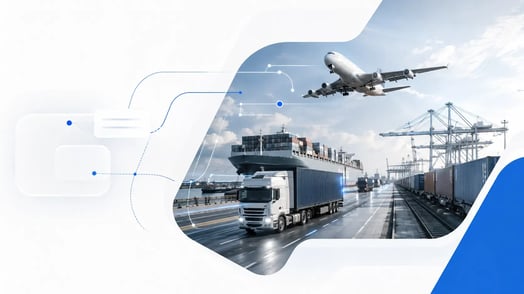
Sea: ideal for transporting large quantities of goods over long distances, sea freight is often the most economical choice for bulky, non-urgent shipments.
Air : perfect for fast consignments and high-value goods, air transport is the fastest, but can be a little costly.
Road: with its flexibility and relatively low costs, road transport is great for door-to-door deliveries and medium distances.
Rail: very attractive for heavy and bulky loads over long distances, rail transport is also more environmentally friendly than road transport.
River: similar to sea freight in terms of capacity and cost, but limited to regions with navigable waterways.
Comparison of freight modes
| Freight mode | Advantages | Minus | Speed | Capacity | Reliability | Ecological impact | Cost |
|
Sea
|
Low cost for large quantities | Slow Subject to weather conditions |
Low | Very high | High | Low | Very low |
| Aerial | Fast Ideal for valuable goods |
Expensive Limited by weight/volume |
Very high | Limited | Very high | High | Very high |
| Road | Flexibility Direct access to sites |
Affected by traffic High fuel costs |
Medium | Moderate | Medium | Medium | Medium |
| Rail | Reliable Good for heavy loads |
Less flexible Dependent on available routes |
Medium | High | High | Moderate | Low |
| River | Economical for bulk transport Environmentally friendly |
Limited to areas with waterways | Low | High | Medium | Very low | Low |
No single mode of freight transport has all the advantages. That's why multimodal transport is the ideal combination of these different solutions. In any case, road freight remains one of the cornerstones of logistics. Indeed, to take goods to a plane or a port, it is necessary to transport them first by road.
How do you select your freight forwarder?
The inevitable question! Finding the right partner is important to ensure that all your logistics operations run smoothly. Here are a few hints and tips to guide you in this decision.
Selection criteria
- Experience and reputation
Choose companies with a proven track record in freight forwarding. Don't hesitate to ask for recommendations or read online reviews to see what other customers think. - Logistical capabilities
Make sure your provider can cover all the regions where you want to send or receive goods. Also check that it offers services that match your needs, such as multimodal transport, warehousing or customs management. - Certifications and compliance
Look for carriers with important certifications such as ISO 9001 to guarantee good quality management. Other certifications specific to their field that prove their compliance with safety and environmental standards are equally important. Make sure, too, that they have all the necessary licenses to work legally in the areas concerned.
What are the pitfalls to avoid ?
- Don't rely solely on the lowest price: choosing a service provider just because it's the cheapest can sometimes lead to inferior services or increased risks of delays and complications.
- Don't neglect the details of the contract: take the time to read the contract carefully to understand all the clauses, especially those concerning responsibilities, insurance, and penalties for delays or damage. And make sure the contract is flexible enough to adapt to your changing needs.
Our tips for a successful partnership
- Clear and regular communication: be sure to exchange frequently with your provider to ensure that all parties are well informed of expectations and updates.
- Regular feedback : share constructive feedback with your provider to help them continually improve their service.
- Performance audit : consider organizing regular performance audits and reviews to see how your provider is doing, and identify areas for improvement together.
What documents are required for freight transport?
Freight transport is a complex business that needs rules to function properly. These rules may seem a little complicated, but don't panic! To make sure you're doing things the right way, here are the documents you need for every freight shipment.
| Mode of transport | Essential documents |
|---|---|
| Maritime 🚢 | Bill of Lading (B/L) |
| Certificate of Origin | |
| Cargo manifest | |
| Air ✈️ | Air Waybill (AWB) |
| Air Cargo Manifest | |
| Commercial invoice | |
| Road 🚚 | Consignment note (CMR for international transport) |
| Commercial invoice | |
| Tracking document (sometimes) | |
| Rail 🚞 | Railway consignment note (CIM) |
| Commercial invoice | |
| Cargo manifest (for large transport networks) | |
| River ⛴️ | River bill of lading |
| Certificate of origin | |
| Commercial invoice |
Explanations of documents
- Bill of Lading (B/L): this is an official document that creates an agreement between the person owning the goods and the carrier, while also serving as a receipt for the goods shipped.
- Air Waybill (AWB): this document is non-negotiable and confirms the contract of carriage.
- Consignment note (CMR): mainly used in international transport, to prove the contract of carriage between shipper and carrier.
- Commercial invoice: details the transaction between seller and buyer, and enables customs duties to be calculated.
- Certificate of origin: very important for international trade, it attests to the origin of a good, which is essential for customs duties and quotas.
- Cargo manifest: this is a complete list of all goods on board a ship or aircraft, used by the captain, freight agents and customs to ensure that everything is in order.
Who's involved?
Freight transport is a complex process. For this reason, there are many players involved, all of whom are essential to the smooth running of the shipment.
The freight forwarder
The freight forwarder is the person mandated by a client (shipper or consignee) to organize the link between different carriers in the case of goods requiring several successive shipments. His role is to ensure continuity of transport. He is also responsible for all related administrative operations, such as customs formalities. Unlike the freight forwarder, it is not the freight forwarder who determines the transport plan, but rather ensures that it runs smoothly.
Intermediaries: brokers or customer agents
The agent represents the customer with the carrier or freight forwarder to establish an order for the transport of goods. Some intermediaries operate directly over the Internet, thanks to the development of on-line transport order creation.
Buying transport via a freight exchange: how does it work?
A freight exchange is a way for a company to organize the transport of its goods. It's an online space where different carriers offer their services. The client can thus study different proposals for the transport of his goods and choose the service provider or providers that seem most suitable.
There's something for everyone. The customer can take advantage of the competition, while the carrier avoids empty runs. The freight exchange enables him to optimize his routes as much as possible. Despite the cost, there are real opportunities for carriers.
For large freight shipments, the freight exchange can be a solution. For smaller shipments (under 3 tonnes), you can use an express or courier logistics service. Companies such as DHL and Fedex have set up fast groupage transport services. Express courier services are therefore ideal for small consignments, avoiding the need to use a freight exchange.
Finally, it is also possible to use a forwarding agent or directly a forwarding agent or carrier to organize your freight transport.
The most important thing in freight forwarding is to clearly define the scope of your activity, so that you can choose the right service providers and partners. Every transport operation and every company has its own specific features and problems. It may seem complex at first, but with the right tools and the right partnerships, it can be a win-win situation.
Why use a TMS to optimize freight transport?
A TMS (Transport Management System) or a FMS (Freight Management System) is software designed to optimize the freight transport process. For shippers, using a TMS is like having an assistant to make the management and execution of their transport operations much more efficient. Here are just a few of the benefits :
- Cost reduction : a TMS helps you find the most economical transport options by comparing carriers' different offers, optimizing routes and consolidating shipments.
- Continuous visibility : shippers can keep an eye on their shipments in real time, enabling them to anticipate possible delays and keep their customers informed at all times.
- Carrier management : with a TMS, it's easier to manage quotations or bookings, performance and costs associated with each carrier.
- Improved customer service : with more accurate and continuous information, shippers can offer better service to their customers, particularly in terms of forecasting delivery dates, managing disputes, and handling exceptions.
- Process automation : TMS can simplify life by automating many manual tasks, such as tracking shipping documents, invoicing and claims management.
- Data analysis : modern systems like these offer analysis tools that help shippers examine their transport operations from different angles, pinpoint areas for improvement and make well-informed decisions.`
- Reduced errors : automating and standardizing processes can really help to reduce small human errors, whether in invoicing or otherwise.
- Flexibility and scalability :when there's a peak in activity or demand changes, a TMS helps shippers to adapt easily by adjusting their transport resources appropriately.
In short, TMS software is a valuable tool for shippers, enabling them to manage their transport operations more efficiently, cost-effectively and reliably. By optimizing processes, reducing costs and improving customer service, a TMS can offer a significant competitive advantage.
Why use Shiptify as a TMS?
Shiptify has been designed to optimize the freight transport process. Discover our strengths:
Global supply chain optimization
- Advanced management of freight expenses.
- Elimination of tasks with little added value (automated reporting, file transfer, more fluid exchanges, centralization of documents, etc.).
Proactive management of disputes
- Notifications to anticipate deviations.
- Close collaboration with your carriers to resolve problems.
Centralized control tower
- Unified vision for better freight management on a single platform.
- Standardized data and KPIs for better analysis.
- No more Excel spreadsheets or calls to individual carriers to request quotes or bookings - everything is centralized on our collaborative tool.
Choose Shiptify, the TMS designed for simplicity, speed and performance in freight transport.