Managing transportation has become increasingly complex.
Rising freight costs, growing customer expectations, tighter delivery windows, and increasing pressure on supply chain performance are forcing companies to rethink how they manage transportation operations.
Spreadsheets, emails, and manual processes are no longer sufficient to ensure visibility, efficiency, and control.
This is where a shipper TMS comes in.
A Transportation Management System (TMS) helps companies centralize transportation planning, automate workflows, improve carrier collaboration, and gain real-time visibility across their logistics operations.
In this guide, we'll explain what a shipper TMS is, how it works, and how to choose the right solution for your organization.
What is a TMS?
A Transportation Management System (TMS) is software designed to plan, execute, monitor, and optimize transportation operations.
It helps companies manage shipments more efficiently by centralizing transportation activities within a single platform.
A modern TMS typically allows organizations to:
- Plan transportation operations
- Manage carrier relationships
- Request and compare freight quotations
- Track shipments in real time
- Control transportation costs
- Manage transport documentation
- Analyze logistics performance
- Improve supply chain visibility
By digitizing transportation processes, companies can reduce manual work while improving operational efficiency.
Many organizations use a TMS as part of a broader strategy to reduce supply chain costs while improving service levels.
Shipper TMS vs carrier TMS
Not all TMS platforms serve the same purpose.
There are two main categories of transportation management systems.
Shipper TMS
A shipper TMS is designed for manufacturers, retailers, distributors, and other companies that organize transportation for their goods.
The primary objective is to manage outbound and inbound shipments while optimizing transportation costs and service levels.
Shipper TMS platforms help companies:
- Create transport orders
- Select carriers
- Compare rates
- Manage shipment execution
- Monitor delivery performance
They are particularly valuable for organizations managing large volumes of freight transport across multiple carriers and regions.
Carrier TMS
A carrier TMS is designed for transportation providers.
Its primary objective is to manage transportation operations from the carrier's perspective.
Carrier TMS platforms typically focus on:
- Fleet management
- Route planning
- Driver management
- Load planning
- Transport invoicing
- Operational dispatching
While both systems manage transportation activities, their users and objectives are very different.
Key features of a shipper TMS
Modern shipper TMS solutions provide a wide range of capabilities designed to improve transportation performance.
Carrier management
A TMS centralizes all carrier relationships within a single platform.
Companies can compare rates, evaluate service quality, and allocate shipments more efficiently.
Transportation procurement
Instead of sending multiple emails and making numerous phone calls, transportation teams can automate freight quote requests and compare carrier offers instantly.
Organizations that manage parcel deliveries can also benefit from dedicated multi carrier shipping software capabilities.
Shipment tracking
Real-time visibility allows logistics teams to monitor shipments throughout the transportation lifecycle.
Potential delays or disruptions can be identified early and managed proactively.
Modern shipment tracking tools provide greater transparency for both logistics teams and customers.
Cost management
Transportation costs can be tracked and analyzed in detail.
This helps organizations identify savings opportunities and improve budget control.
Many companies use TMS platforms as part of a broader transportation spend management strategy.
Performance reporting
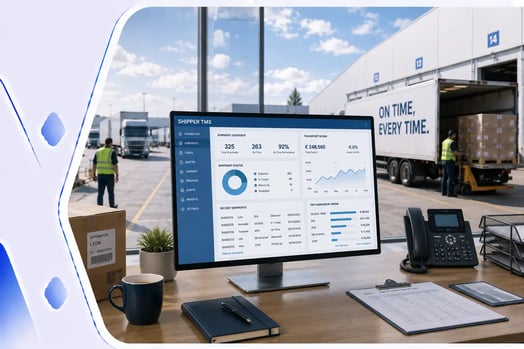
Modern TMS platforms provide dashboards and KPIs that help companies monitor transportation performance and identify areas for improvement.
This data is often consolidated into a centralized supply chain dashboard to improve decision-making.
Documentation management
Shipping documents, transport orders, proof of delivery, invoices, and carrier communications can all be centralized within the system.
This reduces administrative work while improving compliance and traceability.
How to choose the right shipper TMS
Selecting the right TMS starts with understanding your business requirements.
Define your transportation objectives
Before evaluating software providers, clearly identify your priorities.
Typical objectives include:
- Reducing transportation costs
- Improving visibility
- Increasing productivity
- Automating manual tasks
- Improving carrier collaboration
- Supporting business growth
Your goals will influence the features and deployment model you need.
Organizations seeking broader supply chain optimization should ensure their transportation strategy is aligned with overall business objectives.
Understand your logistics profile
Every organization has unique transportation requirements.
Consider factors such as:
- Number of shipments
- Transportation modes
- Geographic coverage
- Number of carriers
- International shipping requirements
- Customs processes
- Warehouse network complexity
The more accurately you define your transportation profile, the easier it becomes to identify suitable solutions.
Companies managing multiple transport modes should verify that the platform supports multimodal transport and international operations.
Establish a realistic budget
Budget remains an important decision factor.
When evaluating a TMS, consider:
- Software subscription costs
- Implementation fees
- Integration costs
- User training
- Ongoing support
The cheapest solution is not always the most cost-effective. The right platform should deliver measurable operational savings and long-term value.
Selection criteria for a shipper TMS
Functional coverage
The first criterion should always be the software's ability to support your transportation processes.
Look for features such as:
- Transportation procurement
- Carrier management
- Shipment visibility
- Route optimization
- Cost control
- Reporting and analytics
- Document management
Companies evaluating different solutions should compare them against the most important transportation management system features required by their operations.
Ease of implementation
Some TMS platforms require months of implementation and significant IT resources.
Others are designed for rapid deployment.
If speed and simplicity are important, prioritize solutions that offer:
- Fast onboarding
- Low implementation effort
- Limited IT involvement
Ease of use
User adoption is often one of the biggest challenges in transportation digitalization projects.
A modern, intuitive interface significantly improves adoption among:
- Transportation teams
- Warehouse operators
- Carriers
- Suppliers
Ease of use should be considered a strategic criterion rather than a secondary feature.
Integration capabilities
Transportation software should not operate in isolation.
The ideal TMS integrates seamlessly with:
- ERP systems
- WMS platforms
- OMS solutions
- Carrier systems
- Tracking providers
Strong integration capabilities improve data quality and eliminate manual work.
For warehouse-intensive operations, connectivity with a warehouse management software solution is often essential.
Many companies also need seamless integration between ERP and WMS systems to ensure end-to-end visibility.
Vendor reputation
Customer reviews provide valuable insight into real-world software performance.
Platforms such as Gartner Peer Insights can help organizations evaluate:
- Product satisfaction
- Customer support quality
- Ease of implementation
- Product innovation
Speaking with existing customers is often one of the most effective ways to validate a software selection.
Customer support
Transportation operations cannot stop because of software issues.
Reliable support is therefore essential.
Evaluate:
- Support availability
- Response times
- Customer success services
- Training resources
The quality of vendor support often has a direct impact on project success.
Data security
As transportation operations become increasingly digital, protecting business data becomes critical.
Look for providers that offer:
- GDPR compliance
- Strong cybersecurity standards
- Data encryption
- Access management controls
- Secure cloud infrastructure
Security should be considered a non-negotiable requirement.
SaaS vs on-premise TMS
Companies generally choose between two deployment models.
SaaS TMS
Cloud-based solutions offer:
- Faster deployment
- Lower upfront investment
- Automatic updates
- Greater scalability
Most modern TMS software platforms now operate using a SaaS model.
On-premise TMS
Traditional on-premise solutions are installed on company-owned infrastructure.
While they provide greater control over hosting environments, they often require:
- Higher implementation costs
- Dedicated IT resources
- Longer deployment times
For most organizations, SaaS solutions provide greater flexibility and faster time-to-value.
What ROI can companies expect from a shipper TMS?
The return on investment of a Transportation Management System depends on shipment volumes, transportation complexity, and the maturity of existing processes.
However, most organizations experience measurable improvements in several areas.
Transportation cost reduction
By improving carrier selection, shipment consolidation, and procurement processes, companies can significantly reduce transportation spending.
Typical savings come from:
- Better carrier competition
- Improved route planning
- Increased load optimization
- Reduced manual errors
Companies managing international freight may also improve performance across modes such as container transport, rail transport, and sea freight.
Productivity gains
Transportation teams often spend a significant amount of time managing emails, spreadsheets, and phone calls.
A TMS automates many repetitive tasks, allowing teams to focus on higher-value activities.
Benefits typically include:
- Faster shipment planning
- Reduced administrative workload
- Improved carrier communication
- Better operational visibility
Improved service levels
Greater visibility allows logistics teams to identify and resolve issues before they affect customers.
This often results in:
- Better on-time delivery performance
- Faster issue resolution
- Improved customer satisfaction
- Increased reliability
Better decision-making
A TMS centralizes transportation data and provides access to meaningful performance indicators.
Organizations can use transportation analytics alongside broader supply chain KPIs to support continuous improvement initiatives.
Why transportation visibility matters more than ever
Modern supply chains are increasingly complex.
Organizations must coordinate:
- Multiple carriers
- Multiple warehouses
- International suppliers
- Growing customer expectations
Without visibility, transportation teams are forced to react rather than anticipate.
A shipper TMS provides real-time information that enables proactive decision-making.
This visibility becomes even more valuable when combined with complementary solutions such as dock scheduling software and warehouse management platforms.
For companies managing high-volume distribution centers, transportation visibility also improves coordination with outbound dock management operations.
How Shiptify helps shippers optimize transportation management
Shiptify is a transportation management platform designed specifically for shippers.
The solution helps organizations centralize transportation activities while improving collaboration with carriers, suppliers, and logistics partners.
With Shiptify, companies can:
- Manage transportation procurement
- Compare carrier rates
- Automate shipment workflows
- Monitor transportation costs
- Track deliveries in real time
- Analyze logistics performance
- Improve carrier collaboration
The platform also supports complex transportation networks involving multiple carriers and transportation modes.
For organizations seeking greater transportation efficiency without long implementation projects, Shiptify offers a fast and scalable approach to transportation digitalization.
Future trends in transportation management
Transportation management continues to evolve rapidly.
Several trends are shaping the future of shipper TMS platforms.
Artificial intelligence and predictive analytics
AI-powered tools increasingly help transportation teams:
- Predict delays
- Forecast transportation costs
- Optimize carrier allocation
- Improve planning decisions
Greater automation
Transportation workflows are becoming increasingly automated.
Future TMS platforms will continue reducing manual intervention across:
- Procurement
- Planning
- Execution
- Reporting
Enhanced collaboration
Digital ecosystems are improving communication between:
- Shippers
- Carriers
- Suppliers
- Warehouses
This creates more connected and resilient supply chains.
Sustainability initiatives
Organizations are increasingly evaluating transportation decisions based on environmental impact.
Modern TMS solutions help reduce emissions through:
- Better route planning
- Improved load utilization
- Reduced empty miles
- Increased use of intermodal transportation solutions
Conclusion
A shipper TMS has become an essential technology for organizations seeking to improve transportation efficiency, control logistics costs, and increase supply chain visibility.
As transportation networks become more complex, manual processes are no longer sufficient to support operational excellence.
By centralizing transportation activities, improving carrier collaboration, automating workflows, and providing real-time visibility, a Transportation Management System helps organizations build more efficient and resilient supply chains.
The key to success is selecting a solution that matches your transportation requirements, integrates with your existing systems, and supports long-term business growth.
For companies looking to modernize transportation operations, improve visibility, and optimize logistics performance, investing in the right TMS is no longer optional—it is a strategic necessity.