In today's global economy, speed is often a competitive advantage.
Whether responding to urgent customer demand, managing critical inventory shortages, or transporting high-value goods, companies increasingly rely on air freight to move products quickly and securely across international markets.
Although air freight is generally more expensive than ocean or road transportation, its speed, reliability, and security make it an essential component of many supply chain strategies. Global air cargo demand reached record volumes in 2025, growing 3.4% year-on-year according to the International Air Transport Association (IATA), confirming the strategic role air transportation plays in modern supply chains.
In this guide, we will explain how air freight works, its advantages and limitations, how pricing is calculated, the key stakeholders involved, and how technology can help optimize air freight operations.
What is air freight?
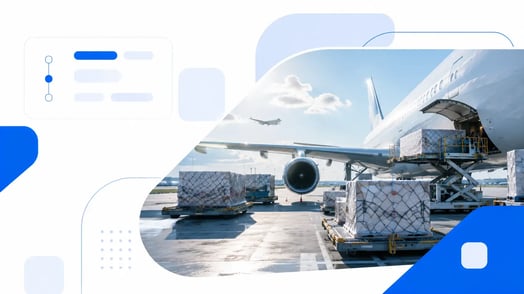
Air freight refers to the transportation of goods by aircraft.
It is one of the fastest transportation methods available and is widely used for shipments requiring rapid delivery, high security, or specialized handling.
Air freight plays a critical role in industries such as:
- Pharmaceuticals
- Electronics
- Aerospace
- Automotive
- Luxury goods
- E-commerce
Its ability to move cargo across continents within hours makes it a strategic transportation solution for international supply chains.
As part of broader freight transport operations, air cargo provides unmatched speed for time-sensitive shipments.
Why use air freight?
Companies choose air freight when speed and reliability are more important than transportation costs.
Faster transit times
Air freight offers significantly shorter transit times than ocean, rail, or road transportation.
International shipments that may take weeks by sea can often be delivered within one to three days by air.
High security
Airports operate under strict security procedures and cargo handling protocols.
This reduces the risk of:
- Theft
- Damage
- Loss
Air freight is particularly suitable for high-value and sensitive goods.
Global connectivity
Air cargo networks connect major economic regions worldwide.
This enables companies to reach international markets quickly and efficiently.
Flexible transportation options
Air freight providers offer specialized services adapted to different cargo types and business requirements.
Types of air freight cargo
Different types of products require different handling procedures.
General cargo
General cargo includes most commercial goods that do not require specialized handling.
Examples include:
- Consumer goods
- Industrial products
- Spare parts
- Retail merchandise
Express freight
Express freight prioritizes speed and is often used for urgent shipments.
Temperature-controlled cargo
Products such as pharmaceuticals and perishable goods require controlled temperature conditions throughout transportation.
Dangerous goods
Hazardous materials must comply with strict IATA Dangerous Goods Regulations (DGR).
High-value cargo
Luxury products, electronics, and sensitive equipment often require enhanced security measures.
Types of aircraft used for air freight
Several aircraft categories support air cargo transportation.
Dedicated freighter aircraft
These aircraft are designed exclusively for cargo operations and provide maximum loading capacity.
Medium-capacity freighters
Medium-sized aircraft offer a balance between transportation capacity and operating costs.
Wide-body freighters
Large aircraft are used for transporting substantial cargo volumes on long-haul international routes.
Belly cargo aircraft
Passenger aircraft also transport freight in their lower cargo holds.
This additional capacity plays an important role in global air cargo networks.
Air freight vs other transportation modes
Each transportation mode serves different business needs.
| Mode | Main advantage | Main limitation |
|---|---|---|
| Air freight | Fastest transit times | Higher transportation costs |
| Ocean freight | Lowest cost for large volumes | Longer transit times |
| Road freight | Flexible door-to-door service | Limited international reach |
| Rail freight | Efficient for long distances | Network limitations |
Air freight is typically chosen when speed, security, and reliability outweigh transportation costs.
For larger international shipments where transit times are less critical, sea freight often provides a more economical alternative.
Likewise, rail transport can offer an efficient balance between cost and sustainability for continental freight movements.
How is air freight pricing calculated?
Air freight pricing depends on multiple factors.
Chargeable weight
Airlines calculate freight costs based on the greater of:
- Actual weight
- Volumetric weight
Volumetric weight reflects the space occupied by cargo rather than its actual mass. It is generally calculated as follows:
Volumetric weight (kg) = (Length x Width x Height, in cm) ÷ 6,000
For example, a package measuring 60 cm x 50 cm x 40 cm has a volume of 120,000 cm3. Divided by 6,000, this results in a volumetric weight of 20 kg. If the package's actual weight is only 15 kg, the airline will charge based on the higher figure, 20 kg, since it better reflects the cargo space used.
Transportation distance
Longer routes generally result in higher transportation costs.
Cargo characteristics
Special handling requirements may increase rates.
Examples include:
- Dangerous goods
- Refrigerated products
- Oversized cargo
Fuel surcharges
Fuel costs are frequently added to base transportation rates.
Airport handling charges
Additional fees may apply for cargo processing and terminal handling services.
Organizations often monitor these expenses through structured transportation spend management practices.
Key stakeholders in air freight
Several parties contribute to successful air cargo operations.
Airlines
Airlines operate aircraft and transport cargo between airports.
Freight forwarders
A freight forwarder organizes shipments, manages documentation, and coordinates transportation activities on behalf of the shipper. Air shipments are typically accompanied by an Air Waybill (AWB), the legal document issued by the airline or forwarder that serves as the contract of carriage. Learn more about how the Air Waybill compares to other transport documents such as the CMR used in road freight.
Ground handling agents
Ground handlers manage cargo loading, unloading, and terminal operations.
Customs authorities
Customs agencies ensure compliance with import and export regulations, following international standards set by bodies such as the International Civil Aviation Organization (ICAO).
International shipments frequently require coordination with a Customs Broker to facilitate customs clearance procedures.
Integrators
Companies such as DHL, FedEx, and UPS provide end-to-end express transportation services.
Challenges of air freight
Despite its advantages, air freight presents several challenges.
Higher costs
Air freight remains one of the most expensive transportation modes.
Capacity constraints
Available cargo capacity can fluctuate due to market conditions.
Environmental impact
Air transportation generates higher emissions per tonne transported than ocean or rail freight.
For this reason, many companies carefully balance speed requirements against sustainability objectives as part of broader supply chain optimization strategies.
Why use a TMS for air freight management?
Managing air freight requires coordination between multiple stakeholders, documents, and transportation providers.
A Transportation Management System simplifies this process.
Carrier management
Compare airlines, freight forwarders, and transportation rates from a single platform.
Document centralization
Store and manage shipment documentation in one place.
Real-time visibility
Track shipments throughout the transportation process.
Cost control
Analyze transportation spending and identify optimization opportunities.
Performance monitoring
Measure carrier performance and delivery reliability through dedicated dashboards using relevant supply chain KPIs.
Modern transportation management system features help automate carrier selection, shipment monitoring, and transportation analytics.
Why use Shiptify for air freight operations?
Shiptify helps logistics teams manage air freight through a centralized transportation platform.
Centralized transportation management
Manage all transportation activities through a single interface.
Document management
The Doc Center centralizes transportation documentation and improves accessibility.
Shipment visibility
Track shipments in real time and receive proactive notifications.
Quotation and booking management
Request quotations, compare offers, and book transportation services efficiently.
Operational efficiency
Automate transportation workflows and improve collaboration with logistics partners.
As a collaborative freight management system, Shiptify enables organizations to streamline international transportation processes and improve visibility.
Advanced TMS software capabilities further simplify procurement, execution, and performance management.
Conclusion
Air freight remains one of the most effective transportation solutions for companies requiring speed, security, and global reach.
Although transportation costs are generally higher than alternative modes, air freight provides unmatched responsiveness and reliability for critical supply chain operations.
By combining air freight services with a Transportation Management System such as Shiptify, companies can improve visibility, optimize costs, and manage international shipments more efficiently.