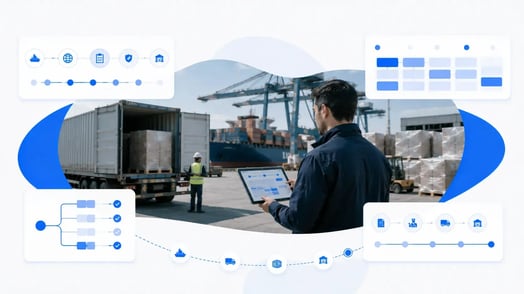
International trade continues to grow as supply chains become increasingly global. However, moving goods across borders involves more than transportation alone. Companies must also comply with customs regulations to ensure their shipments can legally enter or leave a country.
This process is known as customs clearance.
While customs clearance is often perceived as complex, it plays a critical role in international trade. Efficient customs management helps companies avoid delays, reduce costs, maintain compliance, and improve supply chain performance.
In this guide, we'll explain how customs clearance works, the different procedures involved, the key stakeholders, how long the process takes, what it costs, and how digital tools can simplify customs operations.
What is customs clearance?
Customs clearance is the process of obtaining authorization from customs authorities to import or export goods across international borders.
It involves several administrative and regulatory procedures designed to ensure that goods comply with applicable laws and trade regulations.
The customs clearance process typically includes:
- submitting customs declarations;
- providing supporting documentation;
- calculating duties and taxes;
- complying with customs inspections and controls.
Only after these requirements have been fulfilled can goods be released for import or export.
Two elements are central to this process: tariff classification and customs valuation. Every product must be assigned a Harmonized System (HS) code, an internationally standardized classification maintained by the World Customs Organization, which determines the applicable duty rate. The declared customs value, generally based on the transaction price of the goods, is then used to calculate the duties and taxes owed.
Companies involved in international freight transport must integrate customs procedures into their overall logistics strategy.
Why is customs clearance important?
Customs clearance has a direct impact on transportation performance, costs, and customer satisfaction.
Proper customs management helps companies:
Ensure on-time deliveries
Efficient customs procedures reduce border delays and help maintain delivery schedules.
Control costs
Accurate customs declarations help prevent penalties, unexpected fees, and shipment delays.
Maintain compliance
Compliance with customs regulations protects companies from legal risks and reputational damage.
Improve supply chain performance
Faster customs processing contributes to smoother international logistics operations and broader supply chain optimization initiatives.
Import customs clearance process
When importing goods, companies must complete several mandatory steps.
Customs declaration
Importers must provide detailed information regarding:
- product description;
- customs classification;
- country of origin;
- customs value.
Supporting documentation
Required documents may include:
- commercial invoices;
- packing lists;
- certificates of origin;
- health or phytosanitary certificates;
- EUR.1 certificates when applicable.
Businesses trading with the European Union may also need to register for an EORI (Economic Operators Registration and Identification) number, which is required to complete customs declarations within the EU.
Payment of duties and taxes
Customs authorities calculate duties and taxes based on the declared customs value of the goods.
Customs inspections
Some shipments may be selected for documentary or physical inspection before release. In the United States, for example, all inbound shipments are subject to review by U.S. Customs and Border Protection, which verifies documentation and may conduct physical inspections when necessary.
Export customs clearance process
Export procedures differ from import requirements but remain equally important.
Export declaration
Companies must declare exported goods and provide detailed shipment information.
Regulatory compliance
Certain products may be subject to export restrictions or additional regulatory requirements.
Export licenses and permits
Specific goods, such as dual-use technologies or controlled products, may require export authorizations before shipment.
How long does customs clearance take?
Customs clearance times vary significantly depending on several factors. In most cases, shipments with complete and accurate documentation clear within a few hours to one or two business days. However, several elements can extend this timeline:
- Completeness of documentation: missing or inaccurate paperwork is the most common cause of delay.
- Customs inspections: shipments selected for documentary or physical inspection require additional processing time.
- Destination country and regime: customs procedures and average processing times vary widely between countries.
- Product classification and licensing: goods requiring specific permits, certificates, or licenses often take longer to clear.
- Peak season volumes: high shipment volumes at major ports of entry can slow down processing, regardless of documentation quality.
Working with an experienced customs broker and ensuring documentation is submitted in advance are among the most effective ways to reduce clearance times.
How much does customs clearance cost?
The total cost of customs clearance depends on the type of goods, their origin, and the destination country's tariff schedule. It generally includes several distinct components:
- Customs duties: taxes calculated on the declared customs value of the goods, based on their HS code and country of origin. Preferential trade agreements can reduce or eliminate duties for eligible products.
- Value-added tax (VAT) or sales tax: many countries apply VAT or an equivalent consumption tax on imported goods, in addition to customs duties.
- Customs clearance fees: administrative fees charged by customs authorities or brokers for processing declarations and documentation.
- Broker fees: service fees charged by customs brokers for preparing declarations and managing the clearance process on behalf of importers or exporters.
- Storage and demurrage charges: if a shipment is delayed at the border or port, additional storage or demurrage fees may apply for each day the goods remain uncollected.
Accurately anticipating these costs during freight quoting and budgeting helps companies avoid unexpected charges and maintain healthier margins on international shipments.
Simplified customs procedures
Organizations involved in significant international trade volumes may qualify for simplified customs procedures.
Centralized customs clearance
This procedure allows customs formalities to be managed through a single customs office, even when goods move through multiple locations.
Customs clearance at the company's premises
Certain authorized companies can complete parts of the customs process directly from their facilities, reducing administrative complexity and accelerating operations.
These procedures can significantly improve efficiency when supported by robust processes and digital tools.
Key stakeholders in customs clearance
Several parties are involved in the customs clearance process.
Importers and exporters
Importers and exporters are responsible for providing accurate information and ensuring compliance with customs regulations.
Errors in customs declarations can result in delays, penalties, and additional costs.
Customs brokers
Customs brokers act as intermediaries between businesses and customs authorities.
Their expertise helps companies:
- prepare customs documentation;
- comply with regulations;
- reduce administrative errors;
- accelerate customs procedures.
For organizations managing complex international operations, customs brokers often provide valuable operational support.
Customs authorities
Customs authorities verify declarations, collect duties and taxes, and enforce trade regulations.
They play a critical role in protecting national interests and ensuring fair international trade practices.
Common customs clearance challenges
Managing customs operations manually often creates operational difficulties.
Regulatory complexity
Customs regulations vary significantly across countries and jurisdictions, and trade agreements are updated frequently. Companies must continuously monitor evolving requirements to avoid non-compliance and unexpected costs.
Documentation management
International shipments often require multiple supporting documents, sometimes issued by different parties across the supply chain. Missing or inaccurate information can delay customs processing and, in some cases, lead to penalties. For road freight movements, transport documents such as the CMR consignment note remain essential for compliance and traceability.
Limited visibility
Without centralized systems, tracking the progress of customs formalities across multiple shipments and carriers can be difficult, making it harder to anticipate and communicate delays to customers.
Risk of human error
Manual processes increase the likelihood of mistakes in declarations, classifications, and documentation, which are among the leading causes of customs clearance delays and penalties.
Processing delays
Traditional communication methods, such as email and phone calls between carriers, brokers, and customs offices, can slow down information exchange between stakeholders and extend overall clearance times.
How digitalization improves customs clearance
Digital tools help companies manage customs procedures more efficiently and accurately.
By automating repetitive tasks and centralizing information, businesses can improve both compliance and operational performance.
Benefits include:
- faster processing times;
- improved data accuracy;
- reduced administrative workload;
- better shipment visibility;
- stronger compliance management.
Electronic data interchange (EDI) and API connections between carriers, brokers, and customs systems also reduce the need for manual data re-entry, which is one of the most frequent sources of declaration errors.
Organizations can also improve visibility across international shipments involving container transport operations.
How a TMS supports customs clearance
A Transportation Management System (TMS) can play an important role in simplifying customs operations.
Centralized document management
All customs-related documents can be stored and accessed from a single platform.
This includes:
- customs declarations;
- invoices;
- certificates;
- transport documents.
Process automation
Automated workflows reduce manual work and improve data consistency.
Advanced transportation management system features further improve document management and operational efficiency.
Real-time visibility
Logistics teams can monitor customs status alongside transportation operations.
This improves planning and helps anticipate potential delays.
Improved collaboration
A TMS connects all stakeholders involved in international transportation, including:
- carriers;
- customs brokers;
- importers;
- exporters.
Centralized communication reduces complexity and improves responsiveness.
Organizations often rely on dedicated TMS software to centralize transportation and customs-related activities.
Why use Shiptify for customs-related transportation management?
Shiptify helps companies manage international transportation flows through a centralized digital platform, connecting transportation execution with the documentation and visibility needed to support customs compliance.
Transportation visibility
Monitor shipments and customs-related activities from a single interface.
Automated document management
Centralize transportation and customs documents to improve accessibility and compliance.
Improved collaboration
Connect carriers, logistics teams, customs partners, and customers within a shared environment.
Operational efficiency
Reduce manual processes and improve coordination across international supply chains.
As a comprehensive freight management system, Shiptify helps organizations streamline transportation execution and customs-related workflows.
Conclusion
Customs clearance is far more than an administrative requirement. It is a strategic process that directly affects transportation performance, compliance, and supply chain efficiency.
Companies that digitize customs-related workflows can reduce delays, improve visibility, strengthen compliance, and lower operational costs.
Monitoring relevant supply chain KPIs also helps organizations continuously improve customs and transportation performance.
With a Transportation Management System such as Shiptify, customs clearance becomes easier to manage, enabling organizations to build more efficient and resilient international supply chains.
Simplify customs clearance and international transportation with Shiptify
Discover how Shiptify helps logistics teams centralize transportation data, improve shipment visibility, and streamline customs-related processes through a single collaborative platform.