
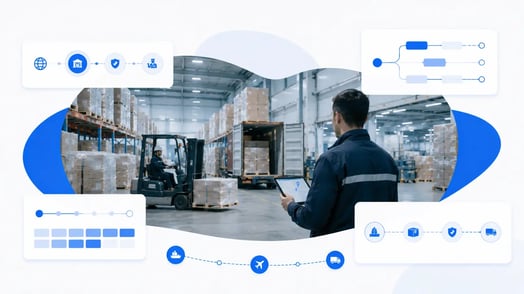
Managing customs duties, VAT payments, and international trade compliance can be challenging for companies importing goods from outside the European Union or the United Kingdom.
A customs warehouse, also known as a bonded warehouse, offers a practical solution.
This customs procedure allows businesses to store imported goods without immediately paying customs duties or import VAT, helping improve cash flow and increase supply chain flexibility.
In this guide, we'll explain how customs warehouses work, their benefits, the different types available, and how digital tools can simplify customs warehouse management.
What is a customs warehouse?
A customs warehouse (or bonded warehouse) is a storage facility authorized by customs authorities where goods can be stored under customs supervision, with customs duties and import VAT suspended for as long as the goods remain under this procedure.
Companies only pay duties and taxes when goods are released into free circulation. If the goods are re-exported instead, customs duties may never become payable at all.
Customs warehouses often play a key role in broader supply chain optimization strategies by improving inventory flexibility and reducing financial pressure on import operations.
A note on EU and UK rules
Within the European Union, customs warehousing is governed by the European Union Customs Code (UCC), which applies uniformly across all member states.
Since Brexit, the United Kingdom operates its own customs warehousing regime, administered by HM Revenue & Customs (HMRC). While the UK framework was originally derived from the EU UCC and remains structurally similar, it is a separate legal system with its own authorisation process. Businesses trading in both markets should treat EU and UK customs warehousing as two distinct authorisations, even though the underlying logic, duty and VAT suspension, is the same. Full details of the UK process are available directly from HMRC's official guidance on operating a customs warehouse.
Customs warehousing vs temporary storage
Customs warehousing is sometimes confused with temporary storage facilities.
- Temporary storage allows goods to be held for a strictly limited period (typically a few weeks) immediately after arrival, while awaiting a customs declaration.
- Customs warehousing allows goods to be stored for an unlimited period under a formal authorisation, with duties and VAT suspended for as long as needed.
This distinction matters because it directly affects how long a company can hold non-cleared goods before deciding whether to release them into the market or re-export them.
Why use a customs warehouse?
Customs warehousing provides both financial and operational benefits.
Improve cash flow
One of the main advantages is the suspension of customs duties and import VAT. Instead of paying duties when goods arrive, companies can defer payment until products are sold or released into the market, reducing working capital requirements.
Increase supply chain flexibility
Customs warehouses allow businesses to store products while waiting for:
- customer orders;
- final destination decisions;
- market opportunities;
- re-export arrangements.
This flexibility is particularly valuable in volatile international markets. For example, goods imported into a bonded UK warehouse can later be re-exported to the EU, or vice versa, without incurring the "double duty" that would apply if the goods had already been released into free circulation.
Simplify international trade operations
Customs warehousing helps companies manage international flows more efficiently while remaining compliant with customs regulations. Working with a qualified customs broker can further simplify customs procedures and compliance requirements.
Support global distribution strategies
Companies can use customs warehouses as regional distribution hubs, storing imported products before shipping them to different destinations. This approach is particularly relevant for organisations handling large volumes of container transport across international markets.
How does customs warehousing work?
Goods can be stored under customs supervision for an unlimited period, provided all regulatory requirements are respected. There are generally two possible outcomes.
Release into free circulation
When products are sold within the domestic market, customs duties and VAT become payable, and the goods enter the market under normal customs conditions.
Re-exportation
If goods are exported to another country without being released into free circulation, customs duties and import VAT may not be payable at all. This can generate significant financial savings for companies involved in international trade.
Many businesses rely on international freight transport networks to distribute these goods efficiently across multiple markets.
Customs warehouse vs conventional warehouse
Although both facilities store goods, their purpose and regulatory framework differ significantly.
- Customs duties and VAT: payable upon import in a conventional warehouse; suspended while goods remain under customs control in a customs warehouse.
- Customs supervision: none for a conventional warehouse; mandatory for a customs warehouse.
- Customs records: standard inventory records for a conventional warehouse; mandatory customs records for a customs warehouse.
- Eligible goods: all legal goods in a conventional warehouse; primarily non-cleared goods under customs procedures in a customs warehouse.
- Compliance requirements: standard for a conventional warehouse; enhanced customs compliance obligations for a customs warehouse.
The additional administrative requirements associated with customs warehousing are generally offset by the financial and operational benefits. Companies managing large inventories often rely on specialised warehouse management software to maintain visibility and compliance.
The different types of customs warehouses
Companies can choose between two main types of customs warehouses.
Public customs warehouse
A public customs warehouse is operated by a third party and can be used by multiple companies. This option is often suitable for businesses with lower import volumes, occasional customs storage needs, or limited customs expertise.
Private customs warehouse
A private customs warehouse is operated for the exclusive use of a single company. This model is often preferred by organisations with significant import volumes, complex international operations, or specific compliance requirements.
The choice depends on import volumes, operational complexity, and long-term supply chain strategy.
Requirements for operating under the customs warehousing procedure
Before using a customs warehouse, companies must meet several regulatory requirements.
Customs authorisation
The warehouse and its operator must obtain the necessary customs authorisations from the relevant customs authority, whether that is a national customs administration within the EU or HMRC in the UK.
Customs record keeping
Companies must maintain accurate records of incoming goods, outgoing goods, stock movements, and customs status. Digital record management is often facilitated through integrated ERP and WMS systems.
Financial guarantees
Customs authorities may require financial guarantees to cover potential customs liabilities, particularly for public warehouses handling goods on behalf of multiple depositors.
Electronic customs declarations
All customs declarations must be submitted through approved customs systems and procedures. Maintaining accurate documentation and traceability is essential for compliance. For road transport operations within Europe, documents such as the CMR consignment note remain essential components of transportation documentation.
How technology improves customs warehouse management
Managing customs warehouse operations manually can quickly become complex.
Digital tools help companies improve visibility, automate workflows, and reduce administrative workload. Benefits include:
- real-time inventory visibility;
- customs documentation management;
- shipment tracking;
- audit readiness;
- improved compliance monitoring.
By digitising customs processes, companies reduce the risk of errors and improve operational efficiency. Modern WMS software can significantly improve inventory accuracy and warehouse productivity.
How Shiptify supports customs warehouse operations
Shiptify helps companies manage international transportation flows while maintaining visibility across their supply chain.
Transportation management
The platform centralises transport planning, carrier management, and shipment execution across all transportation modes through a Transportation Management System.
Real-time visibility
Users can monitor imports, exports, and transportation status through a single interface.
Automated document management
Transportation and customs-related documents can be centralised and shared across teams and logistics partners.
Organisations can further improve efficiency using advanced transportation management system features such as centralised documentation and workflow automation.
Dock scheduling and warehouse coordination
Through Shiptidock, companies can optimise inbound and outbound flows, reducing waiting times and improving warehouse efficiency. Efficient inbound logistics planning is particularly important when coordinating customs-controlled goods entering storage facilities.
Conclusion
A customs warehouse is much more than a storage solution. It is a strategic customs tool that helps businesses improve cash flow, increase flexibility, and optimise international trade operations, whether they operate under EU or UK customs rules.
By combining customs warehousing with digital transportation management solutions such as Shiptify, organisations can improve visibility, strengthen compliance, and streamline their import and export processes.