
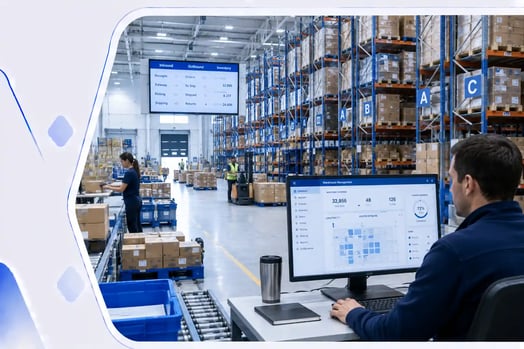
Efficient warehouse operations are critical to modern supply chains.
As customer expectations continue to rise and order volumes increase, businesses need greater visibility, accuracy, and control over their inventory and warehouse processes.
This is where a Warehouse Management System (WMS) becomes essential.
A WMS helps organizations optimize inventory management, streamline warehouse operations, improve order fulfillment, and reduce logistics costs.
In this guide, we'll explain what a Warehouse Management System is, how it works, its key benefits, and how to choose the right solution for your business.
What is a warehouse management system (WMS)?
A Warehouse Management System (WMS) is software designed to manage and optimize warehouse operations from inbound receiving to outbound shipping.
The platform provides real-time visibility into inventory, warehouse activities, and logistics processes, helping companies improve productivity while maintaining inventory accuracy.
A modern WMS supports:
- Goods receiving
- Inventory management
- Storage optimization
- Order picking
- Packing operations
- Shipping management
- Returns processing
- Performance reporting
By centralizing warehouse data, organizations gain complete control over inventory and operational workflows. Companies evaluating warehouse solutions often start by comparing different types of WMS software.
Why is a WMS important?
Warehouse operations have become increasingly complex.
Businesses must manage:
- Higher SKU counts
- Faster delivery expectations
- Omnichannel fulfillment
- Labor shortages
- Rising operational costs
Without a dedicated warehouse management solution, organizations often struggle with:
- Inventory inaccuracies
- Stockouts
- Excess inventory
- Picking errors
- Inefficient warehouse layouts
- Delayed shipments
A WMS helps solve these challenges by providing structure, automation, and visibility across warehouse operations while supporting broader supply chain optimization initiatives.
Key features of a Warehouse Management System
Real-time inventory management
One of the most valuable features of a WMS is real-time inventory visibility.
Warehouse teams can instantly access information about:
- Inventory levels
- Product locations
- Stock movements
- Available quantities
This significantly reduces search times and improves inventory accuracy.
Receiving and putaway optimization
A WMS automates inbound logistics processes.
When goods arrive at the warehouse, the system:
- Records inventory automatically
- Validates incoming shipments
- Assigns optimal storage locations
- Updates stock levels in real time
This improves receiving efficiency and reduces handling time.
Order picking optimization
Picking operations often represent the largest labor cost within a warehouse.
A WMS optimizes picking routes and workflows by:
- Reducing travel distances
- Prioritizing orders
- Supporting batch picking
- Improving picking accuracy
The result is faster order fulfillment and increased productivity.
Shipping and returns management
Modern warehouse management software tracks outbound shipments and returns throughout the fulfillment process.
Benefits include:
- Improved traceability
- Faster returns processing
- Better customer service
- Reduced shipping errors
Shipment visibility can also be enhanced through dedicated shipment tracking capabilities.
Analytics and reporting
A WMS provides dashboards and reporting tools that help managers monitor:
- Inventory turnover
- Picking performance
- Order accuracy
- Warehouse productivity
- Labor efficiency
Many companies centralize these metrics through a dedicated supply chain dashboard.
Benefits of a Warehouse Management System
Improved operational efficiency
By automating manual tasks and reducing process complexity, a WMS significantly improves warehouse performance.
Organizations frequently report:
- Faster receiving times
- Higher picking productivity
- Improved order accuracy
- Reduced administrative workload
Better inventory visibility
Real-time inventory tracking enables warehouse managers to make better decisions regarding replenishment and stock allocation.
Improved visibility reduces both stockouts and overstock situations.
Lower operating costs
Warehouse management systems help reduce costs by:
- Optimizing labor utilization
- Improving space usage
- Reducing inventory carrying costs
- Minimizing errors and returns
Many organizations leverage these improvements as part of broader initiatives to reduce supply chain costs.
Improved customer satisfaction
Faster and more accurate order fulfillment directly impacts customer experience.
Benefits include:
- Shorter delivery times
- Higher order accuracy
- Better product availability
- Improved service levels
Scalability
Modern cloud-based WMS solutions can easily scale alongside business growth.
Companies can increase warehouse capacity and order volumes without completely redesigning operational processes.
Key trends shaping the WMS market
Greater supply chain integration
Organizations increasingly seek seamless integration between:
- ERP systems
- Transportation Management Systems (TMS)
- Order Management Systems (OMS)
- Warehouse Management Systems (WMS)
Companies evaluating these integrations often compare the differences between ERP and WMS platforms.
Many organizations also connect their WMS to a Transportation Management System to synchronize inventory and transportation operations.
Artificial intelligence and machine learning
AI-driven warehouse management systems are increasingly capable of:
- Predicting demand
- Optimizing storage locations
- Improving labor planning
- Reducing inventory costs
Performance improvements are often measured using dedicated supply chain KPIs.
Why combine a WMS with dock scheduling software?
Even the most advanced warehouse management system cannot fully optimize operations if inbound and outbound transportation remains unmanaged.
Warehouse congestion, carrier waiting times, and inefficient dock utilization can significantly impact performance.
This is where dock appointment scheduling software becomes valuable.
Organizations managing large volumes of trucks also benefit from better visibility at the loading dock, where congestion often creates bottlenecks.
For larger logistics facilities, integrating a Yard Management System (YMS) helps coordinate trailer movements and improve yard visibility.
Why use ShiptiDock?
ShiptiDock helps companies optimize warehouse appointments and dock scheduling.
The solution enables organizations to:
- Schedule carrier appointments online
- Reduce dock congestion
- Improve carrier communication
- Increase warehouse visibility
- Reduce waiting times
- Improve warehouse productivity
Companies seeking a dedicated solution can learn more about ShiptiDock.
Key benefits of ShiptiDock
Simplified appointment scheduling
Carriers can reserve dock slots directly through a collaborative platform.
Improved visibility
Warehouse managers gain complete visibility over:
- Upcoming appointments
- Available dock capacity
- Carrier arrivals
- Operational workloads
Reduced waiting times
Better planning reduces congestion and improves carrier satisfaction.
Seamless WMS and TMS integration
ShiptiDock integrates with warehouse systems and TMS software, creating a fully connected logistics ecosystem.
Organizations can further enhance transportation efficiency by leveraging advanced transportation management system features.
Conclusion
A Warehouse Management System has become a critical component of modern supply chains.
By improving inventory visibility, warehouse productivity, and operational efficiency, WMS software enables businesses to reduce costs while improving customer satisfaction.
However, warehouse optimization does not stop at inventory management.
By combining a WMS with a dock scheduling solution such as ShiptiDock, organizations can further improve warehouse performance, reduce congestion, and create a more efficient flow of goods across the entire supply chain.
For companies seeking to modernize warehouse operations in 2026 and beyond, investing in the right WMS is no longer optional it is a strategic necessity.