A truck sitting at the gate isn't moving freight, it's accumulating detention charges, backing up the yard, and pushing every appointment behind it later in the day. A slow or chaotic warehouse gate check-in process creates a bottleneck before a truck even reaches the dock. This guide walks through how gate check-in actually works, what it costs when it breaks down, and how to fix it, whether you're running a single distribution center or a network of sites.
What is a warehouse gate check-in process?
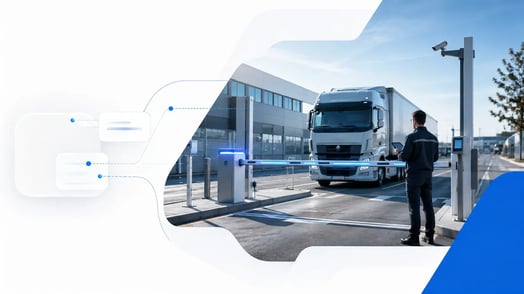
A warehouse gate check-in process is the sequence of steps a truck and driver go through when arriving at a warehouse or distribution center: verifying the appointment, checking driver and vehicle identification, confirming the required documentation, and assigning a yard position or dock door before access is granted. It is the first control point in a facility's operations, and it sets the pace for everything that follows: dock assignment, unloading time, and how quickly the truck can leave again.
Whether this warehouse gate check-in process takes two minutes or twenty depends almost entirely on how much of it is planned in advance versus handled reactively at the gate itself. A facility that verifies appointments and documentation before a truck even arrives moves vehicles through quickly. One that performs these tasks manually, on the spot, inevitably creates queues.
How does a gate check-in process work, step by step?
While the specifics vary by facility, most warehouse gate check-in processes follow the same underlying sequence:
- Verify: confirm the driver has a valid appointment for the expected time window.
- Identify: check driver identification and vehicle or trailer details against the booking.
- Inspect: review required documentation, such as bills of lading, permits, and safety certifications.
- Assign: direct the vehicle to a yard position or dock door based on current availability.
- Notify: alert the relevant dock team that the vehicle has arrived and is on its way.
- Log: record the arrival time, checked documents, and any exceptions for later reporting.
Pre-arrival appointment verification
Before a driver even reaches the gate, staff or an automated system confirm that the booking exists, matches the expected carrier and load, and falls within the scheduled arrival window. This single step separates facilities with smooth gate operations from those dealing with constant unscheduled arrivals. A truck that arrives without a matching appointment will almost always delay other scheduled movements.
Using dock appointment scheduling helps eliminate these preventable disruptions before the vehicle even reaches the facility.
Driver and vehicle identification
Gate staff verify the driver's identity and confirm that the vehicle and trailer match the booking information. This step is as important for security as it is for operational accuracy. It prevents unauthorised vehicles from entering a secured site and allows safety-sensitive facilities to perform additional credential checks where required.
For highly regulated sites, this process is often integrated with warehouse safety procedures to improve both compliance and site security.
Documentation and safety checks
Required paperwork, such as bills of lading, customs documents, hazardous materials certifications, or safety compliance records, is reviewed before the vehicle proceeds into the facility. Missing or incorrect documentation at this stage is one of the most common causes of gate delays because it usually requires manual correction or additional communication before the truck can continue.
Companies operating under U.S. transport regulations should also ensure compliance with DOT compliance requirements where applicable.
Yard or dock assignment
Once verification is complete, the vehicle is directed to a designated yard position or dock door. Facilities with real-time visibility into dock availability can make this assignment immediately, whereas those relying on manual processes, such as whiteboards or radio communication, often introduce unnecessary delays even after all previous checks have been completed.
Modern loading dock management software enables warehouse teams to assign docks dynamically while reducing congestion and improving vehicle flow.
Why gate check-in matters for warehouse and dock operations
The gate is the first operational control point in a warehouse, and delays during the warehouse gate check-in process affect every activity that follows. A truck delayed at the gate for thirty additional minutes does not simply lose time itself, it postpones dock allocation, delays subsequent appointments, and creates congestion that can continue throughout the day.
Beyond operational efficiency, gate check-in is also one of a facility's primary security controls. It is where unauthorised vehicles are prevented from entering the site, hazardous materials documentation is verified before becoming a compliance issue, and a complete digital record of every arrival is created for audits or incident investigations.
Finally, warehouse gate check-in data provides valuable operational insight. Without reliable records of actual waiting times and delay causes, it becomes difficult to determine whether congestion results from poor appointment scheduling, insufficient staffing, documentation issues, or inefficient yard layouts. Facilities that consistently monitor warehouse KPIs are better equipped to identify the true source of delays and implement targeted improvements.
Common gate check-in problems (and what they cost you)
A handful of recurring issues account for most warehouse gate check-in delays:
Unscheduled arrivals. A truck arriving without a matching appointment forces gate staff either to turn it away or fit it into an already full schedule, delaying every appointment that follows. Implementing dock appointment scheduling significantly reduces these disruptions.
Manual paperwork verification. Reviewing physical documents manually takes longer, is more error-prone, and creates no searchable record for future audits or dispute resolution. Digital EDI logistics solutions can automate document exchanges before the truck even arrives.
Unclear yard or dock assignment. Without real-time visibility into occupied and available dock doors, gate staff often rely on radio calls or manual coordination, adding unnecessary minutes to every arrival. A dedicated Yard Management System (YMS) improves coordination between the gate and the warehouse.
Overlapping appointment windows. Scheduling too many carriers within the same time slot creates congestion before the first truck even reaches the gate.
The financial impact is immediate. Once a truck exceeds its free waiting period, typically one to two hours after arrival, detention charges generally range between $50 and $100 per hour. Warehouses handling hundreds of vehicles every month can accumulate thousands of dollars in avoidable detention costs purely because of inefficient gate operations.
Manual vs digital gate check-in: What's the difference?
The main difference between manual and digital warehouse gate check-in lies in when the verification work takes place.
A digital process shifts most administrative tasks upstream, before the truck arrives, dramatically reducing processing time at the gate.
| Step | Manual process | Digital process |
|---|---|---|
| Appointment verification | Phone calls, paper logs, or radio confirmation | Automatic validation against an online booking platform |
| Driver and vehicle identification | Manual visual verification | Instant verification through scanned or digital credentials |
| Documentation | Paper documents reviewed on arrival | Documents uploaded and validated before arrival |
| Dock or yard assignment | Manual coordination by phone or radio | Automatic assignment using real-time yard visibility |
| Record keeping | Paper logs | Digital records available instantly for reporting and audits |
Digital warehouse gate check-in does not eliminate every source of delay, but it removes the two most common bottlenecks:
- manual document verification;
- manual dock allocation.
As vehicle volumes increase, these two activities become increasingly difficult to manage efficiently without automation.
Key features of a modern gate check-in system
When evaluating a warehouse gate check-in solution, prioritise features that directly reduce waiting times while improving operational control.
A modern solution should include:
- Integrated appointment scheduling, ensuring gate operations and dock planning remain synchronised.
- Automated driver and vehicle identification, reducing manual verification.
- Digital document management, allowing paperwork to be completed before arrival.
- Real-time yard visibility, enabling immediate dock assignment.
- Automatic notifications to warehouse teams as soon as a truck enters the site.
- Operational reporting, including waiting times, exceptions, and recurring bottlenecks.
These capabilities become even more valuable when combined with a warehouse management system to coordinate warehouse operations beyond the gate.
How to implement a digital gate check-in process
Transitioning from a manual process to a digital gate check-in solution is usually most successful when deployed progressively.
A typical implementation follows these steps:
- Map the current process to identify where delays actually occur.
- Select a platform that combines appointment scheduling, gate verification, and dock management.
- Launch a pilot project on selected docks or with a limited number of carriers.
- Train warehouse staff and transport partners to ensure consistent adoption.
- Measure waiting times before and after deployment to quantify improvements using relevant warehouse KPIs.
- Expand progressively to additional docks, shifts, or warehouse sites once measurable benefits have been demonstrated.
Digital transformation should simplify warehouse operations rather than replacing existing bottlenecks with new ones. Careful implementation and continuous monitoring remain essential to long-term success.
Streamlining gate check-in and dock scheduling with ShiptiDock
A truck waiting an extra hour at the gate generates the same detention costs whether the delay occurs during check-in or while waiting for a dock. This is why gate check-in and dock scheduling should be managed as one continuous process, not as two separate workflows.
Too often, appointment scheduling, gate verification, and dock allocation are handled by different teams using disconnected tools. The result is unnecessary manual handoffs, duplicated work, and avoidable delays.
ShiptiDock was designed to eliminate these inefficiencies by connecting every step of the arrival process.
Its online appointment portal allows carriers to reserve arrival slots in advance, significantly reducing unscheduled arrivals, one of the leading causes of gate congestion. The platform also automates driver identification and credential verification, improving both security and processing speed.
Because appointment scheduling and dock planning operate within the same platform, a verified truck can immediately be assigned to an available yard position or dock door without relying on radio calls, spreadsheets, or whiteboards. Combined with loading dock management software, warehouse teams gain complete visibility over dock occupancy and vehicle movements.
Supplier performance data is also captured automatically, transforming gate activity into measurable operational KPIs rather than isolated administrative records.
Pairing ShiptiDock with Shiptify TMS extends visibility even further upstream. Real-time transportation visibility provides accurate ETAs before trucks even reach the facility, allowing warehouse teams to anticipate arrivals, prepare dock resources, and minimise idle time.
The control tower connects the original transport order to gate check-in and dock assignment in one continuous workflow, while Transportation Management System capabilities centralise transport execution, dock planning, and performance reporting across every shipment.
The result is a continuous operational flow from transport planning to gate check-in, dock assignment, unloading, and departure, all managed through a single platform.
Still managing truck arrivals with paper logs and phone calls? Discover how digital gate check-in and dock scheduling reduce waiting times, detention charges, and administrative workload.