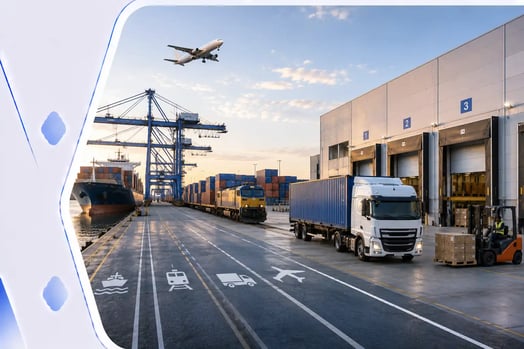
How to choose the best mode of transport for your goods? In 2022, 338 billion tonne-kilometres of goods were transported in mainland France, with road transport dominating. Heavy goods vehicles accounted for 296.2 billion tonne-kilometres, while rail transport, down slightly by 1.4%, totalled 35.3 billion tonne-kilometres1. These figures illustrate the challenges and opportunities facing logistics managers. Choosing the right mode of transport is essential to optimize costs, reduce lead times, maintain service quality and reduce carbon footprints.
What are the different modes of transport?
According to a recent study2, transport choices still differ from one sector to another. Conventional rail is preferred in agriculture and construction materials, while combined transport is used for consumer goods and the transport of chemical products. Road transport remains the main mode of transport for all sectors.
Road freight: definition, advantages and disadvantages
Road freight refers to the transport of goods by truck. It is the most flexible mode of transport, enabling direct door-to-door delivery. The road freight activity of every vehicle registered in France rose by 2.7% in the first quarter of 2024 (CVS-CJO), continuing the acceleration that began at the end of 2023. A total of 42.0 billion tonne-kilometres were covered, contrasting with the declines reported at the start of 2023.
Advantages of road transport
- Flexibility and accessibility;
- Ideal for short and medium distances;
- Fast for urgent deliveries.
Disadvantages
- High environmental impact ;
- Dependence on traffic conditions;
- High cost for long distances.
Rail freight: decarbonizing the transport sector
Rail freight uses trains to transport goods. It is particularly well suited to long continental routes.
A freight train carries a load equivalent to 40 trucks, emits nine times less CO2 and consumes six times less energy. Given the urgent need to tackle climate change, doubling the modal share of freight transport by 2030 is vital. With this in mind, Jean-Pierre Farandou, Chairman of the SNCF Group, points out that shifting 10% of transport from road to rail could achieve 22% to 33% of France's transport decarbonization targets4.
What are the advantages of rail freight?
- High transport capacity;
- Less polluting than road transport;
- Stable and regular, less affected by weather conditions.
Disadvantages
- Less flexible in terms of destinations;
- Requires specific infrastructure;
- Longer transit times than road transport.
Sea freight: transporting goods over long distances
Sea freight is used to transport goods over long international distances, via oceans and seas. CSR and geopolitical issues, as well as the energy crisis, are now influencing shipping choices. In 2023, strikes and congestion in French ports, as well as rising energy prices, were major issues. 57% of companies changed their choices due to ecological concerns, while 51% reacted to the energycrisis2 . These factors call into question the future attractiveness of French ports, affected by high parking and D&D costs.
Advantages of sea transport
- Huge loading capacity ;
- Very low cost per unit;
- Ideal for bulky, heavy goods.
Disadvantages
- Long transit times;
- Dependence on weather conditions;
- Risk of delays due to port congestion.
Air freight: on the rise in 2024
Air freight is the fastest means of transport, used for high-value or urgent goods. The International Air Transport Association (IATA)5 reports 11.1% growth in air freight demand in tonne-kilometres compared with 2023. Available capacity has also increased by 7.1%. In Europe, demand jumped by 12.7%, with a 34.4% increase for intra-European freight. North American carriers recorded more modest growth of 7%.
What are the advantages of air freight?
- Exceptional speed ;
- Reliable schedules;
- Secure for sensitive goods.
Disadvantages
- Very high cost ;
- Limited loading capacity;
- High environmental impact.
Comparison of different modes of freight transport
|
Criteria |
Road freight |
Rail freight |
Sea freight |
Air freight |
|
Type of goods |
Various |
Heavy and bulky |
Voluminous and heavy |
High value and urgent |
|
Distances to be covered |
Short to medium |
Long |
Very long |
Long |
|
Delivery times |
Short |
Medium |
Long |
Very short |
|
Cost and budget |
Moderate to high |
Moderate |
Low |
Very high |
|
Ecological impact |
High |
Moderate |
Low |
High |
Multimodal: the combined alternative
By combining road, rail, sea and air freight, multimodal transport leverages the benefits of each mode to deliver smoother, more sustainable logistics.
What is multimodal transport?
Multimodal transport combines several means of transport for a single shipment. For example, a shipment may be transported by truck to a railway station, then by train to a port, and finally by ship to its final destination.
Combined transport: a major asset for logistics
Combined transport stands out for its many benefits, not least its positive impact on the environment and its ability to massify goods flows. This mode of transport facilitates the organization of regular flows and secures the transport of hazardous materials, and thus plays a predominant role in France's freight transport policy.
Please note
The French government is aiming to double the modal share of rail freight and increase river traffic by half by 2030, as set out in the Climate and Resilience Act. This strategy is supported by aid mechanisms to promote modal shift and develop combined transport, in line with European sustainability ambitions.
Its benefits
Multimodal transport has many advantages and brings real agility to freight transport. Here are just a few:
- Optimization of costs and lead times by selecting the most appropriate mode of transport for each leg of the journey;
- Reduced carbon footprint thanks to the combination of more environmentally-friendly modes of transport;
- Tenfold flexibility thanks to the ability to bypass logistical and geographical obstacles.
Logistical challenges
Nevertheless, certain challenges need to be understood and overcome, as combined transport involves :
- Complex coordination and the need to manage several carriers and their stages;
- Unavoidable tracking and tracing, with the need for advanced solutions to track goods in real time;
- Infrastructures and regulations for each mode of transport that need to be adapted to.
Did you know?
France has some 50 multimodal terminals near major cities and seaports. These terminals are bimodal (rail-road or river-road), trimodal (rail-road-river) or port-based (rail-road-sea and/or river-road-sea). They play a key role in the massification of flows and the energy transition, offering an alternative to exclusive road transport.
What are the current trends in the choice of transport modes?
Current trends reflect a move towards greener solutions, the adoption of innovative technologies and a growing preference for multimodal transport.
The rise of multimodality
With the benefits of multimodal transport, more and more companies are adopting this strategy to optimize their supply chains. In addition, subsidies for the operation of regular combined freight transport services* have been allocated between 2018 and 2022.
These grants aim to reduce the external costs of massive modes (rail, waterway, short sea shipping) compared with road, by compensating for the load break.
These subsidies are granted to combined transport operators for regular services, which encourages transshipment at multimodal terminals. From 2020 to 2022, State support has increased by €20 million, with 29 operators benefiting for 2022 traffic.
Environmental issues: more and more initiatives to reduce our carbon footprint
Companies are seeking to minimize their environmental impact by choosing greener means of transport and optimizing their routes. Numerous initiatives have been introduced, such as :
- The use of electric vehicles;
- Investment in alternative fuel technologies;
- And the implementation of carbon offset programs.
These efforts are part of a global approach to social responsibility and respect for sustainable development objectives.
Innovations and technologies to better manage different modes of transport
Technology plays a vital role in decarbonizing freight, as its many functions improve energy efficiency. The same applies to the development of low-carbon alternative fuels.
However, targets for carbon neutrality by 2050 are ambitious, especially given the expected growth in freight traffic. Even with advanced technologies, a 50% reduction in emissions is possible, but insufficient without moderating demand through sober consumption and the regionalization of logistics chains.
It is in this context that the adoption of technologies such as TMS(Transportation Management Systems) and IoT (Internet of Things) simplifies the management and optimization of different types of transport.
TMS: facilitating different modes of transport
By integrating multiple functionalities, the TMS efficiently manages all aspects of transportation, from planning to execution, including the tracking of each route.
What is a TMS?
A TMS (Transportation Management System) is transportation management software that helps companies plan, execute, optimize and even modify their transport operations.
The Shiptify TMS and its role in choosing your mode of transport
Why choose Shiptify? Here are the advantages of our TMS solution.
- Simple choice of freight mode
Shiptify makes it easy to compare different modes of transport and choose the one best suited to your company's needs. - Multimodal management
Shiptify makes it easy to manage complex supply chains involving several types of transport. Whether it's piggyback or combined road-air transport, the TMS simplifies this particular type of logistics. - Request and compare quotes from carriers
The TMS makes it easy to request quotes and compare carriers' offers, guaranteeing the best value for money. Whether by requesting quotations or through contracts already established with your carriers, transport managers can consciously choose their mode of transport. - Visibility on flows + reactivity to unforeseen events
Shiptify offers continuous visibility of transport flows, enabling immediate reactivity in the event of unforeseen circumstances. In fact, customers receive alerts when unexpected events occur. - Simplified invoicing and document sharing
The software centralizes invoicing and document sharing, simplifying administrative processes. Logisticians have access to all their transport data, including invoices, transport orders, customs documents, etc., for several years.
Choosing the right mode of transport is crucial to optimizing a company's logistics. By understanding the advantages and disadvantages of each mode, and using advanced solutions like Shiptify TMS, you can boost your efficiency, reduce your costs and minimize your carbon footprint.

Sources
- Transport and mobility
- Eurogroup Consulting and AUTF unveil the results of their studies on transport issues
- Road freight transport | Statistical data and studies
- Doubling the modal share of freight by 2030 | SNCF Réseau
- Air freight still growing in the second quarter of 2024 - Stratégies Logistique