International shipping can quickly become complex. Between carrier selection, customs requirements, transport documentation, and shipment tracking, managing cross-border logistics requires significant expertise and coordination.
This is why many companies rely on freight forwarders.
Acting as logistics orchestrators, freight forwarders help businesses manage domestic and international shipments while optimizing costs, transit times, and operational efficiency.
In this guide, we'll explain what a freight forwarder does, how they differ from other logistics intermediaries, and how technology such as a Transportation Management System (TMS) can help companies optimize their transport operations.
What is a freight forwarder?
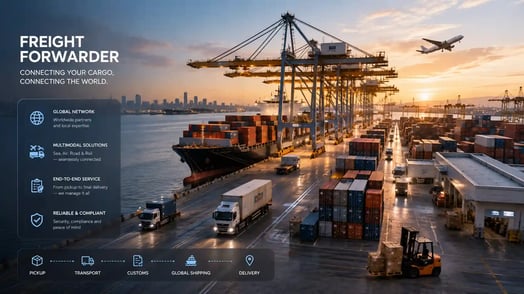
A freight forwarder is a logistics specialist responsible for organizing and coordinating the transportation of goods on behalf of a shipper.
Rather than physically transporting freight themselves, freight forwarders manage the entire shipping process by selecting carriers, coordinating transportation modes, preparing documentation, and ensuring shipments reach their destination efficiently.
They act as a single point of contact between all parties involved in the supply chain, including:
- carriers;
- customs authorities;
- warehouses;
- logistics providers;
- shippers.
Their objective is to simplify transport management while ensuring compliance, visibility, and cost control.
What does a freight forwarder do?
Freight forwarders oversee multiple logistics activities throughout the shipping process.
Their responsibilities typically include:
- selecting carriers and transportation providers;
- negotiating freight rates;
- planning transportation routes;
- organizing multimodal shipments;
- preparing transport documentation;
- coordinating customs clearance;
- monitoring shipment progress;
- managing logistics incidents and delays.
By centralizing these activities, freight forwarders help businesses reduce complexity and improve supply chain optimization initiatives.
Freight forwarder vs carrier: what's the difference?
Although the two roles are closely connected, they serve different purposes.
| Freight forwarder | Carrier |
|---|---|
| Organizes transportation | Physically transports goods |
| Selects transport providers | Operates vehicles, vessels, or aircraft |
| Manages documentation and coordination | Executes transportation services |
| Optimizes routes and costs | Delivers cargo from origin to destination |
| Acts as logistics coordinator | Acts as transport operator |
In short, the carrier moves the freight, while the freight forwarder manages the overall transportation process.
Why use a freight forwarder?
Working with a freight forwarder offers several advantages for companies involved in domestic or international trade.
Access to logistics expertise
Freight forwarders possess extensive knowledge of transportation regulations, customs procedures, and international shipping requirements.
Their expertise helps companies avoid costly mistakes and delays.
Cost optimization
Thanks to established carrier networks and transportation volumes, freight forwarders can often negotiate competitive rates.
This enables businesses to reduce transportation costs while maintaining service quality and improving transportation spend management.
Simplified transport management
Instead of dealing with multiple carriers and service providers, companies benefit from a single logistics partner managing the entire shipment process.
Shipment visibility
Many freight forwarders provide tracking tools that allow businesses to monitor shipments in real time and react quickly to disruptions.
Risk management
In the event of delays, capacity shortages, customs issues, or transport incidents, freight forwarders coordinate alternative solutions to minimize operational impact.
How much does a freight forwarder cost?
Freight forwarder fees vary depending on several factors.
These typically include:
- transportation mode (road, sea, air, or rail);
- shipment volume and weight;
- destination and distance;
- customs requirements;
- storage services;
- cargo insurance;
- urgency of delivery.
Pricing models generally include either:
- a fixed service fee;
- a percentage of transportation costs;
- an all-inclusive logistics package.
Businesses should always request detailed quotations to fully understand the services included.
Freight forwarder responsibilities and legal obligations
Freight forwarders operate within a highly regulated environment and must comply with strict legal requirements.
Their obligations often include:
Regulatory compliance
Ensuring shipments comply with local and international transportation regulations.
Documentation management
Preparing and managing documents such as:
- bills of lading;
- consignment notes;
- customs declarations;
- commercial invoices;
- certificates of origin.
For road transport operations, understanding the CMR meaning is essential.
Liability coverage
Maintaining appropriate professional liability insurance to protect customers against transportation risks.
Customs coordination
Supporting import and export operations while ensuring compliance with customs procedures, often in collaboration with a Customs Broker.
Shipment monitoring
Tracking shipments and coordinating corrective actions when disruptions occur.
How to choose the right freight forwarder
Selecting the right freight forwarding partner can significantly impact supply chain performance.
Key evaluation criteria
Before making a decision, assess the following factors:
✅ Industry experience and expertise
✅ International transportation capabilities
✅ Carrier network quality
✅ Customs knowledge
✅ Digital tools and shipment visibility
✅ Customer service responsiveness
✅ Financial stability
✅ Customer reviews and reputation
Common mistakes to avoid
❌ Selecting providers solely based on price
❌ Lack of shipment visibility
❌ Limited international experience
❌ Poor communication practices
❌ Insufficient insurance coverage
A reliable freight forwarder should combine operational expertise with modern technology and strong customer support.
Freight forwarder or TMS: which option is best?
As transportation becomes increasingly strategic, many companies face an important question:
Should transportation be managed through a freight forwarder or through a Transportation Management System (TMS)?
The answer often depends on shipment volume, internal resources, and logistics maturity.
What is a TMS?
A TMS is software designed to optimize and automate transportation management.
A TMS helps companies:
- compare carrier rates;
- automate transport planning;
- track shipments in real time;
- manage transport documents;
- analyze logistics performance;
- control transportation costs.
Unlike a freight forwarder, a TMS gives businesses direct control over transportation operations.
Organizations increasingly adopt modern TMS software to gain greater visibility and agility.
When should you use a freight forwarder?
A freight forwarder is often the best solution when:
- transportation volumes are limited;
- international shipping expertise is lacking;
- customs procedures are complex;
- companies prefer outsourcing logistics operations.
The freight forwarder provides expertise and operational support without requiring internal logistics resources.
When should you use a TMS?
A TMS becomes particularly valuable when:
- transportation volumes increase;
- multiple carriers are used;
- visibility becomes a priority;
- freight costs require closer control;
- logistics teams want greater operational autonomy.
The TMS centralizes transportation management while improving efficiency and decision-making through advanced transportation management system features.
Why combine a freight forwarder and a TMS?
Many organizations achieve the best results by combining both approaches.
A freight forwarder provides transportation expertise and carrier relationships, while a TMS delivers visibility, automation, and performance management.
Together, they create a more efficient and resilient transportation strategy.
Why use Shiptify?
Shiptify helps companies centralize and optimize transportation management through a collaborative Transportation Management System.
With Shiptify, logistics teams can:
- compare carrier quotations;
- automate transportation workflows;
- monitor shipments in real time;
- centralize transport documentation;
- manage dock scheduling;
- track logistics performance through dedicated dashboards.
Whether you work directly with carriers or collaborate with freight forwarders, Shiptify provides the visibility and control needed to optimize transportation operations.
As a collaborative freight management system, Shiptify connects shippers, carriers, and logistics partners on a single platform.
Conclusion
Freight forwarders play a critical role in modern supply chains by simplifying transportation management, reducing complexity, and ensuring smooth international shipping operations.
However, as transportation networks become increasingly complex, companies also need greater visibility and control over their logistics activities.
By combining freight forwarding expertise with a modern Transportation Management System such as Shiptify, businesses can improve operational efficiency, reduce transportation costs, and build more resilient supply chains.
Optimize your transport operations with Shiptify
Discover how Shiptify helps logistics teams centralize transportation management, improve shipment visibility, and streamline collaboration with carriers and freight forwarders through a single platform.