
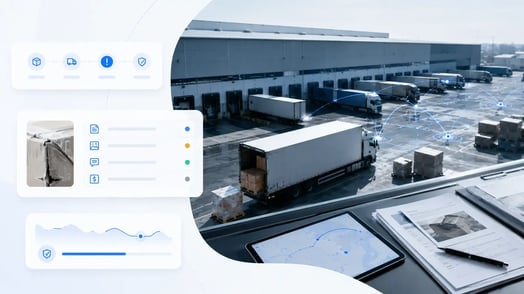
The good news is that these risks are manageable, thanks to good management and accurate forecasts that encourage anticipation. In this 2026 guide, Shiptify explains what a transport dispute is, its different types, and the procedures for compensation and claims in line with French and European regulations.
Above all, you'll learn how a TMS (Transport Management System) can help you manage and prevent these situations effectively. Our aim? To give you the right reflexes to act quickly, easily prove your good faith and preserve your margins, thanks to a proven methodology and collaborative digital tools.
What is a freight transport dispute? Definition
A transport dispute is a conflict between a client (shipper or loader) and a carrier during the execution of a shipment. It may result from late delivery, transport damage, loss of goods or a transport claim linked to a commercial or contractual disagreement.
What is transport damage? Transport damage is any damage suffered by goods during transit as a result of impact, mishandling, exposure to heat or humidity, or faulty stowage.
In practice, damage may be apparent (damaged parcel, leakage, visible breakage) or hidden (product damaged on opening). In all cases, the carrier must be notified within three working days of delivery, by means of a written complaint accompanied by precise reservations on the delivery note.
A challenge for the supply chain
Managing carrier disputes is a daily challenge for logistics players. Surveys by AUTF and bp2r reveal that most companies regularly encounter disputes linked to late delivery, damaged goods or contractual disagreements.
The FNTR points to additional pressure from rising logistics costs and extended lead times, which accentuate friction between carriers and shippers.
On the e-commerce side, according to CEVA Logistics, the explosion in online purchases of express deliveries is accentuating the risk of disputes, making real-time traceability essential to secure flows.
Who is affected by freight claim?
Freight claims concern all modes of goods transport and all sectors that use logistics:
- Domestic transport: last-mile delays, partial losses, quay errors.
- Export/international: transport damage related to maritime or customs transit, transport claims for documentary non-compliance.
- E-commerce: high exposure to customer delivery disputes (damaged parcels, excessively long transit times, etc.).
- Distribution / retail: disagreements over late delivery penalties or quantities received
What types of freight claims are there?
Freight claims concern delivery, invoicing and contractual clauses, as well as compliance with regulations governing the transport of goods. To better understand their origins and responsibilities, here is an overview of the main types of dispute encountered in the transport of goods, whether by road, sea, air, rail or multimodal.
|
Type of dispute |
Description |
Examples from the field |
Principal |
|
Delivery |
Delay, loss, damage or lack of quantity. These incidents disrupt the entire supply chain and can result in contractual penalties. |
Missing pallet, damaged parcel, delay of an export container. |
Carrier |
|
Financial |
Disagreement over invoicing: tariff, fuel surcharge, non-validated surcharge. |
Invoice higher than initial estimate, dispute over diesel surcharge. |
Sales/accounting department |
|
Contractual |
Non-compliance with transport contract clauses: incoterms, transfer of responsibility. |
Goods delivered after contractual deadline or insurance clause not applied. |
Customer or carrier (depending on clause) |
|
Safety / regulations |
Infringement of safety protocol, environmental non-compliance or regulatory breach. |
Use of non-approved vehicles, non-compliance with ADR, absence of customs declaration. |
Driver / charterer / operator |
How to anticipate these disputes?
- Clarify responsibilities as soon as the contract is signed (Incoterms, deadlines, insurance).
- Track operations using real-time monitoring tools (TMS, EDI, proof of delivery).
- Standardize transport claims processes to react quickly and limit financial impact.
- Raise employee awareness of best logistical and regulatory practices through ongoing professional training.
The impact of disputes on the company and the supply chain
Far from being a simple complaint, a transport dispute disrupts the entire logistics chain, from customer service to accounting. Its effects can be measured in financial terms, as well as in operational and relational terms.
Measurable consequences
The impact of a transport dispute can be seen first and foremost in certain logistics performance indicators. At Shiptify, we have noted the following figures.
|
Indicator |
Observed impact |
|
Administrative overload |
Up to +15% internal management time for tracking files. |
|
Average processing time |
45 to 60 minutes per transport claim. |
|
Loss of margin |
Up to 2% of logistics sales, according to industry studies (AUTF, CEVA). |
When repeated, these conflicts reduce overall supply chain performance, increase hidden costs and undermine the profitability of both carriers and shippers.
Underestimated consequences
Even when a dispute with a carrier is settled financially, certain consequences remain:
- loss of trust with the end customer
- late delivery penalties imposed by customers;
- legal risk in the event of contractual non-compliance;
- supply chain disruption, with knock-on effects on planning and service quality.
Direct vs. indirect costs
The logistical cost of a disruption often far exceeds the amount of the initial damage.
|
Direct costs |
Indirect costs |
|
Replacement of goods, resulting in wastage |
Loss of customer confidence |
|
Payment of contractual penalties |
Damage to brand image |
|
Reimbursement or insurance |
Deterioration of business climate |
|
Production stoppage / delay |
Detour of internal resources |
⚠️ Please note: the longer it takes to resolve a dispute, the higher the indirect costs exceed the initial losses.
Moral: optimizing claims management and flow traceability not only reduces losses, but also strengthens the resilience of the supply chain.
How do you calculate compensation for a transport dispute?
When the carrier is held liable, compensation depends on two main factors:
- The nature of the shipment: if it's a national shipment, the disagreement is subject to the terms of the consignment note (Decree 2017-461 of March 31, 2017 amending Annex II to Part 3 of the Transport Code regulations), otherwise, in the case of an international shipment, the CMR Convention regulations apply.
- The gross weight of the lost or damaged goods is used as the basis for calculating compensation, not the actual value of the goods transported.
Summary table of compensation for national and international transport
|
Type of transport |
Legal basis |
Amount of compensation |
Ceiling |
|
National < 3,000 kg |
Decree n°2017-461 of March 31, 2017 |
$38.40 per kg of gross weight lost or damaged |
$1164 / handling unit |
|
National > 3,000 kg |
Decree n°2017-461 of March 31, 2017 |
$23,30 /kg gross weight lost or damaged |
$3725 / ton |
|
International (CMR regime) |
CMR Convention |
8.33 SDR*/kg of lost or damaged gross weight |
Variable according to IMF rate |
*The SDR (Special Drawing Right) is a monetary unit of the IMF (International Monetary Fund). In 2025, 1 SDR ≈ €1.25 (average value).
Insurance for complete coverage
When shipping fragile products or sensitive materials, it's important to insure your goods.
Ad valorem insurance
To recover the full pecuniary value of the loss of goods, it is possible (and recommended) to take out ad valorem insurance, i.e. for the actual value of the goods.
This optional insurance covers the actual value of the goods transported, providing full reimbursement in the event of damage or loss. The cost corresponds to a percentage of the insured value, and is added to the transport price.
💡 Shiptify tip: we recommend this insurance for high-value goods or sensitive items (electronics, pharmaceuticals, luxury goods, etc.).
Declaration of special interest
Do you want to protect yourself against late delivery? Take out a declaration of special interest. The amount of compensation is fixed in advance according to the declared value.
Without this clause, financial compensation is limited to the cost of transport, and depends on an amicable agreement or negotiation between the parties.
How to handle a transport dispute? Practical guide
Dealing with a transport dispute involves three key issues:
- act quickly ;
- prove your case in concrete terms;
- limit the financial and operational impact.
The transport dispute handling process follows 7 key steps.
1. Identify and secure the problem
First:
- Immediately check the delivery: note precise reservations on the delivery note / CMR; example: "package opened - contents damaged - 3 packages missing".
- Do not repair, throw away or modify the goods concerned (this would weaken the evidence).
- Take time-stamped photos and videos of the parcel, packaging and place of delivery.
2. Officially notify the carrier, within the allotted timeframe
Contact the carrier by telephone to inform them, then confirm in writing (registered letter with acknowledgement of receipt) or e-mail if provided for in the contract of carriage.
- How long does it take to declare a transport dispute? It is essential to respect these legal deadlines.
- Notification to the carrier : reservations must be made on the delivery note as soon as the package is received, and a written claim must be sent within 3 working days for non-apparent damage.
- International transport (CMR): reservations must appear on the consignment note upon delivery for apparent damage. For concealed damage, the claim must be made within 7 calendar days of delivery, subject to verification of the applicable law and signed contracts.
- Delays: here, the terms and conditions vary from contract to contract; the declaration of special interest enables specific compensation to be obtained when it has been subscribed.
3. Putting together the complete file
Now it's time to assemble all the information and documents in the file:
- contract of carriage / purchase order / charter confirmation
- consignment note / CMR and delivery note with reservations
- commercial invoice and proof of value
- photos / videos / POD (proof of delivery)
- e-mail exchanges, incident reports, witness statements
- expert reports (if carried out).
4. Assess liability and applicable law
Is your file ready? Cover your bases by checking the conformity of your approach:
- reread the legal basis (national transport, decree/international or CMR?), contractual clauses and Incoterms
- analyze whether the cause of the damage or delay is attributable to the carrier, the shipper, a third party or force majeure
- if ad valorem insurance or a declaration of special interest exists, align your approach with these guarantees.
5. Seek an amicable resolution: a priority
An amicable solution is often the quickest: credit note, repair, replacement, partial compensation, etc. Document all proposals and responses in writing.
In the event of agreement, issue a closing document specifying the amount, deadline and method of settlement.
6. Escalation: mediation, expert appraisal, legal action
If no agreement is reached, you should first resort to mediation or an independent expert opinion to prove your good faith.
As a last resort, you'll have to take your case to the appropriate court. To anticipate this eventuality, keep all evidence and communications.
Competent jurisdiction for freight claims:
- International carriage (CMR Convention): the court of the country where the defendant (carrier) has its principal place of business, or where the goods are taken over, or where delivery is to take place. If both parties so wish, they may also resort to arbitration.
7. Archiving and capitalizing for prevention
Once the situation has been dealt with, and with a view to long-term capitalization, centralize the complete file in your transport management tool (attachments, status, key dates, exchanges).
Then use the data to analyze recurring causes and produce a report based on key performance indicators (KPIs ) such as :
- average processing time
- cost of damage and impact on business
- the carriers most affected
Finally, adjust your internal procedures and contractual clauses according to these results, in order to anticipate and limit the recurrence of these disputes.
In fact, this is also the role of a TMS: to centralize, analyze and anticipate, with the aim of learning from settled conflicts, preventing disputes and dealing with them rapidly should they arise.
How does a TMS help manage and prevent freight claims?
More than just a planning tool, the TMS(Transport Management System) is today a strategic lever for :
- reduce disputes
- speed up handling
- prevent their recurrence
This tool acts at every stage of the logistics cycle.
1. Real-time tracking: anticipate anomalies before they become disputes
A TMS enables you to track the flow of goods in real time, thanks to GPS tracking, ETA (Estimated Time of Arrival ) event feedback and digital proof of delivery (digital POD).
Each stage of transport, loading, transit, delivery is time-stamped and documented, with a photo of the load, electronic signature and incident reporting.
What's more, the user receives instant notifications. In the event of delay, damage or temperature deviation, automatic alerts enable a proactive reaction before the customer suffers any consequences.
2. Document centralization: all shipping documents available in a few clicks
The TMS automatically groups all essential documents, including CMRs, delivery notes, invoices, e-mails, photos and reports. Each document is indexed and time-stamped, while all parties involved (carrier, shipper, consignee, customer) have shared, secure access to all shipping information.
The result? No more searching for scattered documents. The dispute file is complete and instantly accessible, considerably reducing processing times.
3. Proof and traceability: objectivized responsibility
Since each logistical event is time-stamped, located and associated with a user, it is easy to identify the actor responsible for the damage or delay. This detailed traceability makes it easier to pinpoint who is responsible (carrier, shipper, charterer, subcontractor, etc.).
4. Collaboration and rapid resolution: a shared workflow
As you can see, the TMS facilitates communication between all the players involved, thanks to a collaborative workflow in which :
- each file is tracked according to a clear status - in progress, awaiting documents, closed or in mediation ;
- messages, attachments and comments are centralized on the same interface;
- response times are shortened and exchanges are legally traceable.
The result? Less friction, greater responsiveness and enhanced customer satisfaction.
Case study: Shiptify, proactive dispute management
Still not convinced of the power of a TMS? Find out how our customer reduced the number of disputes in just a few months thanks to the Shiptify solution!
Background
An international company shipping over 1,200 parcels a week was experiencing an average 5% rate of transport disputes (delays, damage, delivery errors). Exchanges between shippers and carriers were fragmented between e-mails, calls and Excel files, lengthening processing times and making it difficult to trace incidents.
Shiptify solution
With the Shiptify TMS platform, the company centralized its flow management and automated anomaly detection, through :
- automatic alerts for any deviation from deadlines, lost parcels or document inconsistencies;
- real-time transport tracking with instantaneous sharing of evidence (loading photos, digital POD, geolocation) between all players;
- collaborative management of disputes, with the carrier and shipper working on the same file, with a time-stamped history and follow-up status ("in progress", "closed", "in mediation").
This proactive approach has enabled us to resolve disagreements more quickly and limit their recurrence.
Measurable results
Thanks to Shiptify, the company has seen in just a few months :
- A rapid reduction in disputes: 45% reduction in resolution times and 40% fewer data entry errors.
- Productivity gains: a 30% increase for logistics teams and 40% time saved on planning.
- Improved customer service: 95% of deliveries are on time, thanks to real-time tracking and proactive communication.
- Cost optimization and respect for the environment: reduction in empty kilometers (-15%) and CO₂ emissions (-20%).
Conclusion : what you need to remember about managing disputes in goods transportation.
If we had to keep just three tips for effectively managing freight claims, they would be:
- Identify incidents early to limit their impact.
- Apply the right compensation procedure to resolve disputes fairly and transparently.
- Equip yourself with a high-performance TMS to centralize flow management and anticipate problems before they arise.
By combining vigilance, clear procedures and appropriate tools, your company can only gain in responsiveness, productivity and customer satisfaction.