When people think about Formula 1, they usually focus on the drivers, the cars, and the technology.
Yet one of the most impressive achievements in Formula 1 happens far from the racetrack.
Behind every Grand Prix lies one of the most complex logistics operations in the world.
Every season, Formula 1 teams transport thousands of tons of equipment across multiple continents while operating under extremely tight deadlines. Cars, engines, spare parts, hospitality units, IT infrastructure, tools, and garage equipment must arrive at the right place, at the right time, every single race weekend.
With little time between events and no room for error, Formula 1 logistics has become a masterclass in supply chain optimization, transportation management, and operational execution.
A global logistics operation
Formula 1 is a truly global championship.
Over the course of a season, teams travel across Europe, the Middle East, Asia, North America, South America, and the Middle East again, covering well over 100,000 kilometers.
For each race weekend, teams transport between 30 and 50 tons of equipment, depending on their operational requirements.
This includes:
- Race cars
- Spare parts
- Engines and power units
- Garage equipment
- IT systems
- Communications infrastructure
- Hospitality facilities
- Marketing assets
- Engineering tools
Every piece of equipment must arrive on schedule because even a minor delay can impact race preparation.
Unlike traditional supply chains, Formula 1 operates with almost no flexibility.
Everything follows a highly coordinated timetable.
Building a temporary headquarters every race weekend
One of the most remarkable aspects of Formula 1 logistics is the temporary infrastructure created at every circuit.
Teams effectively build a fully operational headquarters every race weekend.
These facilities often include:
- Technical garages
- Engineering workspaces
- Offices
- Meeting rooms
- Hospitality areas
- Catering facilities
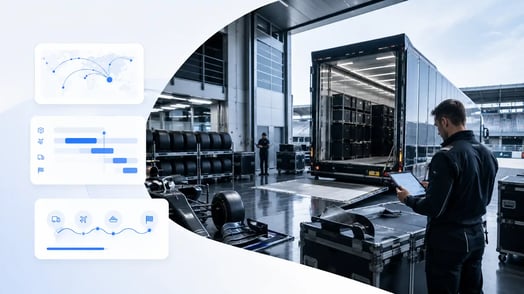
Once the equipment arrives, teams have less than two days to unload, assemble, test, and prepare everything before on-track activities begin.
After the race, the process happens in reverse.
Garages are dismantled, equipment is packed, and transportation operations begin almost immediately after the checkered flag.
In many cases, teardown operations start before the race has even finished to save valuable time.
The efficiency of these temporary facilities closely mirrors best practices in modern warehouse operations.
Why timing is everything
Formula 1 logistics operates under extremely strict deadlines.
After a race weekend ends, teams typically have only a few days before preparation begins for the next event.
When consecutive races are scheduled on back-to-back weekends, the challenge becomes even greater.
Equipment leaving one circuit often needs to arrive at the next destination within 36 to 48 hours.
To achieve this level of efficiency, every shipment follows a precise transportation plan.
Each crate has a designated location.
Each vehicle has a predefined loading sequence.
Every movement is planned months in advance.
Formula 1 is often described as a race on the track.
In reality, it is also a race throughout the supply chain.
Many of these planning principles are similar to those used in advanced logistics scheduling strategies.
How Formula 1 manages European races
Most Formula 1 teams are headquartered in Europe.
As a result, European races benefit from shorter transportation distances and greater logistical flexibility.
For these events, teams primarily rely on road transportation.
Truck fleets transport:
- Race cars
- Spare parts
- Garage equipment
- Hospitality infrastructure
- Engineering materials
Road transport offers several advantages:
- Lower transportation costs
- Greater flexibility
- Door-to-door delivery
- Reduced handling requirements
A single team may use more than ten trucks during the European portion of the season.
Because many European races are scheduled close together, transportation planning becomes critical to maintaining operational continuity.
Road-based freight transport remains the backbone of Formula 1 logistics throughout the European calendar.
Air freight: The backbone of global Formula 1 logistics
When races take place outside Europe, logistics becomes significantly more complex.
Air freight becomes the primary transportation mode because of the long distances involved and the limited time available between events.
Formula 1 relies heavily on dedicated cargo aircraft to transport critical equipment around the world.
Air freight is used for:
- Race cars
- Engines
- Spare parts
- Electronics
- Timing systems
- Broadcasting equipment
The speed of air transportation allows teams to maintain competitive performance despite aggressive race schedules.
However, this speed comes at a cost.
Sea freight and air freight represent two very different transportation strategies, but Formula 1 depends heavily on air transport whenever speed becomes the priority.
Air freight remains one of the most expensive components of Formula 1 logistics.
Why sea freight also plays a role
Although Formula 1 is often associated with air freight, maritime transportation has become increasingly important.
Sea freight is used to transport non-critical equipment that does not require immediate availability.
Examples include:
- Furniture
- Hospitality equipment
- Kitchen supplies
- Promotional materials
- Workshop equipment
Because ocean freight is significantly cheaper than air freight, Formula 1 uses multiple sets of equipment that move around the world simultaneously.
This strategy allows teams to reduce transportation costs while maintaining operational continuity throughout the season.
The approach closely resembles inventory positioning strategies used in global supply chains.
In many ways, Formula 1 combines air, road and maritime transportation into a highly coordinated multimodal transport network.
Supply chain lessons from Formula 1
Formula 1 logistics offers valuable lessons for businesses across every industry.
Plan ahead
Nothing in Formula 1 logistics is left to chance.
Transportation routes, shipment schedules, inventory requirements, and contingency plans are developed long before race day.
The same principle applies to modern supply chains.
Companies that anticipate demand and plan proactively are better positioned to handle disruptions.
Build supply chain visibility
Formula 1 teams know exactly where every shipment is located.
Real-time visibility allows logistics teams to react quickly when unexpected events occur.
For manufacturers, distributors, and retailers, shipment tracking has become equally important.
Reduce operational bottlenecks
Every delay creates consequences.
Formula 1 continuously identifies and eliminates inefficiencies throughout its logistics network.
Businesses can achieve similar gains by improving transportation planning, warehouse operations, and carrier collaboration.
Organizations that actively seek to reduce supply chain costs often begin by identifying these operational bottlenecks.
Create resilient logistics networks
Formula 1 logistics depends on multiple transportation modes.
Road, air, and sea freight all play a role.
This multimodal approach increases flexibility and reduces operational risk.
The same principle applies to modern logistics networks, where transportation diversification helps organizations remain resilient during disruptions.
The environmental challenge
Despite significant technological progress in racing, logistics remains the largest contributor to Formula 1's carbon footprint.
Transportation operations account for a substantial share of overall emissions generated by the sport.
As a result, Formula 1 has launched several initiatives to improve sustainability, including:
- Greater use of sustainable aviation fuel
- Route optimization
- More efficient freight planning
- Reduced equipment duplication
- Lower-emission transportation solutions
The challenge mirrors what many global supply chains face today: balancing performance with environmental responsibility.
Modern companies increasingly rely on route optimization software and transportation analytics to reduce both costs and emissions.
What Formula 1 teaches modern supply chains
Formula 1 logistics demonstrates what is possible when planning, visibility, technology, and execution operate in perfect synchronization.
The sport manages an incredibly complex global logistics network while working under some of the most demanding deadlines imaginable.
For logistics professionals, Formula 1 is more than a motorsport competition.
It is a real-world example of transportation management systems, multimodal transport, supply chain visibility, inventory planning, and operational excellence working together at the highest level.
Every race weekend proves that winning is not only about speed on the track.
It is also about the supply chain behind it.
Visibility creates performance
Formula 1 teams cannot afford uncertainty.
Every shipment, vehicle, container, and piece of equipment must be monitored throughout its journey.
This level of control is similar to what modern companies achieve through supply chain dashboards that centralize operational data and provide real-time decision-making capabilities.
Data drives every decision
Successful Formula 1 teams continuously measure performance.
The same philosophy applies to supply chain management.
Organizations that monitor the right supply chain KPIs can identify inefficiencies, improve service levels, and optimize transportation performance.
Transportation costs must be controlled
Even in a highly competitive environment like Formula 1, logistics budgets remain under constant scrutiny.
Teams continuously seek opportunities to optimize transportation choices, balance costs with service requirements, and improve operational efficiency.
This mirrors the objectives of modern transportation spend management strategies used across global supply chains.
Flexibility is essential
Unexpected disruptions can occur at any moment.
Weather conditions, customs inspections, transportation delays, and operational incidents all have the potential to impact race preparation.
Formula 1 teams therefore build resilient transportation networks capable of adapting quickly to changing circumstances.
This ability to react rapidly is one of the key principles of modern supply chain optimization.
How Shiptify helps companies improve logistics performance
While most companies do not operate on the scale of Formula 1, they face many of the same challenges:
- Shipment visibility
- Transportation planning
- Carrier coordination
- Cost control
- Operational efficiency
Shiptify helps organizations centralize and optimize transportation operations through a collaborative shipper TMS.
By improving visibility, automating processes, and strengthening collaboration between shippers and carriers, companies can build more agile and resilient supply chains capable of meeting today's logistics challenges.
Shiptify TMS
Shiptify's transportation management platform enables organizations to:
- Centralize transportation operations
- Automate carrier communication
- Compare transportation scenarios
- Improve shipment visibility
- Manage transportation documentation
- Monitor transportation performance
The platform acts as a collaborative control tower that helps logistics teams manage increasingly complex transportation networks.
Shiptidock
Transportation efficiency does not stop once goods arrive at a warehouse.
Shiptidock helps organizations optimize warehouse appointments and dock activities through advanced dock scheduling software capabilities.
The solution enables companies to:
- Reduce dock congestion
- Improve carrier punctuality
- Increase warehouse productivity
- Improve resource planning
- Synchronize inbound and outbound operations
Together, Shiptify and Shiptidock help create smoother and more predictable logistics operations from origin to destination.
Conclusion
Formula 1 logistics is one of the most sophisticated transportation operations in the world.
Every season, teams move thousands of tons of equipment across continents while working under extreme time pressure and maintaining near-perfect execution.
The success of Formula 1 logistics relies on the same principles that drive high-performing supply chains:
- Advanced planning
- Real-time visibility
- Transportation optimization
- Multimodal coordination
- Operational discipline
For logistics professionals, Formula 1 provides a powerful example of how efficient transportation management can become a competitive advantage.
Whether managing global racing operations or commercial supply chains, the objective remains the same:
Deliver the right goods, to the right place, at the right time, with maximum efficiency and minimum disruption.