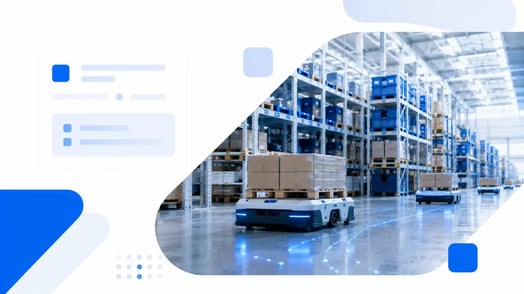
An Autonomous Mobile Robot (AMR) is a self-navigating robot designed to transport goods, totes, shelving units, or pallets throughout a warehouse without requiring fixed tracks, magnetic tape, or dedicated infrastructure. Using onboard sensors, cameras, and a digital map of its environment, an AMR dynamically calculates the most efficient route while safely navigating around obstacles and working alongside warehouse operators.
Unlike conveyors, automated sorters, or Automated Guided Vehicles (AGVs), which rely on predefined routes, AMRs continuously adapt to their surroundings in real time. This flexibility has made them one of the fastest-growing warehouse automation technologies, driven by the rapid expansion of e-commerce, increasing labor costs, and growing demand for operational efficiency, a trend closely tracked by industry bodies such as the Association for Advancing Automation (A3).
This guide explains how warehouse AMRs work, their main use cases, how they compare with AGVs, and how to evaluate whether they are the right automation solution for your operation.
What is an AMR in a warehouse?
An Autonomous Mobile Robot (AMR) is a robotic platform equipped with:
- Onboard sensors
- Navigation software
- Wireless communication capabilities
- A connection to the Warehouse Management System (WMS) or Warehouse Control System (WCS)
The robot receives tasks from fleet management software, such as:
- Transporting a tote
- Moving a pallet
- Delivering shelving units to a picking station
- Transferring carts between warehouse zones
Once assigned, the robot executes each task autonomously before reporting completion back to the warehouse system.
The defining characteristic of an AMR is its ability to navigate independently. Rather than following a predefined route, the robot continuously analyzes its surroundings, plans the optimal path, avoids obstacles, and automatically adapts whenever the warehouse environment changes.
Unlike industrial robots used in manufacturing, warehouse AMRs are purpose-built for material handling and internal transportation.
Today, their four primary warehouse applications include:
- Goods-to-Person (G2P) picking
- Person-to-Goods assistance
- Sortation
- Internal material transport
Each application offers different productivity gains, investment levels, and operational benefits.
How AMRs work
Every warehouse AMR solution consists of three essential layers:
- Robot hardware
- Onboard navigation software
- Fleet management software
Understanding these components is essential when evaluating different vendors.
Robot hardware
The robot itself includes a drive base, payload handling equipment, batteries, onboard computers, and navigation sensors.
Depending on the model, payload capacities typically range from 30 kg for small tote carriers to more than 1,500 kg for pallet-moving robots.
Most warehouse AMRs operate for 8 to 10 hours before automatically returning to a charging station during periods of low activity.
Navigation system
The onboard navigation system performs several critical functions: localization, mapping, route planning, obstacle detection, and collision avoidance.
This software enables AMRs to move safely alongside warehouse employees, forklifts, and other automated equipment.
Unlike AGVs, navigation decisions are continuously recalculated as warehouse conditions evolve.
Fleet management software
Fleet management software coordinates the entire robot fleet.
Its responsibilities include receiving tasks from the WMS, assigning work to the most appropriate robot, monitoring battery levels, scheduling charging, tracking robot locations, and reporting task completion.
Fleet management is the central orchestration layer that transforms individual robots into a coordinated warehouse automation system.
When integrated with a Warehouse Management System and efficient warehouse optimization processes, fleet software ensures warehouse tasks are completed with maximum efficiency.
AMR navigation technologies
Navigation technology is one of the main differentiators between AMR vendors.
SLAM (Simultaneous Localization and Mapping)
SLAM is the most widely used navigation technology in modern warehouse AMRs.
Using LIDAR sensors, the robot creates a digital map of its surroundings during initial deployment.
As it moves through the warehouse, incoming sensor data is continuously compared with this map to determine the robot's exact position.
One of SLAM's greatest advantages is flexibility. When warehouse layouts change, for example after relocating storage racks or adding staging areas, the map can simply be updated without modifying the warehouse floor.
Many leading AMR vendors, including Locus Robotics, Fetch Robotics (Zebra), and Geek+, rely on SLAM technology.
Natural feature navigation
Natural feature navigation operates similarly to SLAM but relies on permanent warehouse structures, such as walls, columns, rack ends, and fixed building features.
This approach works particularly well in stable warehouse environments where layouts rarely change.
QR code navigation
Some AMR systems use QR codes or barcode grids installed directly on the warehouse floor.
Downward-facing cameras continuously scan these markers to determine the robot's precise position.
This approach offers exceptional positioning accuracy and is widely used in very high-throughput warehouse environments. However, it requires floor markings and additional maintenance whenever layouts change.
In practice, SLAM offers greater flexibility, while QR code navigation delivers maximum positioning precision.
AMR vs. AGV: what's the difference?
Although Autonomous Mobile Robots (AMRs) and Automated Guided Vehicles (AGVs) are often compared, they are designed for different warehouse environments and operational requirements.
The key distinction lies in how they navigate.
An AGV follows predefined routes using magnetic tape, embedded wires, or reflective markers. If an obstacle blocks its path, the vehicle typically stops and waits until the route is clear.
An AMR, by contrast, continuously analyzes its surroundings and automatically calculates an alternative route. This ability to adapt makes AMRs particularly effective in warehouses where people, forklifts, and equipment share the same workspace.
| Feature | AMR | AGV |
|---|---|---|
| Navigation | Dynamic, map-based | Fixed routes |
| Obstacle handling | Automatic rerouting | Stops and waits |
| Infrastructure | Wi-Fi and digital mapping | Tape, wires or reflectors |
| Layout changes | Software update | Physical infrastructure changes |
| Flexibility | High | Moderate |
| Typical deployment | Weeks | Several months |
| Best suited for | Dynamic warehouse environments | Repetitive fixed transport routes |
AMRs generally require a higher initial investment per unit, but significantly less warehouse infrastructure.
AGVs remain highly effective for repetitive transport tasks such as pallet movements between fixed production lines or conveyor systems, while AMRs excel in fast-changing fulfillment environments where flexibility is essential.
Many modern distribution centers now combine both technologies, using AGVs for predictable transport routes and AMRs for dynamic warehouse operations.
Main warehouse AMR use cases
Warehouse AMRs can support several operational workflows depending on business needs and warehouse layout.
Goods-to-Person (G2P)
Goods-to-Person (G2P) is the highest-productivity AMR application.
Instead of operators walking through the warehouse, robots transport shelving units or inventory pods directly to fixed picking stations.
The workflow is simple:
- The robot retrieves the storage pod.
- It delivers the pod to the operator.
- The operator picks the required items.
- The robot returns the pod to storage before retrieving the next one.
Because picker travel is virtually eliminated, productivity can increase dramatically.
Typical performance ranges include 400 to 600 picks per hour in G2P environments, compared with approximately 80 to 120 picks per hour using conventional walking-based picking methods.
This model is widely associated with Amazon Robotics (formerly Kiva).
For organizations looking to optimize pick and pack operations, G2P represents one of the most effective automation strategies available.
Person-to-Goods assist
In a Person-to-Goods model, warehouse operators continue walking through the warehouse, but an AMR accompanies them and transports completed order containers.
The robot follows the operator, carries totes or carts, automatically delivers completed orders to the packing area, and returns with an empty container to continue picking.
Unlike G2P systems, this approach requires very little warehouse modification, making it one of the easiest AMR deployments for existing facilities.
Organizations typically report productivity improvements of 20% to 35%, with minimal disruption to daily operations.
Locus Robotics remains one of the leading vendors in this category.
Sortation
AMRs can also replace or complement traditional conveyor sortation systems.
Instead of relying on fixed conveyor networks, robots transport individual totes or cartons to outbound lanes, packing stations, shipping areas, and dispatch docks.
One major advantage is flexibility. Changing outbound routes or adding new shipping lanes only requires software configuration rather than expensive conveyor modifications.
Combined with efficient loading dock management and order fulfillment processes, AMR sortation provides a highly scalable outbound workflow.
Internal transport
Internal transport is often the first AMR application implemented by warehouses beginning their automation journey.
Robots automatically move pallets, carts, totes, and stillages between warehouse zones, including receiving, storage, picking, packing, and dispatch staging.
By automating repetitive transportation tasks, warehouses reduce forklift traffic, improve labor utilization, and free operators to focus on higher-value activities.
Benefits of warehouse AMRs
Exceptional flexibility
Unlike fixed automation, AMRs adapt quickly to warehouse changes.
Adding new storage zones, modifying picking areas, or expanding outbound operations generally requires only software updates rather than physical infrastructure changes.
Rapid deployment
Compared with conveyor systems or other fixed automation solutions, AMRs can be deployed remarkably quickly.
Many Person-to-Goods implementations become operational within 4 to 8 weeks, whereas large conveyor installations often require several months of engineering and construction.
Scalability
Warehouse automation can grow incrementally. Instead of making a large capital investment upfront, organizations simply add more robots as demand increases.
Improved safety and ergonomics
AMRs reduce operator travel and heavy manual handling, resulting in lower physical strain, reduced walking distances, fewer repetitive movements, and improved workplace safety.
Modern AMRs continuously monitor their surroundings using LIDAR sensors, cameras, and obstacle-detection systems, enabling them to work safely alongside warehouse personnel.
Strong performance in cold-storage environments
AMRs also perform extremely well in refrigerated and frozen warehouses. Because robots handle repetitive transport tasks, employees spend less time in cold environments while productivity remains high.
Limitations and challenges
Although Autonomous Mobile Robots (AMRs) provide significant operational advantages, they are not the right solution for every warehouse.
Upfront investment
A warehouse AMR project represents a substantial capital investment, including robot hardware, fleet management software, WMS integration, wireless network upgrades, and implementation and training.
Dedicated floor space for Goods-to-Person systems
G2P deployments generally require a dedicated robot operating zone. In many facilities, this represents 30% to 50% of the warehouse footprint, separated from pedestrian and forklift traffic.
Mixed-traffic management
Successful deployments establish dedicated traffic rules, speed zones, right-of-way procedures, operator training, and emergency stop protocols.
Compliance with ISO 3691-4 provides an important safety foundation, but every warehouse should also conduct its own site-specific risk assessment.
WMS integration complexity
An AMR solution is only as effective as its integration with the Warehouse Management System (WMS). The fleet management platform must be able to receive warehouse tasks, assign them to robots, report task completion, and synchronize inventory updates.
Payload limitations
Not every AMR is designed to move heavy pallets. Operations primarily handling palletized freight may require specialized pallet AMRs, which involve higher acquisition costs and different deployment considerations.
Building the AMR business case
Labor savings
Goods-to-Person systems dramatically reduce operator travel. In a traditional warehouse, picker travel often represents 50% to 70% of total shift time.
Example: 50 warehouse operators spending 60% of their time walking, with an average fully loaded labor cost of $18/hour, can represent over $1 million in annual labor value recovered, depending on warehouse size and operating schedule.
Increased throughput
Person-to-Goods AMRs typically improve productivity by 20% to 35%, allowing organizations to process more orders using the same workforce.
Lower error rates
By automating repetitive transport activities, AMRs reduce handling mistakes, misplaced inventory, manual transport errors, and unnecessary product movements.
Typical project costs
A mid-sized deployment involving approximately 20 robots generally includes robot hardware (approximately $1,000,000), fleet management software and WMS integration ($150,000 to $300,000), and facility preparation ($50,000 to $100,000).
Overall investment typically ranges between $1.2 million and $1.4 million, depending on warehouse complexity and vendor selection.
Typical payback period
For high-volume Goods-to-Person operations, payback periods commonly range between 13 and 16 months. Person-to-Goods implementations generally require 24 to 36 months, reflecting lower investment costs but more moderate productivity gains.
How to implement AMRs successfully
Step 1: Define the operational use case
Before selecting vendors, clearly identify the warehouse process you want to improve: Goods-to-Person picking, Person-to-Goods assistance, sortation, or internal transport.
Step 2: Assess warehouse readiness
Evaluate floor flatness, Wi-Fi coverage, traffic flows, storage layouts, and temperature-controlled areas.
Step 3: Review WMS integration
Confirm that your Warehouse Management System can communicate effectively with the AMR fleet management software.
Step 4: Launch a pilot project
Measure baseline KPIs before deployment, including picks per hour, travel distance, robot utilization, and picking accuracy. A pilot lasting 6 to 8 weeks typically provides sufficient operational data to validate the business case.
Step 5: Design safety procedures
Successful projects establish traffic management rules, operator training programs, emergency procedures, and maintenance workflows.
Step 6: Scale progressively
Once pilot objectives are achieved, additional robots can be deployed incrementally.
Leading AMR vendors
Locus Robotics
One of the leading providers of Person-to-Goods robots. Its Robotics-as-a-Service (RaaS) model has made it particularly popular among e-commerce companies and third-party logistics providers (3PLs).
6 River Systems
6 River Systems offers the Chuck collaborative mobile robot, widely deployed across retail and e-commerce fulfillment operations. The company was previously owned by Shopify, which acquired it in 2019; following Shopify's 2023 sale of its logistics business to Flexport, 6 River Systems now operates as part of the Flexport group.
Geek+
Geek+ is one of the world's largest AMR manufacturers, with a portfolio including Goods-to-Person systems, pallet AMRs, and sorting robots, and a strong international presence across Europe, Asia, and North America.
Quicktron
Quicktron specializes in Goods-to-Person automation, pallet transportation, and QR-code navigation systems, widely adopted in large retail and e-commerce distribution centers.
Scallog
Scallog is a French robotics company specializing in modular Goods-to-Person systems, particularly well suited to mid-sized European warehouses seeking flexible automation.
Körber
Körber combines warehouse software with integrated robotics, offering native AMR capabilities within its warehouse execution platform.
Final thoughts
Autonomous Mobile Robots (AMRs) have become one of the most flexible and scalable automation technologies available for modern warehouses. Unlike fixed automation systems, they can adapt to changing layouts, support growing order volumes, and integrate into existing warehouse operations with minimal infrastructure changes.
Whether used for Goods-to-Person picking, Person-to-Goods assistance, sortation, or internal transport, AMRs help reduce non-value-added travel, improve productivity, enhance workplace safety, and increase operational flexibility.
However, a successful AMR deployment depends on more than selecting the right robots. Warehouse readiness, WMS integration, wireless network quality, safety planning, and a well-structured pilot project are all essential to achieving a strong return on investment.
When combined with a modern Warehouse Management System and streamlined logistics processes, AMRs become a powerful driver of warehouse performance.