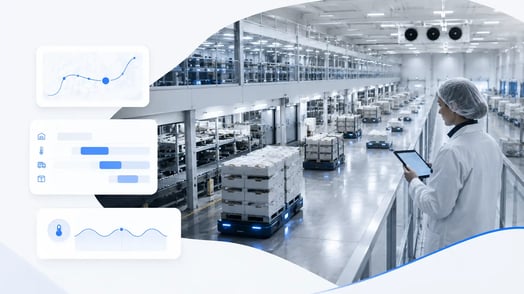
The food and beverage industry operates under some of the most demanding logistics requirements of any sector.
Unlike many other industries, food supply chains must manage strict shelf-life constraints, temperature-sensitive products, traceability requirements, and increasingly demanding customer expectations. A single disruption can compromise product quality, create compliance issues, or lead to significant financial losses.
As supply chains become more complex, food manufacturers, distributors, and retailers must rely on efficient logistics processes and advanced technologies to maintain product quality while controlling costs.
In this guide, we explore the key challenges of food logistics, the strategies used by leading companies, and the technologies helping businesses improve supply chain performance.
What is food logistics?
Food logistics refers to the planning, transportation, storage, handling, and distribution of food and beverage products throughout the supply chain.
Its primary objective is to ensure that products arrive at their destination safely, on time, and in optimal condition.
Food logistics covers a wide range of operations, including:
- Procurement of raw materials
- Inventory management
- Warehouse operations
- Transportation planning
- Cold chain management
- Product traceability
- Retail distribution
- Returns management
Because food products often have limited shelf lives and strict storage requirements, logistics plays a critical role in maintaining quality and regulatory compliance.
Understanding the different segments of food logistics
The food industry includes several product categories, each with its own logistical requirements.
Fresh products
Fresh products such as fruits, vegetables, dairy products, meat, and seafood require rapid transportation and precise temperature control.
Even minor delays can significantly reduce product quality and shelf life.
Frozen products
Frozen goods require uninterrupted temperature monitoring throughout storage and transportation.
Any break in the cold chain may result in product loss and regulatory non-compliance.
Dry goods
Dry food products generally offer longer shelf lives and fewer temperature constraints, but still require effective inventory management and traceability.
Beverages
The beverage sector presents its own challenges, including high transportation volumes, weight constraints, and seasonal demand fluctuations.
Each category requires dedicated logistics strategies to ensure product availability and quality.
The main challenges of food logistics
Maintaining product quality and freshness
One of the biggest challenges in food logistics is preserving product quality from production to final delivery.
Products must be transported and stored under precise conditions to avoid spoilage, contamination, or quality degradation.
This is particularly important for:
- Dairy products
- Seafood
- Fresh produce
- Frozen foods
- Prepared meals
Any failure in temperature management can generate significant losses and damage customer trust.
Managing the cold chain
Cold chain management remains one of the most critical components of food logistics.
Temperature-controlled transportation and storage ensure products remain within predefined ranges throughout their journey.
Companies must continuously monitor:
- Storage temperatures
- Vehicle temperatures
- Transit times
- Loading and unloading operations
Modern visibility tools and shipment tracking solutions allow logistics teams to identify deviations before they become costly problems.
Ensuring full traceability
Consumers and regulators increasingly demand transparency.
Food companies must be able to track products throughout the supply chain, from raw material sourcing to final delivery.
Traceability systems help businesses:
- Improve food safety
- Simplify recalls
- Demonstrate regulatory compliance
- Strengthen customer confidence
Managing demand volatility
Food demand can fluctuate significantly due to:
- Seasonal trends
- Promotional campaigns
- Weather conditions
- Consumer behavior changes
Accurate forecasting and flexible logistics processes are essential to maintain service levels while avoiding excessive inventory.
Controlling transportation costs
Transportation often represents one of the largest logistics expenses for food companies.
Rising fuel prices, driver shortages, and increasing service expectations make transportation optimization a strategic priority.
Many organizations invest in transportation spend management initiatives to gain greater control over freight expenses.
Optimizing logistics resources in the food industry
Improving product flow management
Food supply chains require smooth coordination between suppliers, manufacturers, warehouses, carriers, and retailers.
Improving product flows helps companies:
- Reduce delays
- Minimize waste
- Improve inventory turnover
- Increase service levels
Real-time visibility is increasingly important for making faster operational decisions and driving broader supply chain optimization.
Optimizing warehouse operations
Warehouse efficiency directly impacts product freshness and order fulfillment performance.
Food logistics operations benefit from:
- Optimized picking routes
- Automated inventory management
- FEFO (First Expired, First Out) inventory strategies
- Real-time stock visibility
These practices reduce waste while ensuring proper product rotation.
Managing storage conditions
Storage conditions must be carefully monitored to maintain product integrity.
This includes:
- Temperature control
- Humidity monitoring
- Product segregation
- Hygiene compliance
Advanced warehouse technologies help automate these controls and reduce operational risks.
Best practices for successful food logistics
Improve inventory visibility
Real-time inventory visibility allows companies to respond quickly to changes in demand and supply conditions.
Accurate inventory information helps reduce:
- Stockouts
- Overstocking
- Product waste
- Emergency transportation costs
Maintaining the right balance between safety stock and operational efficiency is essential.
Implement robust traceability processes
Traceability should cover every stage of the supply chain.
Modern digital tools provide complete visibility over:
- Product origins
- Batch numbers
- Storage history
- Transportation conditions
This capability is particularly valuable during audits and product recalls.
Use predictive analytics
Data-driven forecasting helps logistics teams anticipate future demand and better allocate resources.
Predictive analytics supports:
- Inventory optimization
- Transportation planning
- Workforce allocation
- Capacity management
Strengthen collaboration across the supply chain
Food logistics relies heavily on collaboration between manufacturers, logistics providers, carriers, and retailers.
Sharing information in real time improves responsiveness and reduces disruptions.
The role of technology in food logistics
Warehouse management systems (WMS)
A Warehouse Management System helps organizations:
- Manage inventory accurately
- Improve picking productivity
- Monitor stock movements
- Optimize storage capacity
For food operations, WMS solutions also support expiration-date management and product traceability.
Transportation management systems (TMS)
Transportation Management Systems help companies optimize transportation operations.
Key benefits include:
- Carrier management
- Route optimization
- Shipment visibility
- Freight cost control
- Performance monitoring
For food manufacturers and distributors, transportation visibility is critical to maintaining product quality and service levels.
To learn more, explore the main transportation management system features.
Real-time visibility platforms
Modern visibility solutions provide continuous monitoring of shipments and transportation activities.
This allows logistics teams to:
- Track deliveries
- Identify delays
- Monitor carrier performance
- Improve customer communication
Managing compliance in food logistics
Food supply chains operate under strict regulatory requirements.
Compliance obligations often include:
- Food safety standards
- Temperature monitoring
- Product traceability
- Hygiene controls
- Transportation regulations
Failure to comply can lead to product recalls, financial penalties, and reputational damage.
Digital tools help companies automate compliance processes and maintain complete audit trails.
How Shiptify supports food logistics operations
Food logistics companies require complete visibility across transportation operations.
Shiptify helps manufacturers, distributors, and retailers improve transportation management through a collaborative platform designed to centralize logistics operations.
The platform enables organizations to:
- Manage carrier relationships
- Track shipments in real time
- Improve transportation visibility
- Monitor logistics KPIs
- Reduce transportation costs
- Improve operational collaboration
For warehouses and distribution centers, Shiptidock complements transportation management by optimizing dock appointment scheduling.
This allows logistics teams to:
- Reduce truck waiting times
- Improve dock utilization
- Better plan labor resources
- Improve inbound and outbound flow management
Together, these solutions help food companies increase supply chain efficiency while maintaining high service levels.
Conclusion
Food logistics is one of the most demanding areas of supply chain management.
Maintaining product quality, ensuring traceability, managing temperature-sensitive products, and controlling costs require a combination of operational excellence and technology.
Organizations that invest in visibility, transportation optimization, warehouse efficiency, and collaborative logistics processes are better positioned to improve service levels while reducing waste and operating costs.
As food supply chains continue to evolve, advanced logistics technologies such as TMS, WMS, and dock scheduling software will play an increasingly important role in maintaining performance, compliance, and customer satisfaction.