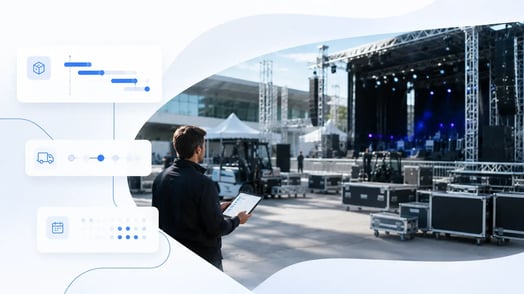
Event logistics is one of the most demanding areas of supply chain management.
Whether you're organizing a trade show, corporate conference, sporting event, concert, exhibition, product launch, or film production, success depends on hundreds of moving parts working together seamlessly.
Equipment, suppliers, transportation providers, venue operators, technical teams, exhibitors, and contractors must all be coordinated within strict deadlines and often under significant operational pressure.
Unlike traditional logistics operations, event logistics cannot tolerate delays. Once the event starts, there is no opportunity to reschedule deliveries, postpone installations, or extend timelines.
This is why effective planning, real-time visibility, and strong collaboration are essential for successful event logistics.
What is event logistics?
Event logistics refers to the planning, coordination, transportation, installation, operation, and removal of all resources required to deliver an event successfully.
These resources typically include:
- Exhibition stands and displays
- Audio-visual equipment
- Furniture and staging
- Technical infrastructure
- Marketing materials
- Catering equipment
- Security installations
- Temporary structures
- Workforce and contractors
Event logistics covers the entire lifecycle of an event, from initial planning through setup, operation, dismantling, and return transportation.
The objective is simple: ensure that everything arrives at the right place, at the right time, and in the right condition.
Why event logistics is uniquely challenging
While every supply chain faces operational challenges, event logistics operates under particularly demanding conditions.
Fixed deadlines
Most logistics operations allow some degree of flexibility.
Events do not.
A trade show opens on a specific day. A concert starts at a specific time. A sporting event follows a predetermined schedule.
If equipment fails to arrive on time, there is no alternative production window.
This makes planning and execution critical.
Multiple stakeholders
Event logistics often involves coordinating numerous participants, including:
- Organizers
- Venue operators
- Transportation providers
- Equipment suppliers
- Technical contractors
- Exhibitors
- Security teams
- Catering providers
Each stakeholder has different responsibilities, timelines, and operational requirements.
Without effective coordination, delays quickly multiply.
Limited setup windows
Many venues provide only a short installation period before the event begins.
This means equipment deliveries, unloading operations, assembly work, and testing activities must be precisely synchronized.
A single delay can disrupt the entire setup schedule.
Managing the unexpected
Weather disruptions, transportation delays, equipment failures, labor shortages, and last-minute schedule changes are common realities in event logistics.
The ability to respond quickly often determines whether an event succeeds or fails.
Why communication is essential
Planning alone is not enough.
Even the most detailed event plan can fail if information is not shared effectively.
Communication is one of the most important success factors in event logistics.
Every stakeholder must have access to accurate and up-to-date information regarding:
- Delivery schedules
- Venue access
- Loading dock availability
- Setup timelines
- Transportation status
- Equipment requirements
- Last-minute changes
Traditional communication methods such as spreadsheets, emails, and phone calls often create information silos and increase the risk of misunderstandings.
As events become larger and more complex, companies increasingly rely on digital collaboration platforms to centralize communication and improve visibility.
How digitalization is transforming event logistics
Digital technologies have significantly improved how logistics teams manage events.
Modern software platforms help organizations streamline operations, improve visibility, and reduce administrative workload.
Enterprise resource planning (ERP)
ERP systems help organizations manage business processes such as:
- Procurement
- Financial management
- Resource planning
- Project management
- Supply chain coordination
For large event organizations, ERP systems provide a centralized operational foundation.
Organizations often combine ERP solutions with specialized systems dedicated to warehouse and logistics execution. Understanding the differences between ERP and WMS platforms is essential when building an integrated logistics ecosystem.
Customer relationship management (CRM)
CRM platforms centralize information related to exhibitors, sponsors, customers, and event participants.
They improve communication and help manage stakeholder relationships throughout the event lifecycle.
Transportation management systems (TMS)
Transportation remains one of the most critical components of event logistics.
A Transportation Management System (TMS) helps companies:
- Plan shipments
- Select transportation providers
- Track deliveries
- Manage transportation documents
- Monitor transportation performance
- Coordinate logistics operations
For event organizers, a TMS provides the visibility and control needed to manage complex transportation requirements while meeting strict deadlines.
The role of transportation in event success
Transportation failures can jeopardize an entire event.
A delayed exhibition stand, missing audiovisual equipment, or unavailable staging materials can create significant operational issues.
For this reason, logistics managers require complete visibility into every shipment.
They need to know:
- Where shipments are located
- Estimated arrival times
- Potential delays
- Carrier performance
- Delivery confirmation status
Real-time shipment tracking has become a major competitive advantage in event logistics.
How a TMS supports event logistics
A modern Transportation Management System provides several benefits for event organizers and service providers.
Centralized logistics information
Transportation orders, delivery schedules, carrier details, documentation, and shipment status updates are stored within a single platform.
This reduces administrative complexity and improves collaboration.
Better carrier management
A TMS enables logistics teams to compare transportation providers, evaluate pricing, and select the most appropriate carrier for each shipment.
This is particularly valuable when managing urgent event deliveries and optimizing overall transportation spend management.
Real-time shipment visibility
Transportation delays can have major consequences during event setup.
Real-time tracking enables logistics managers to identify issues early and take corrective action before they impact the event.
Faster decision-making
When unexpected situations occur, logistics teams can quickly evaluate alternatives and communicate with stakeholders through a centralized platform.
Modern platforms often rely on operational dashboards and analytics. A dedicated supply chain dashboard allows teams to monitor logistics performance and react more efficiently to disruptions.
Why event organizers need greater visibility
Modern events generate significant volumes of logistics data.
Without proper visibility, teams often rely on manual processes, fragmented communication, and reactive decision-making.
Greater visibility allows organizations to:
- Improve planning accuracy
- Reduce transportation costs
- Increase operational efficiency
- Minimize delays
- Improve stakeholder collaboration
- Deliver better event experiences
Visibility is no longer a luxury. It has become a requirement for successful event execution.
How Shiptify helps event logistics teams
Shiptify helps organizations centralize and optimize transportation management through a collaborative Transportation Management System.
The platform enables logistics teams to:
- Manage transportation operations from a single interface
- Centralize shipment information
- Collaborate with carriers in real time
- Track deliveries throughout the transportation process
- Anticipate delays and disruptions
- Improve communication between stakeholders
- Analyze transportation performance after the event
For event organizers, exhibitors, logistics providers, and production teams, Shiptify provides the visibility and control required to manage complex transportation operations under tight deadlines.
Companies looking to better understand the value of these solutions can explore the main transportation management system benefits available today.
Lessons from event logistics
Event logistics teaches valuable lessons that apply across all industries.
Successful events rely on:
- Detailed planning
- Strong communication
- Real-time visibility
- Efficient transportation management
- Rapid response to unexpected situations
Organizations that master these principles not only deliver better events but also build more resilient and efficient supply chains.
Effective event planning also depends on strong logistics scheduling capabilities to coordinate suppliers, carriers, venue operators, and technical teams.
Conclusion
Event logistics is one of the most demanding disciplines in supply chain management.
Fixed deadlines, multiple stakeholders, limited setup windows, and constant operational pressure require exceptional coordination and execution.
As events become increasingly complex, digital tools play a critical role in ensuring success.
By combining effective planning, strong collaboration, transportation visibility, and modern logistics technology, organizations can improve operational performance and deliver successful events with greater confidence.
For companies looking to improve transportation visibility, streamline logistics operations, and better coordinate stakeholders, solutions such as Shiptify provide the tools needed to manage event logistics efficiently from planning to execution.