For logistics professionals, the last mile remains one of the most complex and expensive stages of the supply chain. The challenge becomes even greater when dealing with bulky products such as furniture, appliances, mattresses, fitness equipment, or home improvement materials.
Unlike standard parcel delivery, oversized goods require specialized vehicles, dedicated handling equipment, appointment scheduling, and more complex reverse logistics processes. This type of service is commonly known in the industry as white glove delivery.
As customer expectations continue to rise and urban regulations become stricter, companies must rethink how they manage both deliveries and returns of large products.
In this article, we explore what white glove delivery is, the key challenges of last mile logistics for bulky goods, and the solutions helping retailers, carriers, and logistics providers improve efficiency while controlling costs.
What is white glove delivery?
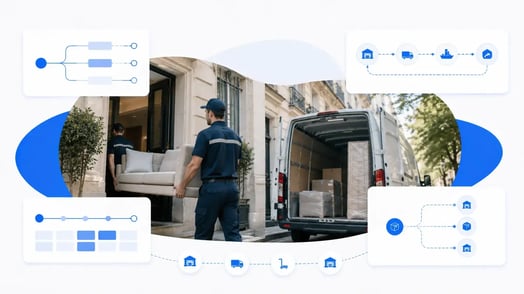
White glove delivery is a premium logistics service for large, fragile, or high-value products that goes beyond standard curbside drop-off. It typically includes appointment scheduling, delivery to a specific room, unpacking, assembly or installation, and removal of packaging materials.
Unlike standard parcel delivery, white glove delivery generally involves two-person delivery teams, specialized vehicles equipped with lift gates or protective padding, and dedicated handling protocols designed to prevent product damage during transport.
This service model is widely used for furniture, major appliances, mattresses, fitness equipment, electronics, and other oversized or high-value goods where a poor delivery experience would directly harm customer satisfaction and brand reputation.
What is last mile logistics?
Last mile logistics refers to the final stage of the supply chain, where products are delivered from a distribution hub, warehouse, or local depot to the end customer.
Although it represents only a small portion of the total transportation distance, the last mile often accounts for a significant share of overall logistics costs.
For bulky products, this stage becomes even more complex because deliveries frequently require:
- appointment scheduling;
- specialized handling;
- multiple operators;
- vehicle access management;
- urban delivery restrictions;
- installation or assembly services.
The quality of the last mile experience directly impacts customer satisfaction and brand perception. For large products, last mile operations are closely linked to furniture logistics, where handling constraints, delivery appointments, and return flows are particularly complex.
Why bulky goods create additional challenges
Delivering a small parcel and delivering an American-style refrigerator are two completely different logistics operations. Large products require more planning, more resources, and greater coordination between all stakeholders.
Common challenges include:
- limited vehicle accessibility in urban areas;
- delivery appointment management;
- failed delivery attempts;
- product damage risks;
- high handling costs;
- longer delivery times;
- complex returns processes.
These constraints significantly increase operational costs compared with traditional parcel delivery.
The growing importance of reverse logistics
For retailers, delivery is only half the equation. Returns have become a critical component of customer experience, particularly in e-commerce. According to the National Retail Federation, returns represent a growing share of total retail sales, and the cost of processing them rises sharply for oversized items.
When a customer decides to return a bulky product, the process is far more complicated than simply dropping off a parcel at a collection point.
Consider the example of a refrigerator purchased online. The customer must:
- contact customer service;
- validate return eligibility;
- schedule a collection;
- prepare the product for pickup.
Meanwhile, the retailer must coordinate:
- transportation;
- product inspection;
- refurbishment or repackaging;
- inventory reintegration;
- recycling when necessary.
This process generates substantial operational costs and requires complete visibility across the reverse logistics chain.
The key challenges facing retailers
Simplifying the customer experience
Consumers increasingly expect frictionless delivery and return experiences.
Retailers must provide:
- clear instructions;
- easy scheduling options;
- real-time visibility;
- flexible delivery windows.
The easier the process becomes, the higher customer satisfaction tends to be.
Improving traceability
Large products often move through multiple logistics partners before reaching their final destination. End-to-end visibility is therefore essential.
Real-time shipment tracking helps retailers:
- reduce customer inquiries;
- improve operational efficiency;
- resolve incidents faster;
- enhance service quality.
Controlling transportation costs
Bulky product logistics generates higher transportation costs due to:
- lower vehicle utilization;
- additional handling requirements;
- longer service times;
- failed delivery risks.
Optimizing routes and consolidating deliveries becomes critical for profitability. Many companies rely on route optimization software to improve delivery efficiency and reduce unnecessary mileage.
Reducing environmental impact
Last mile logistics is also under pressure to reduce emissions. Cities are introducing new regulations designed to limit congestion and pollution, forcing logistics providers to rethink traditional delivery models.
Urban logistics: a growing challenge
Large cities present unique operational constraints.
Carriers must manage:
- restricted access zones;
- delivery time windows;
- parking limitations;
- traffic congestion;
- environmental regulations.
These factors increase operational complexity and reduce delivery productivity. A growing number of cities are introducing zero- and low-emission delivery zones, as documented by the World Resources Institute, which directly affect how carriers plan bulky item deliveries in dense urban areas.
As urban populations continue to grow, logistics providers must develop smarter delivery networks capable of handling increasing volumes while reducing their environmental footprint.
How technology improves bulky goods logistics
Digital platforms are transforming the way retailers and logistics providers manage deliveries and returns.
Modern logistics solutions allow organizations to:
- automate appointment scheduling;
- centralize customer communications;
- provide real-time tracking;
- manage reverse logistics workflows;
- improve carrier coordination.
The result is greater visibility, faster response times, and improved customer satisfaction. For retailers managing high volumes of online orders, e-commerce logistics strategies are essential to synchronize inventory, delivery promises, and customer experience.
XXL lockers: an emerging solution
One innovative approach gaining attention is the development of oversized parcel lockers designed specifically for bulky products.
Solutions such as those developed by E-Picking provide secure storage locations capable of handling large items including furniture and household appliances.
These XXL lockers offer several advantages:
- 24/7 accessibility;
- reduced failed delivery attempts;
- consolidated delivery routes;
- lower transportation costs;
- improved traceability;
- reduced CO₂ emissions.
For logistics providers, these facilities can act as urban consolidation points, improving both delivery and return operations.
Why flow consolidation matters
One of the most effective ways to reduce last mile costs is through shipment consolidation.
By grouping deliveries and returns within the same geographical area, companies can:
- increase vehicle utilization;
- reduce empty miles;
- lower transportation costs;
- improve driver productivity;
- reduce carbon emissions.
Consolidation becomes particularly valuable for bulky products, where transportation costs represent a significant portion of the total logistics budget. This approach is part of broader logistics management strategies focused on cost control, service quality, and operational efficiency.
The future of bulky goods delivery
The future of last mile logistics for oversized products will be shaped by several trends:
- greater digitalization of delivery operations;
- increased use of appointment scheduling tools;
- urban consolidation centers;
- alternative delivery networks;
- enhanced reverse logistics capabilities;
- stronger sustainability requirements.
Companies that invest in visibility, automation, and collaborative logistics networks will be better positioned to manage growing customer expectations while maintaining profitability.
Conclusion
Managing the delivery and return of bulky products remains one of the biggest challenges in modern logistics.
From customer experience and transportation costs to urban regulations and sustainability goals, every stage of the process requires careful coordination.
By combining digital tools, real-time visibility, shipment consolidation, and innovative solutions such as XXL lockers, retailers and logistics providers can improve operational efficiency while delivering a better white glove customer experience.
As e-commerce continues to grow, mastering last mile and reverse logistics for bulky goods will become an increasingly important competitive advantage.