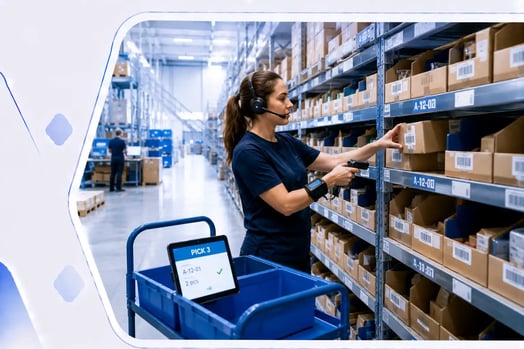
Voice picking is a warehouse order fulfillment method in which operators receive picking instructions through a headset and confirm their actions verbally, allowing them to keep both their hands and eyes free throughout the picking process. Connected to the Warehouse Management System (WMS) through a voice-directed work (VDW) solution, operators move through the warehouse in a continuous audio workflow, eliminating the need to carry scanners, read paper pick lists, or interact with handheld screens.
As warehouses face increasing pressure to improve productivity, reduce picking errors, and onboard temporary workers more quickly, voice picking has become one of the most mature and effective warehouse execution technologies.
This guide explains how voice picking works, compares it with other order-picking methods, explores the hardware and software required, and provides practical guidance for evaluating and implementing a voice-directed picking solution.
What is voice picking?
Voice picking, also known as voice-directed warehousing (VDW) or pick by voice, is an order-picking method based on a continuous audio dialogue between the warehouse operator and the Warehouse Management System.
The workflow is simple:
- The system speaks.
- The operator listens.
- The operator responds verbally.
- The system validates the response and issues the next instruction.
Instead of following a paper list or scanning barcodes with a handheld device, operators wear:
- a rugged wearable terminal;
- a wireless headset with a noise-cancelling microphone.
All communication takes place through voice commands.
Unlike traditional RF scanning, there is no device to hold, no screen to read, and no barcode to scan during the picking cycle.
Voice picking first appeared in industrial warehouses in the early 2000s with Vocollect (now part of Honeywell). Today, it is a mature technology that integrates with most leading Warehouse Management Systems and is widely used in retail, grocery, pharmaceuticals, manufacturing, and cold-chain logistics.
How voice picking works : step by step
A typical voice-picking workflow follows a structured sequence from login to task completion.
Step 1: Operator login and task assignment
The operator logs into the system using the headset.
Example dialogue:
System: "Ready."
Operator: "Warehouse 3, John."
System: "John, you have a pick task. Go to aisle 7, location B-14."
The voice middleware retrieves the task directly from the Warehouse Management System and immediately guides the operator to the first picking location.
Step 2: Travel and check-digit validation
After arriving at the storage location, the operator reads the check digit displayed on the shelf.
Example:
System: "Aisle 7, location B-14. Say the check digit."
Operator: "Four seven."
System: "Pick six units of SKU 00842."
The check digit is one of the most important accuracy mechanisms in voice picking.
Rather than relying solely on the aisle or location number, the operator must verbally confirm a short numeric code printed at the pick location.
If the code doesn't match the expected value, the system immediately stops the workflow and requests another verification before allowing the pick to continue.
This simple validation process is responsible for much of the 99.9% picking accuracy commonly associated with voice-directed systems.
Step 3: Quantity confirmation
Once the products have been picked, the operator confirms the quantity verbally.
Example:
Operator: "Six."
System: "Confirmed. Go to aisle 12, location C-03."
The system immediately validates the transaction and sends the next instruction.
No barcode scanning or manual confirmation is required.
Step 4: Deposit and task completion
At the end of the picking route, the operator receives instructions for the staging area.
Example:
System: "Deposit to door 4, pallet 2."
Operator: "Done."
System: "Task complete. New task: go to aisle 5, location A-09."
The completed task is automatically recorded in the WMS, allowing supervisors to monitor productivity and order progress in real time.
When combined with loading dock management software and efficient order fulfillment processes, voice picking creates a seamless flow from warehouse picking to outbound shipping.
Hardware required for voice picking
A voice-picking solution typically consists of three hardware components.
Wearable terminal
The wearable terminal is a rugged mobile computer worn on the operator's belt or arm.
It is responsible for:
- connecting to the WMS over Wi-Fi;
- running the voice middleware;
- processing speech recognition;
- generating text-to-speech instructions.
Leading hardware vendors include:
- Honeywell
- Zebra Technologies
- Ivanti
Depending on the operating environment, terminals must be certified for:
- ambient warehouses;
- chilled environments;
- freezer operations.
Noise-cancelling headset
The headset is the primary interface between the operator and the system.
Industrial warehouses often generate ambient noise levels between 75 and 95 dB, making high-quality noise-cancelling microphones essential for reliable speech recognition.
Unlike consumer headsets, industrial models are designed for durability, comfort, and long operating shifts.
Wireless network infrastructure
Voice picking depends entirely on reliable wireless connectivity.
Before deployment, warehouses should evaluate:
- Wi-Fi coverage;
- access point density;
- roaming performance;
- dead zones.
Poor wireless coverage remains one of the most common causes of voice-picking performance issues.
The software layer
Voice-picking software acts as the bridge between the Warehouse Management System (WMS) and the wearable hardware. Its primary role is to convert WMS picking tasks into spoken instructions while interpreting the operator's verbal responses and sending confirmations back to the warehouse management system.
Two main software approaches are available.
WMS-native voice modules
Several leading WMS providers offer voice picking as a built-in capability within their warehouse execution layer.
Examples include:
- SAP Extended Warehouse Management (EWM)
- Manhattan Associates
- Blue Yonder
- Körber Warehouse Management
The main advantage of this approach is the elimination of an additional middleware layer, simplifying system architecture and reducing integration complexity.
However, voice functionality generally follows the WMS release cycle, which can limit flexibility when introducing new features.
Third-party voice platforms
Many organizations prefer dedicated voice middleware that integrates with multiple Warehouse Management Systems through APIs.
Leading providers include:
- Honeywell Vocollect
- Lydia Voice (EPG Group)
- Lucas Systems
- Ivanti Wavelink
These platforms generally provide:
- broader hardware compatibility;
- advanced speech recognition capabilities;
- more flexible deployment options;
- easier upgrades independent of the WMS.
This approach is often preferred by companies operating multiple warehouses with different WMS platforms.
Speaker-dependent vs. speaker-independent recognition
Earlier generations of voice-picking systems required each operator to complete a voice enrollment session before using the system.
Operators spent around 20 to 30 minutes reading calibration phrases so the software could learn their speech patterns.
Modern voice-picking solutions use speaker-independent speech recognition, allowing new employees to begin working immediately without voice training.
This dramatically reduces onboarding time, particularly for seasonal workers and temporary staff.
Voice picking vs. other picking methods
Choosing a picking technology depends on warehouse layout, SKU profile, labor availability, and throughput requirements.
| Method | Accuracy | Productivity | Hands-free | Eyes-free | Best suited for |
|---|---|---|---|---|---|
| Paper picking | ~99.0% | Baseline | ❌ | ❌ | Small warehouses |
| RF scanning | ~99.5% | +5–10% | ❌ | ❌ | Standard warehouse operations |
| Pick-to-light | ~99.9% | +20–35% | Partial | ❌ | High-volume fixed picking zones |
| Voice picking | ~99.9% | +10–25% | ✅ | ✅ | Mixed SKU, wide-area and cold storage operations |
| Vision picking | ~99.9% | +10–20% | ✅ | Partial | High-value and complex picking |
The greatest advantage of voice picking is that operators never need to look at a screen or hold a handheld scanner.
This makes it particularly effective in environments where mobility and safety are critical.
Unlike pick-to-light, which requires fixed hardware installed at every storage location, voice picking scales across the warehouse without additional infrastructure at each picking position.
For warehouses operating a combination of pick and pack processes and warehouse optimization initiatives, voice picking often provides the best balance between flexibility, accuracy, and deployment cost.
Benefits of voice picking
Higher picking accuracy
One of the strongest arguments for voice picking is accuracy.
Industry deployments consistently report picking accuracy rates above 99.9%, largely thanks to the check-digit validation process.
For example, a warehouse processing 5,000 picks per day with a mispick cost of $20 could save tens of thousands of dollars annually simply by reducing picking errors.
Fewer errors also result in:
- fewer customer complaints;
- fewer returns;
- lower reshipping costs;
- improved inventory accuracy.
Increased productivity
Voice picking removes the barcode scanning step from every pick.
Although this saves only 2 to 4 seconds per picking line, those seconds accumulate quickly across thousands of daily picks.
Most organizations report productivity improvements between 10% and 25%, depending on warehouse layout and travel distances.
Faster onboarding
Thanks to speaker-independent speech recognition, new operators can become productive within their first hour.
This is particularly valuable during seasonal peaks when warehouses rely heavily on temporary labor.
Improved ergonomics and safety
Because operators keep both hands free and maintain visual awareness of their surroundings, voice picking contributes to safer warehouse operations.
Benefits include:
- reduced repetitive movements;
- improved situational awareness;
- lower risk of accidents involving forklifts and other warehouse equipment.
Excellent performance in cold storage
Voice picking performs particularly well in refrigerated and frozen warehouses.
Unlike handheld scanners and touchscreens, which become difficult to operate with insulated gloves, voice-controlled workflows remain efficient even at temperatures below −25°C.
This explains why voice picking has become one of the preferred technologies in cold-chain logistics and temperature-controlled distribution centers.
Limitations and challenges
Although voice picking delivers significant operational benefits, it is not the ideal solution for every warehouse. Organizations should evaluate several technical and operational constraints before deployment.
High ambient noise
Very noisy environments can reduce speech recognition accuracy.
Areas located near:
- heavy machinery;
- automated conveyor systems;
- loading docks;
- outdoor operations;
may exceed 95 dB, making voice recognition more difficult despite modern noise-cancelling headsets.
For this reason, a warehouse noise assessment should always be carried out before implementation.
Multilingual workforces
Modern speaker-independent systems recognize a wide range of accents, but warehouses employing operators who speak multiple languages may require additional testing during the pilot phase.
Many voice platforms support multilingual environments, although configuration complexity varies from one vendor to another.
WMS integration complexity
Voice picking is not a plug-and-play technology.
The Warehouse Management System must:
- expose picking tasks to the voice platform;
- receive verbal confirmations as valid warehouse transactions;
- synchronize inventory updates in real time.
Older WMS platforms with limited API capabilities may require additional integration work before deployment.
Organizations already using a modern Warehouse Management System generally benefit from a simpler implementation.
Change management
For operators accustomed to RF scanners or paper pick lists, speaking continuously to a system can initially feel unfamiliar.
Successful implementations therefore invest heavily in:
- pilot programs;
- operator involvement;
- structured training;
- internal champions.
Technology adoption is often more dependent on change management than on the technology itself.
Voice picking ROI and business case
A voice-picking project is usually justified through improvements in three measurable areas:
- reduced picking errors;
- higher productivity;
- faster employee onboarding.
Error cost reduction
Reducing picking errors has an immediate financial impact.
A simple calculation is:
Daily picks × Current error rate × Cost per picking error × Working days
Example:
- 5,000 picks/day
- 0.5% error rate
- $20 per picking error
- 250 working days
Annual cost of picking errors:
$125,000
Reducing the error rate from 0.5% to 0.1% lowers annual error costs to approximately $25,000, generating savings of roughly $100,000 per year.
Productivity improvement
Removing barcode scanning typically saves 2 to 4 seconds per picking line.
A simplified calculation is:
Daily picks × Seconds saved per pick × Hourly labor cost ÷ 3,600
Even modest time savings translate into meaningful labor productivity gains across thousands of daily picks.
Faster onboarding
Speaker-independent speech recognition significantly reduces operator training time.
Example:
- 50 new employees each year;
- 4 training hours saved per employee;
- $18/hour labor cost.
Annual onboarding savings:
Approximately $3,600.
Typical payback period
For a warehouse with approximately 10 operators, a voice-picking implementation generally represents an investment between $150,000 and $200,000, including:
- hardware;
- software;
- integration;
- implementation services.
Most successful projects achieve a return on investment within 12 to 24 months, depending on:
- current picking accuracy;
- warehouse layout;
- labor costs;
- implementation quality.
How to implement voice picking
A structured implementation significantly increases the likelihood of success.
Step 1: Assess WMS readiness
Confirm that your WMS can:
- expose picking tasks;
- communicate with voice middleware;
- receive voice confirmations.
This assessment often identifies the largest technical risks before the project begins.
Step 2: Evaluate the warehouse environment
Review:
- Wi-Fi coverage;
- warehouse noise levels;
- temperature zones;
- existing hardware.
Environmental conditions directly influence hardware selection and speech recognition performance.
Step 3: Select the right vendor
Evaluate vendors based on:
- WMS compatibility;
- hardware ecosystem;
- multilingual support;
- implementation methodology;
- long-term technical support.
Whenever possible, request a proof of concept using your own warehouse processes rather than a generic demonstration.
Step 4: Launch a pilot
Instead of deploying warehouse-wide immediately, begin with:
- one warehouse zone;
- one shift;
- approximately 8 to 15 operators.
Before go-live, establish baseline KPIs such as:
- picks per hour;
- picking accuracy;
- training duration.
Running a pilot for four to eight weeks provides reliable performance data before expanding deployment.
Step 5: Support operators through the transition
Successful projects actively involve warehouse teams from the beginning.
Operators who participate in testing typically adopt the technology more quickly than those introduced only after deployment.
Step 6: Measure performance before scaling
Compare pilot KPIs against baseline performance.
If objectives are achieved, expand progressively to additional warehouse zones.
If not, resolve issues such as:
- Wi-Fi coverage;
- speech recognition accuracy;
- workflow configuration;
- WMS integration.
Scaling should only begin once pilot performance is stable.
Leading voice-picking vendors
Several providers dominate today's voice-directed warehouse market.
Honeywell Vocollect
The global market leader, offering one of the largest ecosystems for:
- wearable hardware;
- industrial headsets;
- WMS integrations.
Honeywell remains the benchmark solution for enterprise warehouse operations.
Lydia Voice (EPG)
Particularly strong across Europe, Lydia Voice is widely deployed in:
- retail;
- food and beverage;
- pharmaceutical logistics.
Its multilingual capabilities make it well suited for international warehouse environments.
Zebra Technologies
Zebra combines wearable terminals with voice software, making it an attractive option for organizations already standardized on Zebra mobile devices.
Lucas Systems
Lucas Systems focuses on voice-directed work integrated into broader warehouse execution capabilities.
Its solutions are especially popular within grocery and food distribution.
WMS-native solutions
Several major Warehouse Management Systems now include built-in voice modules, including:
- SAP EWM;
- Manhattan Associates;
- Blue Yonder;
- Körber Warehouse Management.
These native solutions often simplify deployment by reducing middleware requirements.
Final thoughts
Voice picking has become one of the most mature and effective warehouse execution technologies available today.
By allowing operators to work hands-free and eyes-free, it improves picking accuracy, increases productivity, enhances workplace safety, and reduces training time. These benefits are particularly valuable in large warehouses, cold-storage facilities, and operations with complex picking routes or seasonal labor requirements.
However, successful deployment depends on more than selecting the right hardware. Organizations should carefully evaluate WMS integration, wireless network coverage, warehouse noise levels, and operator adoption before rolling out a solution. A structured pilot project, combined with strong change management, is often the key to long-term success.
When integrated with technologies such as a Warehouse Management System (WMS), order fulfillment software, warehouse optimization, and pick and pack processes, voice picking enables organizations to build faster, more accurate, and more scalable warehouse operations.