
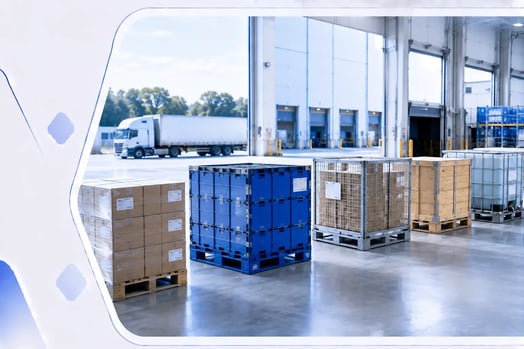
Transportation can represent between 40% and 60% of total logistics costs, depending on the industry. Improving vehicle utilization, reducing handling operations, and maximizing storage efficiency all depend on one critical element: the logistics load unit.
Whether goods are transported on pallets, in containers, inside swap bodies, or on specialized carriers, the way products are grouped and handled has a direct impact on operational performance, transportation costs, warehouse productivity, and sustainability.
Beyond the physical support itself, load units are now fully integrated into modern supply chains through WMS software, Transportation Management Systems (TMS), barcode systems, RFID technologies, and GS1 identification standards.
In this guide, you'll learn what a logistics load unit is, the different types used across supply chains, and why load unit optimization has become a strategic priority for logistics teams.
What is a logistics load unit?
A logistics load unit is a group of products assembled on a support structure so they can be handled, stored, tracked, and transported as a single entity.
The objective is to:
- Simplify handling operations
- Improve transportation efficiency
- Optimize warehouse space
- Reduce product damage
- Minimize load breaks throughout the supply chain
Typical examples include:
- Pallets
- Containers
- Roll cages
- Swap bodies
- Industrial racks
- Bulk bags
Load units allow logistics operators to move multiple products simultaneously instead of handling individual items separately.
By reducing the number of handling operations, load units improve productivity while lowering operational costs and reducing the risk of product damage.
Understanding load unitization
The concept behind logistics load units is known as load unitization.
Load unitization consists of grouping multiple products, cartons, or packages into a single handling and transportation unit.
This principle has become a foundation of modern logistics because it allows organizations to:
- Increase handling productivity
- Reduce transportation costs
- Improve warehouse efficiency
- Strengthen product protection
Containerization is one of the most widely recognized examples of load unitization, enabling goods to move seamlessly between road transport, rail transport, and sea freight networks.
Modern logistics networks increasingly rely on intermodal transportation to improve flexibility while reducing costs and environmental impact.
Load unit vs logistics unit vs handling unit
These concepts are often confused, despite serving different purposes.
Load unit
A load unit is the physical grouping of goods on a support structure.
Examples include:
- A stretch-wrapped pallet
- A loaded roll cage
- A full container
The concept focuses primarily on physical movement and handling.
Logistics unit
A logistics unit is an identifiable entity within supply chain systems such as ERP, WMS, and TMS platforms.
Each logistics unit contains associated information such as:
- Destination
- Quantity
- Batch number
- Serial number
- Shipping information
A logistics unit may also be a load unit, but includes traceability and data management capabilities.
Handling unit
A handling unit is any load designed to be moved as a single entity using material handling equipment.
Examples include:
- Pallets
- Containers
- Roll cages
- Industrial racks
The focus here is operational handling rather than transportation or data management.
Transportation unit
A transportation unit refers to the equipment used to move goods across a transport network.
Examples include:
- ISO containers
- Swap bodies
- Semi-trailers
- Air cargo units
Transportation units are often standardized to facilitate multimodal transport operations and improve compatibility across logistics networks.
The hierarchy of logistics units
Products typically move through several levels of grouping before reaching the end customer.
Consumer unit
The individual item purchased by the customer.
Examples include:
- A bottle
- A smartphone
- A garment
Carton or case
Multiple consumer units grouped together.
For example:
- A carton containing 12 bottles
- A case containing 24 products
Pallet
Several cartons assembled on a pallet and secured using stretch wrap or strapping.
The pallet becomes a handling unit and storage unit.
Container
Multiple pallets or loose goods loaded into a container for transportation.
This represents the highest level of unitization in international logistics.
This hierarchical structure improves handling efficiency while maintaining traceability throughout the supply chain.
Types of logistics load units
Different logistics operations require different types of load units.
Pallets
The pallet remains the most widely used logistics load unit worldwide.
Common formats include:
- Euro pallet (1200 × 800 mm)
- Industrial pallet (1200 × 1000 mm)
Pallets can be:
- Reusable
- Returnable
- Disposable
Key benefits include:
- Standardization
- Equipment compatibility
- Efficient storage
- Easy handling
Containers
Containers are the foundation of international freight transport.
The most common formats are:
- 20-foot containers
- 40-foot containers
Specialized variants include:
- Dry containers
- Reefer containers
- Open-top containers
Containers support seamless transportation between ships, trains, and trucks while improving asset utilization and cargo protection.
Swap bodies
Swap bodies are widely used across European transportation networks.
Unlike maritime containers, they are optimized primarily for road and rail transportation.
Benefits include:
- High volume capacity
- Efficient intermodal operations
- Reduced handling requirements
- Faster loading and unloading
Specialized carriers
Certain industries require dedicated load units.
Examples include:
- Roll cages for retail distribution
- Bulk bags for chemicals and food products
- Metal racks for automotive logistics
- Long-load racks for construction materials
These solutions improve safety and operational efficiency for specific product categories.
Traceability and load unit identification
Modern logistics requires complete visibility over load unit movements.
This is achieved through standardized identification technologies and digital supply chain platforms.
SSCC and GS1 standards
The Serial Shipping Container Code (SSCC) is a globally recognized identifier developed by GS1.
Each logistics unit receives a unique identification number.
Benefits include:
- Global traceability
- Unique identification
- Reduced shipping errors
- Improved visibility
Logistics labels
GS1 logistics labels typically include:
- SSCC number
- Product information
- Quantity
- Batch information
- Expiration dates when applicable
Standardized labeling improves data accuracy throughout the supply chain.
RFID technology
RFID technology allows logistics operators to identify and track multiple units simultaneously without direct scanning.
Advantages include:
- Faster inventory counts
- Improved warehouse visibility
- Reduced human error
- Better supply chain synchronization
Combined with modern shipment tracking solutions, RFID provides real-time visibility throughout the logistics network.
How WMS and TMS platforms manage load units
Load units become significantly more valuable when connected to supply chain software.
Warehouse Management Systems (WMS)
A WMS tracks:
- Storage locations
- Inventory movements
- Picking activities
- Replenishment operations
Every barcode or RFID scan updates inventory records in real time.
Modern warehouse management software helps organizations improve inventory accuracy while optimizing warehouse productivity.
Transportation Management Systems (TMS)
A TMS manages:
- Transportation planning
- Carrier assignment
- Shipment tracking
- Delivery performance
Organizations using dedicated TMS software gain greater transportation visibility and stronger control over logistics costs.
By connecting load unit information to transportation workflows, companies gain end-to-end visibility across the supply chain.
Metric vs imperial units in global logistics
International supply chains frequently operate across regions using different measurement systems.
Most countries use the metric system:
- Kilograms
- Meters
- Cubic meters
The United States and some other markets continue to use imperial measurements:
- Pounds
- Feet
- Cubic feet
Incorrect conversions can lead to:
- Freight rating errors
- Incorrect dimensional weight calculations
- Customs issues
- Loading capacity problems
Modern transportation platforms automatically convert measurements and ensure consistency across global operations.
Why load units are strategic for supply chain performance
Load units influence nearly every logistics process.
Improved handling efficiency
Standardized units reduce manual handling and speed up operations.
Better transportation utilization
Efficient load design improves truck, container, and trailer fill rates.
Lower logistics costs
Reduced handling and improved asset utilization help companies reduce supply chain costs while improving overall profitability.
Improved product protection
Properly designed load units reduce damage during storage and transportation.
This also reduces claims and administrative workload associated with damaged shipments.
Lower carbon emissions
Higher load density means fewer trips and better transportation efficiency.
This contributes directly to broader supply chain optimization initiatives and sustainability objectives.
The impact of load units on warehouse operations
Warehouse performance is closely linked to load unit design and standardization.
Benefits include:
- Better slotting strategies
- Improved storage density
- Faster picking operations
- Reduced warehouse travel distances
- Improved inventory accuracy
Organizations using modern warehouse inventory management software can further improve the efficiency of load unit management by gaining real-time inventory visibility and stronger warehouse control.
When combined with dock appointment scheduling and warehouse planning tools, standardized load units significantly improve operational efficiency.
For logistics service providers operating multiple warehouses, integrating load units with a 3PL WMS can further streamline inventory visibility and operational coordination.
Best practices for load unit management
Organizations seeking to improve logistics performance should follow several key principles.
Select the right load unit
Choose carriers and supports according to:
- Product characteristics
- Weight
- Dimensions
- Fragility
- Transportation mode
Standardize formats
Reducing the number of load unit formats simplifies warehouse and transportation operations.
Standardization also improves compatibility between warehouse and transportation systems.
Improve traceability
Implement:
- Barcodes
- SSCC identification
- RFID technology
These technologies improve visibility and support data-driven decision-making.
Plan for peak periods
Ensure sufficient availability of:
- Pallets
- Containers
- Racks
- Dock capacity
Organizations relying on strong logistics planning often integrate load unit forecasting into broader logistics scheduling processes.
Monitor performance
Track indicators such as:
- Fill rates
- Cost per load unit
- Damage rates
- Handling productivity
Many organizations monitor these metrics through dedicated supply chain KPIs dashboards to identify improvement opportunities and measure operational performance.
Connect warehouse and transportation data
The greatest value comes when load units are connected across the entire supply chain.
Integrating warehouse systems, transportation platforms, and inventory data helps create a single source of truth.
For example, understanding the differences between ERP and WMS solutions can help organizations design more efficient information flows between inventory management and warehouse execution.
Likewise, implementing a freight management system enables companies to connect transportation execution with load unit planning and performance monitoring.
Conclusion
The logistics load unit may appear simple, but it plays a critical role in transportation efficiency, warehouse productivity, traceability, and supply chain performance.
From pallets and containers to specialized industrial carriers, choosing the right load unit strategy helps organizations reduce costs, improve service levels, increase visibility, and support sustainability objectives.
As supply chains become increasingly digitized, load units are no longer just physical supports. They are data-driven assets that connect warehouse operations, transportation management, and end-to-end supply chain visibility.
Organizations that combine standardized load units, digital traceability tools, modern warehouse systems, and transportation management platforms will be best positioned to improve operational performance in 2026 and beyond.