
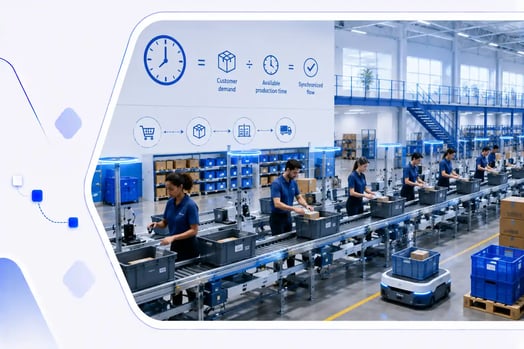
In logistics and manufacturing, efficiency depends on one key challenge: matching operational capacity with customer demand.
Produce too slowly and deliveries are delayed. Move too quickly and resources are wasted. Finding the right balance is essential for maintaining productivity, controlling costs, and meeting service expectations.
This is where Takt Time comes in.
Originally developed as part of Lean Manufacturing, Takt Time has become a powerful planning tool for manufacturers, warehouses, and distribution centers looking to synchronize operations with actual demand.
In this guide, you'll learn what Takt Time is, how to calculate it, how it differs from Cycle Time and Lead Time, and how it can improve logistics performance.
What is Takt Time?
Takt Time represents the pace at which a product, order, or operation must be completed to satisfy customer demand.
The term originates from the German word "Taktzeit," meaning rhythm or beat. The concept was later popularized by Japanese manufacturers as part of the Toyota Production System.
Rather than focusing on how fast a task can be completed, Takt Time focuses on how fast it needs to be completed.
It provides a target operational rhythm that aligns available capacity with customer requirements.
In logistics environments, Takt Time can be applied to:
- Receiving operations
- Order picking
- Packing activities
- Shipping processes
- Loading dock operations
- Distribution center workflows
The objective is to create a consistent flow while avoiding bottlenecks, idle time, and resource overload.
Takt Time vs Cycle Time vs Lead Time
These three metrics are frequently confused, but they measure different aspects of performance.
Takt Time
Takt Time defines the required pace of work based on customer demand.
It answers the question:
"How often must we complete a task to satisfy demand?"
Cycle Time
Cycle Time measures the actual time needed to complete a specific operation.
It answers the question:
"How long does it really take to complete the task?"
Lead Time
Lead Time measures the total elapsed time between order placement and final delivery.
It answers the question:
"How long does the customer wait?"
A simple example:
- Takt Time = 60 seconds
- Cycle Time = 50 seconds
- Lead Time = 3 days
In this situation, the operation is performing faster than required, while the customer receives the product within three days.
How to calculate Takt Time
The standard formula is straightforward:
Takt Time = Available production time ÷ Customer demand
The calculation requires two pieces of information:
- Available working time
- Customer demand during the same period
Example
A distribution center operates 8 hours per day and must process 1,200 orders.
Available time:
8 hours × 60 minutes × 60 seconds = 28,800 seconds
Customer demand:
1,200 orders
Calculation:
Takt Time = 28,800 ÷ 1,200
Takt Time = 24 seconds
This means the operation must complete one order every 24 seconds to meet customer demand.
The figure does not necessarily represent the work of a single employee. Instead, it represents the required pace of the overall process.
Practical examples of Takt Time
Automotive manufacturing
A factory assembles 500 vehicles during a 16-hour production shift.
Available time:
57,600 seconds
Customer demand:
500 vehicles
Takt Time:
115 seconds per vehicle
The production line must therefore complete one vehicle every 115 seconds.
Warehouse receiving operations
A warehouse expects 300 inbound deliveries during a 10-hour shift.
Available time:
36,000 seconds
Customer demand:
300 deliveries
Takt Time:
120 seconds per delivery process
This target helps managers allocate labor and equipment effectively.
Parcel fulfillment
A fulfillment center processes 5,000 parcels during a 10-hour shift.
Available time:
36,000 seconds
Demand:
5,000 parcels
Takt Time:
7.2 seconds per parcel
This calculation helps determine staffing levels and process requirements.
Why Takt Time matters in logistics
Better resource allocation
Takt Time helps warehouse managers determine whether current resources can support expected demand.
It allows companies to:
- Balance workloads
- Reduce idle time
- Prevent operational overload
- Improve labor planning
Smoother warehouse flows
When activities are synchronized with demand, warehouse operations become more predictable.
This reduces:
- Congestion
- Waiting times
- Bottlenecks
- Inventory accumulation
Improved customer service
Aligning operations with demand contributes to:
- Faster order processing
- Better delivery performance
- Improved service levels
- Higher customer satisfaction
Benefits of using Takt Time
Reduced operational costs
When workflows are balanced correctly, companies avoid unnecessary labor costs and operational inefficiencies.
This helps reduce:
- Overtime expenses
- Equipment underutilization
- Process waste
Greater productivity
Takt Time encourages continuous process improvement.
By comparing actual Cycle Time with required Takt Time, organizations can quickly identify performance gaps and optimization opportunities.
Better inventory management
Balanced workflows help limit excess inventory while reducing the risk of stock shortages.
This supports more efficient supply chain management and broader supply chain optimization initiatives.
Improved operational visibility
Takt Time provides a clear performance benchmark that managers can monitor continuously.
Teams immediately understand whether operations are keeping pace with demand.
Challenges when implementing Takt Time
Although highly valuable, Takt Time has limitations.
Demand variability
Customer demand rarely remains constant.
Seasonal peaks, promotions, and unexpected order surges can make Takt Time difficult to maintain.
Supplier disruptions
Late deliveries or inventory shortages can affect operational performance and disrupt planned workflows.
Equipment failures
Unexpected downtime increases Cycle Time and can create bottlenecks throughout the operation.
Workforce constraints
Staff shortages or skill gaps may prevent teams from maintaining the required operational pace.
Because of these challenges, Takt Time should be viewed as a dynamic management tool rather than a fixed target.
Using technology to support Takt Time
Digital tools help logistics organizations adapt more effectively to changing conditions.
Warehouse management software, TMS software, and dock scheduling platforms provide the visibility needed to monitor and adjust operations in real time.
These technologies allow companies to:
- Track throughput rates
- Monitor workload distribution
- Predict bottlenecks
- Optimize labor allocation
- Improve flow synchronization
How Shiptidock supports operational flow management
Although Takt Time is primarily a planning metric, its effectiveness depends heavily on the smooth movement of goods throughout the facility.
Loading docks often represent one of the most critical points in warehouse operations.
When trucks arrive late, too early, or in excessive volumes, warehouse workflows become disrupted and productivity declines.
Shiptidock helps companies maintain smoother operations by:
- Scheduling inbound and outbound appointments
- Balancing workloads throughout the day
- Reducing dock congestion
- Improving visibility on expected arrivals
- Allocating resources more effectively
- Minimizing waiting times
By creating a more predictable flow of vehicles and goods, Shiptidock helps warehouse teams operate closer to their target rhythm and maintain higher operational efficiency.
Best practices for managing Takt Time
To maximize the benefits of Takt Time, organizations should:
- Review demand forecasts regularly
- Monitor Cycle Time continuously
- Balance workloads across teams
- Invest in process automation
- Improve warehouse visibility
- Eliminate operational bottlenecks
- Use real-time performance dashboards
Continuous monitoring and adjustment are essential for maintaining alignment between operational capacity and customer demand.
Companies can also track these improvements through dedicated supply chain KPIs and operational dashboards.
Conclusion
Takt Time is one of the most valuable concepts in Lean operations.
By defining the pace required to meet customer demand, it helps organizations balance workloads, improve productivity, reduce costs, and create smoother logistics flows.
When combined with real-time visibility and digital tools such as WMS, TMS, and dock scheduling software, Takt Time becomes a powerful framework for improving operational performance across the entire supply chain.
Companies that successfully align their operations with demand are better positioned to improve service levels, increase efficiency, and remain competitive in increasingly demanding logistics environments.