
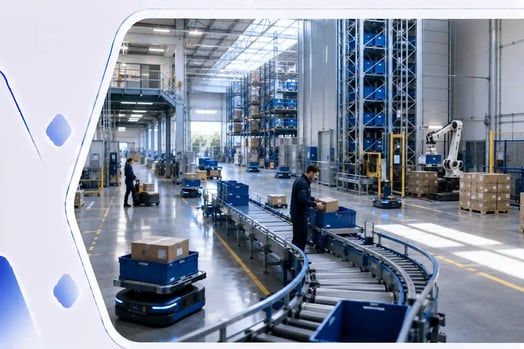
Intralogistics is the discipline of managing, automating and optimizing the flow of materials, goods and information within a single facility, whether that is a warehouse, a distribution center or a manufacturing plant. From the moment a pallet arrives at the loading dock to the second a parcel leaves the dispatch bay, every movement in between is part of intralogistics.
As e-commerce volumes surge and customer expectations for same-day or next-day delivery continue to rise, intralogistics has become one of the most strategically important disciplines in modern operations. Companies that optimize their internal logistics do not just reduce costs, they gain a lasting competitive advantage over slower, less organized competitors.
This guide explains what intralogistics is, how it works, the technologies that power it, and what to consider when evaluating an intralogistics solution for a facility.
What is intralogistics?
Intralogistics is the integrated management of all material and information flows within a facility. The term combines "intra" (Latin for "within") and logistics, describing everything that happens to inventory inside a warehouse or production site before goods leave for customers.
A complete intralogistics operation includes:
- Receiving and unloading inbound goods
- Putaway and storage management
- Inventory tracking and cycle counting
- Order picking and sorting
- Packing and labeling
- Staging and dispatch to outbound transportation
Where traditional logistics focuses on moving goods between locations, from supplier to manufacturer, manufacturer to distributor and distributor to customer, intralogistics focuses on optimizing operations inside each warehouse or distribution center.
Modern intralogistics relies heavily on technology. Warehouse management software, automated conveyors, robotic picking systems, warehouse execution software and AI-driven orchestration platforms all contribute to a more efficient operation.
When these technologies work together as a unified ecosystem, facilities can process more orders, improve inventory accuracy, reduce manual handling, shorten fulfillment times and operate with greater overall efficiency.
Intralogistics vs. logistics: key differences
Although the terms are often used interchangeably, intralogistics and logistics address different parts of the supply chain.
- Scope: intralogistics operates within a single facility, while logistics spans the entire supply chain, from raw material sourcing to final delivery.
- Primary focus: intralogistics concentrates on internal material flow, while logistics concentrates on transportation and distribution between locations.
- Key assets: intralogistics relies on conveyors, warehouse management systems, robots and storage systems, while logistics relies on trucks, carriers and freight networks.
- Main stakeholders: intralogistics is managed by warehouse managers and operations teams, while logistics involves supply chain managers, procurement teams, carriers and third-party logistics providers.
- Primary objective: intralogistics aims to maximize throughput, accuracy and productivity, while logistics aims to minimize lead time and freight costs while maximizing delivery reliability.
Logistics can be thought of as the network connecting facilities, while intralogistics is everything happening inside those facilities.
A company may operate an excellent transportation network, but if warehouse operations are inefficient, shipments will still be delayed and customer satisfaction will decline. This is why intralogistics should be viewed as a critical component of broader logistics management and supply chain optimization initiatives, rather than a separate or secondary concern.
Core components of an intralogistics system
A modern intralogistics system is rarely a single solution. Instead, it combines multiple hardware and software technologies that work together to optimize the movement of goods throughout a facility.
Automated storage and retrieval systems (AS/RS)
Automated Storage and Retrieval Systems, commonly known as AS/RS, store and retrieve inventory automatically using cranes, shuttles or mini-load systems.
Compared with conventional racking, AS/RS can typically:
- Increase storage density significantly, since narrower aisles and taller racking become possible once human access is no longer required
- Reduce retrieval times compared to manual picking
- Improve inventory accuracy by removing manual handling errors
- Minimize physically demanding tasks for warehouse staff
These systems are available for pallet storage, cartons, totes and high-density small-item applications, making them suitable for both industrial warehouses and high-volume e-commerce fulfillment centers.
Conveyor and sortation systems
Conveyors form the backbone of large-scale intralogistics operations by transporting goods efficiently between receiving, storage, picking, packing and shipping areas.
Sortation systems automatically identify products using barcodes or RFID tags and direct them to the correct destination. Modern installations can process very high volumes of items per hour while maintaining high accuracy levels, which makes them essential for high-throughput operations such as parcel hubs and large distribution centers.
Warehouse management systems (WMS)
A Warehouse Management System, or WMS, acts as the operational brain of the warehouse. It manages inventory locations, labor allocation, picking instructions, putaway activities, replenishment and real-time inventory visibility.
The WMS also integrates with ERP platforms, automation equipment and transportation systems to orchestrate every warehouse process, from inbound receiving to outbound shipping.
Warehouse execution systems (WES)
A Warehouse Execution System (WES) sits between the WMS and the physical automation equipment on the warehouse floor. The WMS decides what needs to happen. The WES coordinates how and when it happens in real time, dynamically allocating tasks between conveyors, robots and human operators based on current workload and priorities.
Facilities that combine a WMS with a WES generally achieve better resource utilization. The WES can rebalance work across zones within seconds, rather than relying solely on fixed rules defined in advance.
Autonomous mobile robots (AMRs) and AGVs
Autonomous Mobile Robots, or AMRs, are one of the fastest-growing technologies in modern intralogistics.
Unlike traditional Automated Guided Vehicles, or AGVs, which follow predefined paths, AMRs use onboard sensors, cameras and artificial intelligence to navigate dynamically throughout the warehouse. They can avoid obstacles, adapt to changing layouts and collaborate safely with warehouse operators.
AMRs are commonly used to transport goods between warehouse zones, support goods-to-person operations, automate putaway tasks, replenish picking locations and reduce non-value-added travel time.
Their relatively low deployment cost and rapid return on investment make them an attractive option for facilities seeking to automate progressively rather than through a single, large capital investment.
Picking technologies
Order picking is typically the most labor-intensive and costly warehouse activity. To improve productivity and accuracy, modern intralogistics systems rely on several technologies:
- Voice picking: operators receive spoken instructions through a headset, allowing hands-free and eyes-free operation
- RF scanning: barcode scanners validate picks and update inventory in real time
- Pick-to-light and put-to-light: LED indicators guide operators to the correct storage location and quantity
- Vision-guided robotics: AI-powered robotic arms identify, grasp and move products automatically
These technologies significantly improve throughput while reducing picking errors, especially in high-volume fulfillment centers.
How intralogistics works: the flow of goods
Understanding intralogistics becomes easier by following the journey of a product from receiving to dispatch.
1. Receiving
Inbound shipments arrive at the warehouse, where operators verify deliveries against purchase orders. Products are scanned using barcode or RFID technology before being registered in the WMS.
This first step determines inventory accuracy throughout the rest of the process. Efficient receiving processes are closely linked to well-organized inbound logistics and optimized dock operations.
2. Putaway and storage
Once received, the WMS automatically assigns the optimal storage location according to several criteria, including SKU velocity, product dimensions, weight, turnover frequency and storage constraints.
Fast-moving products are stored close to picking areas, while slow-moving inventory is placed in high-density storage locations.
Some facilities also manage inventory using methods such as First In, First Out (FIFO) or First Expired, First Out (FEFO), depending on product characteristics and shelf-life requirements. Automated AS/RS installations can complete putaway without human intervention.
3. Inventory management
The WMS maintains a perpetual inventory by tracking every product movement inside the warehouse.
Instead of shutting down operations for a full physical inventory count, most facilities now perform continuous cycle counting to verify inventory accuracy while maintaining productivity.
Effective inventory management also requires monitoring appropriate safety stock and stock coverage levels, in order to reduce stockouts without increasing excess inventory.
4. Order picking
When customer orders are received, the WMS generates optimized picking tasks. Depending on the warehouse configuration, two approaches are generally used:
- Person-to-goods: operators travel through storage aisles to collect products
- Goods-to-person: automated systems bring products directly to stationary workstations
The goods-to-person approach significantly reduces walking time, which industry studies commonly estimate to account for roughly half to two thirds of a warehouse operator's working time in manual environments.
5. Sorting and consolidation
After picking, products are consolidated according to customer orders. Sortation systems automatically direct cartons or totes toward the appropriate packing station based on destination, carrier, shipping service and order identification.
This automation improves throughput while reducing manual handling.
6. Packing and labeling
At the packing station, operators or automated machines verify order accuracy, select the appropriate packaging, generate shipping labels and confirm shipment details in the WMS.
The order management system is updated immediately once packing is completed.
7. Staging and dispatch
Finished orders are transferred to staging lanes organized by carrier, destination, departure time and shipping route.
Efficient staging relies heavily on dock appointment scheduling and modern loading dock management software to reduce congestion and improve truck turnaround times.
As trucks are loaded, shipment information is validated and transmitted to transportation systems, enabling shipment tracking and real-time transportation visibility throughout the delivery process.
In highly automated facilities, this entire sequence, from receiving goods to dispatching customer orders, can often be completed in well under an hour for standard orders.
Why intralogistics matters for modern operations
The business case for investing in intralogistics has never been stronger. Several structural trends are reshaping warehouse operations and making internal logistics a strategic priority.
E-commerce has transformed warehouse operations
The rise of e-commerce has fundamentally changed warehouse workflows. Instead of shipping pallets to retail stores, many distribution centers now process thousands of individual customer orders every day. This shift has increased operational complexity and requires faster, more accurate fulfillment processes.
Manual operations alone are no longer sufficient to meet modern customer expectations.
Labor shortages continue to challenge warehouses
Warehouse operators face increasing labor costs, recruitment difficulties and high employee turnover. According to the U.S. Bureau of Labor Statistics, material moving and warehousing occupations remain among the roles with the highest turnover and recruitment pressure in the broader transportation and logistics sector.
Automation does not replace employees entirely. Instead, it allows staff to focus on higher-value activities while repetitive and physically demanding tasks are handled by automated equipment. This combination improves productivity while reducing operational pressure on existing teams.
Accuracy expectations are higher than ever
Customers now expect near-perfect order accuracy. A single picking error generates multiple downstream costs, including return processing, replacement shipments, additional customer service workload and customer dissatisfaction.
Modern automated intralogistics systems regularly achieve very high picking accuracy rates, helping companies significantly reduce costly fulfillment errors.
Sustainability and energy efficiency are becoming priorities
Beyond productivity, intralogistics is increasingly evaluated through a sustainability lens. Optimized slotting and routing reduce unnecessary equipment travel and energy consumption, while consolidated picking and packing reduce the amount of packaging material and the number of partial shipments.
Many automated storage systems, conveyors and robots are also designed with regenerative braking and energy-efficient motors, which reduces the overall energy footprint of a facility as automation levels increase.
Together, these trends make intralogistics a strategic investment rather than simply an operational improvement.
Intralogistics automation and technology trends
Warehouse technologies continue to evolve rapidly. Several innovations are reshaping modern intralogistics systems.
Artificial intelligence and predictive analytics
Artificial intelligence is increasingly embedded in Warehouse Management Systems and Warehouse Execution Systems. According to the World Economic Forum, AI helps organizations optimize slotting dynamically, improve picking routes, balance workloads between warehouse zones, forecast demand and position inventory before order peaks occur.
These capabilities improve both operational efficiency and decision-making across the facility.
Goods-to-person systems (GTP)
Goods-to-Person systems have become one of the most impactful innovations in warehouse automation. Instead of operators walking through warehouse aisles, inventory is automatically brought to a stationary workstation using AS/RS systems, AMRs or shuttle systems.
Since walking often represents a large share of a picker's working time in manual operations, GTP dramatically improves productivity while reducing operator fatigue.
Digital twin technology
A digital twin is a virtual replica of a warehouse that continuously mirrors real-world operations. Warehouse managers use digital twins to simulate new layouts, evaluate storage strategies, test conveyor modifications and prepare for seasonal peaks before making costly physical changes.
This approach allows organizations to improve operations while minimizing implementation risks.
IoT and real-time visibility
Connected sensors, RFID readers and industrial IoT devices continuously monitor warehouse activity. They provide real-time visibility into inventory locations, equipment status, throughput, congestion and overall warehouse performance.
Combined with Yard Management Systems and dock scheduling software, these technologies enable proactive management of inbound and outbound flows before bottlenecks occur.
Robotics-as-a-Service and flexible automation
Robotics-as-a-Service (RaaS) allows warehouses to deploy AMRs, automated picking arms and other robotic equipment through a subscription or pay-per-use model, rather than a large upfront capital purchase.
This model lowers the barrier to entry for small and mid-sized facilities. Fleets can be scaled up or down according to seasonal demand, and maintenance responsibilities shift to the equipment provider. It is one of the reasons cited in the MHI Annual Industry Report for accelerating automation adoption, even among companies that previously considered robotics too costly or too risky to deploy.
Industries that rely on intralogistics
Intralogistics plays a critical role across numerous industries.
E-commerce and retail
High SKU counts, fluctuating order volumes and demanding delivery expectations make automation essential. Modern fulfillment centers rely heavily on advanced intralogistics technologies to maintain both speed and accuracy, particularly within e-commerce logistics operations.
Automotive manufacturing
Automotive production depends on precise just-in-sequence deliveries. Every component must arrive at the correct workstation exactly when required. Even short delays can stop production lines and generate significant financial losses.
Pharmaceuticals and healthcare
Healthcare logistics requires regulatory compliance, full traceability, temperature-controlled storage and near-zero picking errors. Automated WMS solutions, serialization and rigorous inventory controls are therefore standard practice in this sector.
Food and beverage
Food distribution introduces additional operational constraints. Warehouses must simultaneously manage temperature-controlled storage, expiration dates, high inventory turnover and strict product traceability.
Inventory rotation methods such as FIFO and FEFO are fundamental to maintaining product quality and regulatory compliance in this industry.
Third-party logistics (3PL)
A 3PL warehouse management system enables logistics providers to manage inventory and operations for multiple customers within a single warehouse. Each client may require different storage rules, labeling standards, reporting formats and service levels.
An efficient intralogistics system provides the flexibility needed to support these diverse operational requirements without creating administrative overhead.
How to evaluate an intralogistics solution
Choosing an intralogistics solution requires more than comparing software features. Organizations should first evaluate their operational requirements before selecting technology.
Define your throughput objectives
Estimate both current peak activity and expected growth over the next three to five years. Selecting an undersized solution often results in expensive upgrades later, while an oversized solution can waste capital that could be deployed elsewhere.
Analyze your order profile
The right solution depends on factors such as SKU count, average order size, product dimensions, weight, fragility and shipping volumes. A warehouse shipping thousands of e-commerce parcels each day has very different requirements from one shipping palletized freight.
Evaluate integration capabilities
An intralogistics platform should integrate seamlessly with ERP systems, order management systems, the WMS, carrier platforms, transportation management software and automation equipment.
Well-integrated systems eliminate duplicate data entry and improve operational visibility across the entire organization.
Prioritize dock and yard visibility
Intralogistics does not stop at the warehouse doors. Inbound and outbound flows depend heavily on how efficiently trucks are scheduled, received and dispatched at the dock. A dock and yard visibility solution that lacks appointment scheduling, yard occupancy tracking and truck turnaround monitoring will limit the benefits of internal automation. Goods cannot move faster inside the facility than they can move in and out of it.
Build a realistic ROI model
According to McKinsey research on warehouse automation, most projects achieve payback within roughly two to five years. ROI calculations should consider labor savings, throughput improvements, reduced picking errors, lower operating costs and improved customer satisfaction.
Assess vendor expertise
An intralogistics platform is a long-term investment. Organizations should evaluate implementation methodology, customer support, service-level agreements, software roadmap and industry-specific expertise before signing a contract.
Plan for future scalability
Choose modular solutions that allow additional robots, storage capacity or picking stations to be added without redesigning the entire warehouse. Scalable architectures reduce long-term costs while supporting continuous business growth.
Common intralogistics mistakes to avoid
Even well-funded automation projects can underperform when a few recurring mistakes are not addressed early.
- Underestimating peak season variability: sizing a system only for average daily volume, rather than for realistic seasonal peaks, often leads to bottlenecks during the busiest and most important periods of the year
- Automating without an integration strategy: deploying robots or conveyors before defining how they will connect to the WMS, ERP and transportation systems frequently creates data silos and manual workarounds
- Neglecting inbound dock and yard coordination: optimizing picking and packing has limited impact if trucks are still delayed or mismanaged at the dock
- Underestimating change management: employees need training and clear communication before new technology is introduced, otherwise adoption and productivity gains suffer
- Skipping pilot testing: rolling out automation across an entire facility without first testing it on a limited scope increases the risk of costly, large-scale failures
Final thoughts
Intralogistics has become one of the key drivers of warehouse performance and supply chain competitiveness.
As customer expectations continue to increase and labor shortages persist, organizations must optimize every internal movement of goods to remain competitive. By combining warehouse automation, intelligent software, robotics and real-time visibility, companies can increase productivity, improve inventory accuracy, reduce operating costs and deliver better customer service.
Whether an organization is modernizing an existing warehouse or designing a new logistics facility, investing in the right intralogistics technologies creates a strong foundation for long-term operational excellence.