What is shuttle racking?
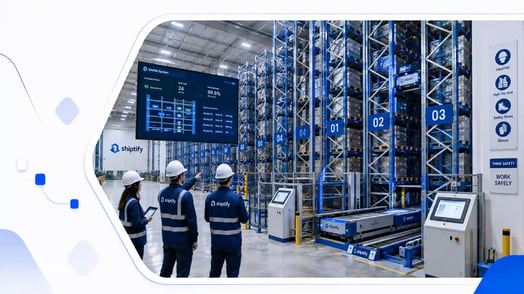
Shuttle racking is a high-density storage system made up of a racking structure and a motorized shuttle that travels inside the storage lanes to place and retrieve pallets. Unlike conventional selective racking, where a forklift accesses every location directly, the shuttle alone handles all movement inside each lane.
In practice, pallets are stored one behind another in deep lanes across multiple levels. The forklift operator places the shuttle at the entrance of the relevant lane, and the shuttle stores or retrieves pallets without any vehicle entering the lane itself. This principle eliminates the aisles normally needed between rows of pallets, freeing up considerably more space than a traditional selective storage layout inside a logistics warehouse.
The system can operate using two inventory management methods: LIFO (Last In, First Out), when the lane has a single access point, or FIFO (First In, First Out), when the lane is accessible from both ends. The appropriate method depends on the products being stored and their turnover rate.
How does a shuttle racking system work?
A shuttle racking system relies on four main components: the racking structure itself (rails and reinforced uprights designed to support pallets across multiple levels, the motorized shuttle, a remote control or dedicated software, and a charging station used to recharge the shuttle's battery between operating cycles.
Most shuttles run on rechargeable batteries that provide several hours of continuous operation, generally enough to cover a complete receiving or shipping wave without requiring a mid-shift recharge. Some models also include onboard sensors that automatically detect pallet positions and lane obstructions, reducing the risk of misplaced pallets or collisions inside the lane compared with forklifts operating in narrow storage aisles.
Day-to-day operation follows the same sequence:
- Load the shuttle: the operator places the shuttle at the lane entrance using the forklift forks, just as they would with a standard pallet.
- Set the instructions: using the remote control or software, the operator specifies how many pallets to store or retrieve and the target position inside the lane.
- Travel: the shuttle moves autonomously along the rails without human intervention inside the lane.
- Store or retrieve: the shuttle lifts the pallet slightly, transports it to the programmed location, or retrieves it and brings it back to the lane entrance.
- Return: once the cycle is complete, the shuttle returns to the lane entrance, where the operator retrieves it and moves it to another lane if required.
On more advanced installations, the shuttle communicates directly with the Warehouse Management System (WMS), which sends real-time storage and picking priorities. The operator simply validates the suggested movements, reducing location errors and improving picking efficiency. Discover how a WMS helps optimize warehouse operations.
Some shuttles are permanently assigned to a single lane, while others are shared between multiple lanes as needed. This choice has a direct impact on the overall investment and operational flexibility.
Cycle speed is another important consideration. A modern shuttle can move a pallet over several dozen metres in only a few tens of seconds, making the system well suited to facilities handling high inbound and outbound pallet volumes, provided the rest of the warehouse operation can sustain the same pace.
Preventive maintenance is equally important. Batteries, wheels and sensors are the components subject to the greatest wear. Poor maintenance planning can immobilize an entire lane, affecting access to every pallet stored behind the shuttle.
Shuttle racking vs. other storage systems: Which one should you choose?
Shuttle racking is not the only way to optimize warehouse storage. Before investing, it is worth comparing it with the main alternatives available on the market.
Shuttle racking vs. conventional selective racking
Selective racking provides direct access to every pallet without requiring any automation, making it the simplest and least expensive solution to install. However, every pallet requires its own access aisle, which significantly reduces storage density. Shuttle racking removes these internal aisles and can double or even triple storage capacity within the same footprint, although it requires a higher investment and reduces direct pallet accessibility.
Shuttle racking vs. drive-in / drive-through racking
With drive-in racking, the forklift enters the storage lane to deposit or retrieve pallets. This slows operations, increases structural wear and raises the risk of impacts. Shuttle racking eliminates this issue because only the shuttle travels inside the lane, resulting in faster operations, improved safety and reduced damage to the structure. Nevertheless, drive-in racking remains a more economical solution for warehouses with relatively low pallet movement.
Shuttle racking vs. automated storage and retrieval systems (AS/RS)
An AS/RS is a fully automated solution capable of handling very large volumes with minimal human intervention and high accuracy. Shuttle racking occupies an intermediate position by automating pallet movement inside the lanes while still requiring forklift operators to position and relocate the shuttles. Consequently, AS/RS installations involve substantially higher investment costs and greater implementation complexity.
Shuttle racking vs. storage mezzanines
A storage mezzanine creates additional usable floor space inside a warehouse, typically for manual storage or low-turnover picking activities. It addresses a different operational need than shuttle racking, which focuses on increasing pallet density by storing pallets deeper rather than creating additional walkable space. In many facilities, both solutions are used together to maximize warehouse capacity. Complementary optimization methods such as slotting can further improve warehouse performance.
In which warehouses should you use shuttle racking?
Shuttle racking is particularly well suited to businesses that store large numbers of pallets of the same SKU or a limited range of similar SKUs. The greater the pallet volume per SKU, the more cost-effective the system becomes.
Typical applications include:
- food and beverage warehouses, where pallet volumes are high and stock turnover is fast;
- cold storage facilities, where every cubic metre saved helps reduce energy consumption;
- distribution centres handling high daily pallet throughput;
- manufacturing plants producing large production runs;
- beverage, building materials and chemical industries.
By contrast, shuttle racking is generally not suitable for warehouses managing thousands of SKUs with only a few pallets per reference. In these cases, conventional selective racking usually provides greater operational flexibility and can be combined with an efficient warehouse management system.
The main advantages of shuttle racking
Shuttle racking has become increasingly popular because it delivers several significant operational benefits.
Maximum storage density
The main advantage is the substantial space saving. By eliminating intermediate aisles, storage capacity can increase by 50% to 90%, depending on the warehouse layout, compared with conventional selective racking.
This additional capacity often allows companies to postpone or even avoid the cost of warehouse expansion.
Higher productivity
Forklift travel is greatly reduced because operators no longer need to drive inside the storage lanes. Instead, they remain at the lane entrance while the shuttle carries out all internal pallet movements.
This reduces non-productive travel time, shortens loading and unloading cycles, and increases the number of pallets handled per hour.
Businesses looking to optimize these operations can also improve their overall warehouse logistics.
Improved safety
Removing forklifts from the storage lanes significantly reduces the risk of collisions with the racking structure. As a result, the racks suffer less damage, maintenance costs decrease and the overall lifespan of the installation is extended.
The reduction in forklift traffic inside the storage lanes also improves operator safety.
Better cold storage efficiency
In refrigerated and frozen warehouses, shuttle racking maximizes storage density while minimizing the volume of air that must be cooled.
This can lead to significant reductions in refrigeration costs while increasing available pallet capacity within the same building envelope.
Better inventory control
When integrated with a Warehouse Management System (WMS), shuttle racking improves stock traceability and minimizes storage location errors. Inventory accuracy is enhanced because pallet movements are recorded automatically and follow predefined storage rules.
Companies seeking complete visibility over inventory movements often combine shuttle racking with a warehouse inventory management solution.
The limitations of shuttle racking
Although shuttle racking offers numerous advantages, it is not suitable for every warehouse environment.
Higher initial investment
The cost of the shuttle units, batteries, chargers and control systems makes shuttle racking considerably more expensive than conventional pallet racking.
However, the return on investment can be attractive when warehouse space is limited or expensive.
Less suitable for highly diversified inventories
Shuttle racking performs best when each lane stores multiple pallets of the same SKU. Warehouses with a large number of low-volume product references may struggle to fully utilize the available storage lanes.
Dependence on equipment availability
If a shuttle becomes unavailable because of maintenance or battery failure, access to the pallets stored within that lane may be temporarily interrupted until another shuttle is assigned.
For high-throughput operations, many companies therefore maintain spare shuttle units to ensure operational continuity.
Staff training requirements
Although operation is relatively straightforward, forklift drivers and warehouse operators require specific training to use the shuttle safely and efficiently.
Proper training also helps maximize productivity while minimizing equipment damage and operating errors.
How much does shuttle racking cost?
The total investment depends on several factors, including warehouse dimensions, storage capacity, the number of shuttles required and the level of automation.
The overall project generally includes:
- the racking structure;
- one or more shuttle units;
- battery charging equipment;
- remote controls or software licences;
- installation and commissioning;
- operator training;
- optional WMS integration.
As an indication, a complete shuttle racking installation often represents an investment ranging from tens of thousands to several hundred thousand euros, depending on warehouse size and operational requirements.
The number of shuttle units is one of the most significant cost drivers. Warehouses operating continuously or handling high pallet volumes often require multiple shuttles working simultaneously to achieve the expected throughput.
In addition to the initial investment, businesses should also budget for preventive maintenance, battery replacement over time and software support where applicable.
For many companies, however, the savings generated through improved space utilization, reduced handling times and lower building costs compensate for the higher acquisition cost over the long term.
How to choose the right shuttle racking system
Choosing the right shuttle racking solution depends on much more than warehouse size alone. Several technical and operational criteria should be assessed before investing.
Storage capacity
The first step is to determine the number of pallet locations required, both now and in the coming years.
A warehouse that is already approaching saturation should plan for future growth to avoid having to redesign the installation only a few years later. Conducting a proper warehouse capacity planning assessment helps anticipate future storage needs.
Pallet dimensions and load capacity
Not all pallets are identical.
The shuttle and the racking system must be compatible with:
- pallet dimensions;
- pallet weight;
- load stability;
- the type of pallet used (wooden, plastic or metal).
Using pallets outside the recommended specifications can reduce system performance and increase the risk of operational issues.
Stock rotation
The inventory management method plays an important role in system design.
- LIFO is generally suitable for products without strict expiry constraints.
- FIFO is preferred for perishable goods, pharmaceuticals and any products requiring chronological stock rotation.
Selecting the correct configuration from the outset prevents costly modifications later.
For businesses managing complex inventory flows, understanding inventory rotation is equally important.
Number of shuttles
A single shuttle may be sufficient for warehouses with moderate throughput.
By contrast, facilities handling large inbound and outbound volumes often require several shuttles operating simultaneously in different lanes to avoid bottlenecks.
The appropriate number depends on expected pallet movements per hour rather than warehouse size alone.
Integration with existing systems
Many companies already operate a Warehouse Management System (WMS).
Verifying compatibility between the shuttle control software and the existing WMS simplifies implementation and improves inventory visibility, traceability and operational efficiency.
A connected warehouse execution system can further optimize warehouse performance.
Maintenance and technical support
Finally, the availability of local technical support should not be overlooked.
Fast access to spare parts, preventive maintenance programmes and responsive technical assistance all contribute to minimizing downtime and protecting long-term productivity.
Future trends in shuttle racking
Warehouse automation continues to accelerate, and shuttle racking is evolving alongside it.
Several trends are shaping the next generation of systems.
Greater automation
Manufacturers increasingly combine shuttle technology with automated conveyors, pallet lifts and robotic handling systems to reduce manual intervention throughout the warehouse.
These integrated solutions enable fully automated pallet flows from receiving through storage to shipping.
Artificial intelligence and predictive maintenance
Newer shuttle systems increasingly incorporate sensors capable of monitoring battery condition, wheel wear and motor performance.
Combined with artificial intelligence, these systems can anticipate maintenance needs before failures occur, reducing unplanned downtime.
Multi-shuttle systems
Instead of relying on a single shuttle moving from lane to lane, more warehouses are deploying multiple shuttles operating simultaneously.
This approach significantly increases throughput during peak activity while improving operational resilience.
Improved energy efficiency
Battery technology continues to improve, providing longer operating times, shorter charging cycles and lower energy consumption.
These advances are particularly valuable for cold storage facilities, where battery performance has historically been more challenging.