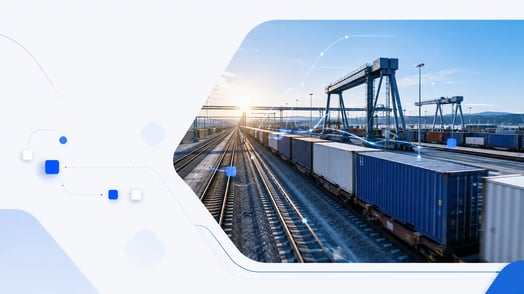
Over the past 35 years, rail service has grown by 30%*, mainly thanks to the development of regional express trains. However, the acceleration of infrastructure work has reduced freight train capacity, necessitating a rebalancing to give more room to rail freight transport. What's more, the asset renewal cycle in rail freight is up to ten times longer* than in road transport, with the average age of rail fleets approaching 35 years. A program, backed by industry associations and public authorities, aims to optimize performance, digitalization, multimodality and decarbonization, with an investment of 1 billion euros* over 10 to 15 years. Technology plays a key role in this process: focus.
Rail freight: what does it involve?
Technology is revolutionizing rail freight, improving the efficiency, visibility and sustainability of logistics operations.
Rail freight: its role in the logistics chain
Rail freight is the transport of goods by rail. It offers a sustainable alternative to road and sea transport. Used to transport a wide range of goods, from bulk to manufactured products, it is an essential link in a continuous, reliable transport flow.
Types of goods transported
Here are the different types of goods transported by rail freight:
- Bulk goods: minerals, cereals, coal,
- Manufactured goods: cars, household appliances,
- Hazardous materials : chemicals, fuels.
What are the different types of rail freight?
Rail freight offers several different modes of transport, such as wagonload, container and groupage. Each is adapted to the specific needs of the logistics chain.
Different types: wagonload, container and groupage
Rail freight can be transported in several different ways:
- Railcars: suitable for bulk materials and products requiring special care;
- Containerized : facilitates intermodal transport and smooth transitions between different modes of transport;
- Groupage: consolidation of small shipments to optimize costs.
Intermodal freight: combining with other modes of transport
Intermodal freight combines rail transport with other modes of transport (road, sea) to deliver a flexible, efficient logistics solution. This approach leverages the advantages of each mode, optimizing costs and delivery times.
Piggybacking : an integrated solution
Piggybacking, or combined road-rail transport, is a method whereby trucks, trailers or containers are transported by train for part of their journey. This reduces CO2 emissions and road congestion, while benefiting from the efficiency of rail transport over long distances. In France, the development of piggyback transport is encouraged by its ecological and economic advantages, offering a viable alternative to exclusive road transport.
Rail freight: its advantages
Rail freight offers many advantages, particularly in terms of safety, reliability, ecology, cost and transport capacity.
Safety & reliability
Rail freight is renowned for its safety and reliability. Rail accidents are rare, and trains follow precise schedules, reducing the risk of delays.
Ecology
Rail transport is one of the most environmentally-friendly modes of transport, with CO2 emissions well below those of trucks and aircraft. It thus contributes to green logistics, an essential element in the fight against climate change.
Cost & efficiency
Rail freight is often more economical for transporting large quantities over long distances. It reduces logistics costs by optimizing filling and resource utilization.
Trains can carry large quantities of goods, making them an ideal solution for bulky or heavy shipments. Their ability to load massive cargoes at once reduces the number of journeys required, thus boosting efficiency tenfold and undeniably limiting the carbon footprint.
Rail freight: its challenges and limitations
Rail freight must overcome challenges such as lack of flexibility, early booking, restrictions on fragile goods, and various international regulations.
Little operating flexibility
Rail freight lacks the flexibility of road transport. Routes and schedules have to be planned well in advance, which can make it difficult to deal with emergencies or last-minute changes.
Booking well in advance
Shipments often have to be booked well in advance, which limits the ability to react quickly to changes in demand.
Not suitable for fragile goods
Rail transport may not be ideal for fragile goods, due to vibration and movement on the rails.
International regulatory issues
Regulations vary from country to country, complicating cross-border operations and requiring strict compliance with different laws and standards.
Who are the players in rail transport?
Rail transport players include major freight operators, regulators, industry associations and suppliers of specialized services and equipment: here's how.
Major freight operators
Major rail freight operators include companies such as SNCF Logistics, Deutsche Bahn Cargo and Union Pacific. These players play a key role in maintaining and expanding rail networks worldwide. They facilitate the transport of goods across complex infrastructures.
Regulators and associations
Regulators and associations, such as the European Union Railway Agency (ERA) and the Association of American Railroads (AAR), oversee safety standards, regulations and technological innovations in the rail freight sector.
Suppliers of specialized services and equipment
Suppliers of specialized services and equipment, such as railcar manufacturers and rail maintenance companies, ensure the availability and performance of rail infrastructures.
Rail freight: why use a TMS?
A TMS (Transport Management System) or a FMS (Freight Management System) facilitates rail freight management by improving processes. It reduces errors, improves responsiveness and integrates different logistics platforms.
Optimized rail freight management
Such a transport management system greatly facilitates rail freight management by automating processes, centralizing data and improving visibility of operations. Our multimodal TMS solution boosts rail freight management.
Shiptify: a game changer for rail freight management
Our TMS is designed to simplify and optimize transport management, notably by reducing manual tasks and potential errors. It's a minor revolution, thanks to the automation of processes and the centralization of data. This solution provides proactive management, improving responsiveness to unforeseen events.
Improved integration and communication
Thanks to its interoperability with other systems, our TMS enables fluid, constant communication between all players in the supply chain. All parties are informed of updates and modifications.
Towards a more >virtuous>economic and environmental impact
By optimizing costs and reducing carbon footprints, we contribute to more sustainable and economical logistics. Multi-carrier piloting and dock management integrated into our TMS maximize savings and minimize environmental impact.

Sources :
* Innovation & digital: a whole program to revive rail freight
*Freight Rail Data Center - AAR