
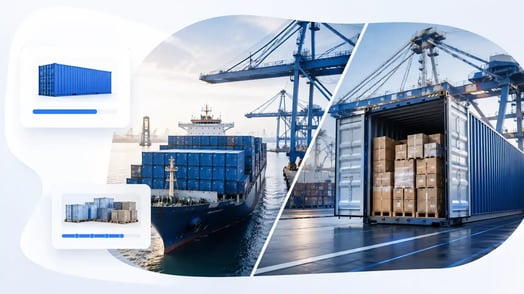
Do you need to ship goods by sea and are wondering whether to choose a Full Container Load (FCL) or a Less than Container Load (LCL) shipment?
While FCL provides greater security, more predictable transit times, and better control over cargo handling, LCL offers a cost-effective alternative for businesses shipping smaller volumes.
Choosing the right option can significantly impact transportation costs, delivery performance, inventory planning, and customer satisfaction.
In this guide, we'll explain the differences between FCL and LCL, compare their advantages and limitations, and help you determine which solution best fits your supply chain requirements.
Understanding FCL and LCL shipping
Before selecting a shipping method, it is important to understand how each model works and what it is designed for.
What is FCL?
FCL (Full Container Load) means that a single shipper books an entire container for its cargo.
The container is dedicated exclusively to one shipment, regardless of whether it is fully utilized.
This approach offers several advantages:
- Greater cargo security
- Limited handling throughout the journey
- Reduced risk of damage or contamination
- More predictable transit times
- Faster port operations
- Competitive costs for larger shipment volumes
Because the container is sealed at origin and typically opened only at destination, cargo integrity is significantly improved.
However, FCL also comes with certain constraints:
- Higher upfront transportation costs
- The shipper pays for the entire container capacity
- Space utilization must be optimized to maximize cost efficiency
- Additional charges may apply for detention, demurrage, or storage delays
- Booking deadlines and documentation requirements are often stricter
What is LCL?
LCL (Less than Container Load) allows multiple shippers to share space within the same container.
Each shipper pays only for the volume occupied by its cargo, typically calculated based on cubic meters (CBM) or volumetric weight.
LCL is particularly suitable for:
- Small shipment volumes
- Occasional imports or exports
- Product launches and market testing
- Prototype shipments
- Businesses with irregular shipping patterns
The main advantage is cost efficiency for smaller shipments.
However, LCL involves additional logistics operations:
- Cargo consolidation before departure
- Cargo deconsolidation upon arrival
- Additional handling throughout the journey
- Potentially longer transit times
Because shipments from multiple companies are grouped together, containers often remain at consolidation warehouses until sufficient cargo volume has been collected.
FCL vs LCL: Key differences
| Criteria | FCL | LCL |
|---|---|---|
| Container usage | Entire container reserved for one shipper | Shared container |
| Pricing model | Fixed cost per container | Charged by volume or weight |
| Cargo security | Very high | Moderate |
| Handling operations | Minimal | Multiple handling stages |
| Transit time | Faster and more predictable | Longer and less predictable |
| Flexibility | Best for larger volumes | Ideal for small volumes |
| Risk of damage | Low | Higher due to additional handling |
| Administrative complexity | Moderate | Higher due to consolidation processes |
How to choose between FCL and LCL
There is no universal answer.
The right decision depends on a combination of operational, financial, and strategic factors.
Shipment volume
Volume is usually the first criterion.
As a general rule, shipments approaching 12–15 CBM often justify evaluating FCL rates, although the break-even point varies depending on trade lanes, carrier rates, and local charges.
Smaller shipments typically benefit from LCL pricing.
Shipping frequency
Businesses shipping small volumes regularly may find LCL more flexible.
Organizations moving large and recurring volumes often achieve better economies of scale with FCL.
Cargo characteristics
High-value, fragile, temperature-sensitive, or contamination-sensitive goods generally benefit from FCL.
Because cargo remains isolated from other shipments, risks are significantly reduced.
LCL is generally suitable for robust, non-sensitive products.
Transit time requirements
FCL offers more predictable transit times because the container moves directly through the shipping process without consolidation or deconsolidation delays.
If delivery reliability is critical, FCL is usually the preferred option.
Total landed cost
Transportation decisions should never be based solely on freight rates.
Additional charges must also be considered:
- Origin handling charges
- Destination handling charges
- Consolidation fees
- Customs clearance fees
- Documentation costs
- Storage charges
In some cases, an FCL shipment may become more economical than an LCL shipment once all ancillary costs are included.
Typical use cases for FCL
FCL is commonly selected by:
- Electronics manufacturers
- Industrial equipment suppliers
- Large retailers
- Automotive companies
- Importers shipping full purchase orders
These organizations value:
- Greater shipment security
- Reduced handling
- Better schedule reliability
- Improved inventory planning
For large and recurring shipments, FCL often delivers the best overall performance.
Typical use cases for LCL
LCL is particularly well suited for:
- SMEs importing smaller quantities
- E-commerce businesses
- Startups launching new products
- Companies testing new markets
- Businesses with irregular purchasing cycles
By paying only for the space used, companies maintain flexibility while avoiding the cost of underutilized containers.
The shipping process: FCL vs LCL
Although both options follow the same general transportation flow, important differences exist.
FCL process
- Container booking
- Container loading
- Container sealing
- Sea freight transport
- Customs clearance
- Direct unloading
- Final delivery
LCL process
- Space booking
- Cargo delivery to consolidation warehouse
- Container consolidation
- Ocean transport
- Customs clearance
- Container deconsolidation
- Final delivery
The additional consolidation and deconsolidation steps explain why LCL transit times are often longer.
Why shipment visibility matters
Ocean freight involves long lead times and multiple stakeholders.
Without real-time visibility, delays can disrupt inventory planning, production schedules, and customer commitments.
This is why many companies invest in transportation visibility solutions.
Real-time tracking enables logistics teams to:
- Monitor shipment status
- Anticipate delays
- Improve communication
- Reduce manual follow-up
- Improve customer satisfaction
Modern platforms offering shipment tracking capabilities allow teams to maintain greater control over international flows.
How a TMS improves FCL and LCL management
A Transportation Management System centralizes shipment information and provides visibility across the entire transportation process.
For ocean freight, a connected TMS helps companies:
- Manage bookings
- Track containers in real time
- Monitor ETA and ETD changes
- Coordinate with freight forwarders
- Centralize shipping documentation
- Receive automated alerts
This reduces manual workload while improving operational control.
Ocean freight visibility with Shiptify
Shiptify provides dedicated ocean freight capabilities that allow logistics teams to manage container shipments through a centralized platform.
Users can easily track:
- Bill of Lading numbers
- Shipping lines
- Ports of origin and destination
- Estimated departure dates (ETD)
- Estimated arrival dates (ETA)
- Transshipment events
For companies managing multiple freight forwarders and shipment flows, Shiptify centralizes visibility and generates automatic alerts when delays, schedule changes, or critical events occur.
This allows teams to anticipate disruptions and make faster decisions.
Conclusion
Choosing between FCL and LCL is not simply a transportation decision—it is a supply chain decision.
FCL generally offers greater security, faster transit times, and better performance for larger volumes.
LCL provides flexibility and cost efficiency for smaller or irregular shipments.
The right choice depends on shipment volume, cargo characteristics, delivery requirements, and total transportation costs.
Whatever option you select, real-time visibility and shipment tracking are essential for maintaining control over ocean freight operations and improving supply chain performance.
By combining the right shipping strategy with a modern transportation management platform, companies can reduce risk, improve predictability, and optimize their international logistics operations.