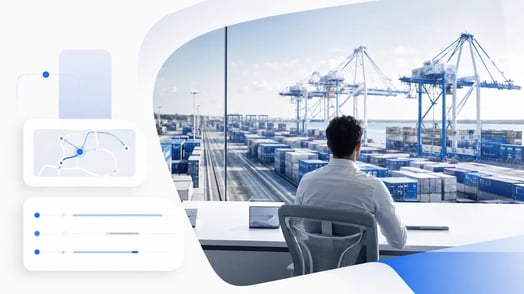
Mainly used by overseas operations, container transport meets the needs of global trade. Designed to travel long distances, containers are particularly well-suited to maritime transport. Containers can be transported by rail or truck to and from ports of embarkation and disembarkation. While its practicality and security appeal to customers on international markets, the use of containers requires a thorough understanding of how equipment rotates, and above all a mastery of the aspects of maritime transport. We explain this method of transport.
What is a container? Definition and characteristics
What is a container?
The word "container" is used interchangeably with "conteneur" in French. The former is used in the English language, the latter is the French term, but they both designate the same object. A container is a large metal box, about the size of a truck trailer, designed to hold goods during transport. In the jargon of overseas transport, sea containers are called "boxes". For example, a ship can take a given number of boxes to a port.
Containers are designed to transport goods, whether packaged or not, and comply with very precise ISO-referenced standards. There are different container sizes, but all correspond to standard dimensions, expressed in feet. The most commonly used sizes are 40-foot and 20-foot containers. 40-foot containers are slightly shorter than a truck trailer, at around 12.20m long by 2.44m wide. 20-foot containers are about 6.10m long and 2.44m wide.
Containers are steel or aluminum crates, which generally open via two hinged doors, except in special cases. They cannot move on their own, and are not motorized. They must be accompanied by a motor vehicle, such as a truck, train or ship, and handled by heavy-duty lifting equipment. Extremely sturdy, they can withstand bad weather and are secure, as they can be locked.
The different types of container
Standard containers, or dry containers, transport conventional freight such as industrial products and solid, non-perishable goods. There are also reefer containers for temperature-controlled freight, such as perishable or heat-sensitive goods. There are also open-top containers, with a removable, solid tarpaulin roof, for the transport of bulky freight, handled by crane or overhead crane. Flat containers, or flat racks, are designed for oversized freight that exceeds weight, length, width or height. They consist of a floor with removable walls and numerous anchoring points. Tank containers can be used to transport both hazardous and non-hazardous liquids. And there are half-height containers, designed to carry dense and heavy freight such as minerals or construction materials, since their reduced height allows for better weight distribution.
Containers: what modes of transport are used?
Sea freight
Sea freight is the most commonly used freight mode for container transport. It enables large quantities of goods to be moved across the oceans, linking ports in France and around the world. Container ships are specially designed to maximize the number of boxes transported. It's also the most economical mode of transport for international trade: according to the UNCTAD Review of Maritime Transport, maritime transport carries around 80% of the volume of international trade in goods.
Road transport
Road transport is used for the pre- and post-carriage of containers. Container trucks feature special chassis and twist-lock fastening systems, which lock the container to the trailer. This mode of transport offers unrivalled flexibility over short distances.
Rail transport
Container transport by rail is particularly suitable for long distances over land. It's an ecological and economical solution for moving large quantities of goods. Container trains comprise dedicated railcars with special fastening systems. They reduce road freight, cutting the number of trucks on the road.
What are the challenges of containerized transport?
Capacity management
Containers are the property of shipping lines, which can experience periods of shortage. As a customer, it's up to you to anticipate your transport requests so that you can have the necessary equipment on hand. Likewise, you need to optimize your container space to save as much room as possible. A 40-foot container can carry around 23 to 24 Europe-size pallets on the ground. Note that containers accept stacked pallets, as they have internal anchoring points.
Logistics coordination
One of the main challenges of container transport lies in the very organization of the journey to the ports. Container transport involves a number of stages, for which fluid, responsive communication is absolutely essential. Contact with all the parties involved is of paramount importance, since it is this contact that enables operations to be synchronized: container booking, loading, pre-carriage, customs, transport, disembarkation, post-carriage.
Security
When your container travels, it's likely to be subject to a number of hazards. For example, did you know that the captain is the sole master of his ship, and that he may decide to jettison your container overboard? This is a rare occurrence, of course, but it remains a legally recognized option under international maritime regulations, since the captain can dispose of the cargo to save his ship, particularly in the event of severe weather. But your container is also subject to theft, damage or other uncontrollable events, such as dockers' strikes at the port, for example.
Regulatory compliance
When it comes to sea freight, it's imperative to comply with international standards and customs regulations. Depending on the Incoterm of sale with your customer, you may or may not be responsible for customs formalities, as well as related duties and taxes, if you are the consignee of the goods. Likewise, you may or may not be responsible for insuring the goods, organizing transport and handling operations. If you're not familiar with these parameters, it's best to entrust your freight to a forwarding agent, who will take care of everything.
Operational costs
Shipping is subject to a number of variables that have an impact on operating costs. These include fluctuating dollar exchange rates, fuel surcharges, demurrage, and competitive pressure on ports. Controlling these costs remains a key factor in the profitability of your operations.
Tracking and tracing
Tracking goods is becoming a real asset for companies who need to respond to customer queries. Visibility into the different stages of a shipment means you can react quickly to any problems that may arise, and ensure customer satisfaction. Logistics software is an invaluable aid, as is fluid communication with your carrier. So you can anticipate the arrival of your goods at the port.
The advantages and disadvantages of containerized transport
The advantages
- Efficiency: containerized transport can move large volumes of goods at relatively low cost. What's more, container standardization optimizes handling and transport operations.
- Safety: containers offer optimum protection for goods during transport.
- Ecology: reduced carbon footprint due to transit by ship rather than by road or air.
- Flexibility: containerized transport can carry a wide variety of goods over long distances.
- Cost-efficiency: container ships carry several thousand boxes, which means that overall costs can be shared, and rates lowered.
Disadvantages
- Delays: transport times can be long, especially for sea freight.
- Logistical complexity: a great deal of coordination is required between the many parties involved.
- Regulatory risks: compliance with international standards and customs documents can block certain shipments, resulting in significant additional costs in the event of non-compliance.
- Environmental impact: shipping is responsible for a significant proportion of greenhouse gas emissions.
TMS: how does technology simplify the management of containerized transport?
Transport management systems are ideally suited to managing containerized transport. Their tracking function enables shipments to be tracked, and their many functions automate processes such as requesting quotations, choosing the freight mode and the service provider. A TMS also centralizes all data for better communication between all stakeholders. Thanks to the TMS, you can be more responsive to unforeseen events, and ensure regulatory compliance at both local and international level.
Shiptify, the container transport facilitator
At Shiptify, we've developed an innovative TMS capable of handling all the tasks involved in container transport:
- Capacity management
- Logistics coordination
- Operational cost control
- Regulatory compliance
- Worldwide shipment tracking
- Process automation
- Improved communication between the various parties involved
- Reactive management of unforeseen events
- Multimodal booking
- Sharing of metadata on a multi-container file
Our TMS excels in optimizing freight transport operations. Its SaaS mode makes it accessible from any connected screen. Users can consult their shipments to different ports, exchange information rapidly with all stakeholders, and resolve problems efficiently. It also saves on software updates and maintenance.
Containerized transport is one of the best solutions for international trade. A combination of efficiency, safety and flexibility, it nevertheless requires rigorous management to overcome logistical and regulatory challenges. With the help of innovative tools such as our TMS, it's easier to control operational aspects, optimize costs and guarantee customer satisfaction.